AI Search Marketing Hong Kong: Boost Leads
Enterprise marketing teams in Central are bleeding AI budget while watching competitors’ chatbots absorb their traffic — and most of them still cannot explain why. The answer sits inside AI search marketing Hong Kong, a discipline the market keeps misreading as SEO with an AI wrapper stapled on. That misreading has a cost. Gartner confirmed traditional search engine volume will drop 25% by 2026 as users migrate to AI chatbots and virtual agents. The SERP your team keeps optimising no longer exists in the form you remember.
Hong Kong enterprises are caught in a peculiar trap. They know AI matters. They have the budget. Yet only 42% of Hong Kong consumers agree that brands’ AI implementations meet their expectations, per Marketing-Interactive’s 2025 study. Your legal team approved the pilot. Your CTO deployed the tool. Your users noticed nothing changed. That is not an AI problem — it is an AI search marketing execution failure specific to this market’s bilingual, cross-border, regulation-heavy reality.
Why AI Search Marketing Hong Kong Is Now Non-Negotiable
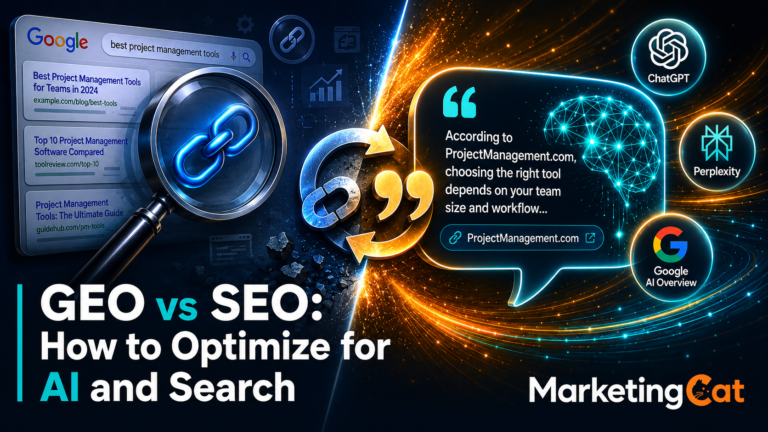
The traditional playbook — keyword research, backlinks, monthly content calendars — assumed users would type queries into a search box and click blue links. That user is gone. The 2026 user in Hong Kong asks ChatGPT, Perplexity, or Google’s Search Generative Experience a natural language question and receives a synthesised answer panel citing three to five sources. If your brand is not one of those sources, you do not exist in that interaction. No click-through. No brand impression. No pipeline.
What most HK agencies will not tell you: AI search marketing is entity-first architecture, structured data layers that make your brand machine-readable, and content designed to be cited by AI systems rather than merely ranked by them. The shift is ontological. Google no longer returns ten blue links — it returns one AI-generated answer that either names you or does not. Brutal arithmetic.
Hong Kong’s market makes this harder than most. You are serving two linguistic audiences — Cantonese-first locals alongside English-first expats and cross-border professionals. You are navigating dual regulatory environments if you touch the Greater Bay Area. Meanwhile, Mainland enterprises have spent two years optimising for Baidu’s AI Agent (Zhinengti) while your team was still fixing Core Web Vitals. The gap is widening, and frankly, the consultants selling AI transformation packages in Wan Chai right now are making a killing off this confusion.
The Deloitte Reality Check: Pilot Theatre Is Over
Deloitte’s 2026 HKU AI Adoption Index crystallises the problem: Hong Kong enterprises have moved AI from pilot phases to enterprise core, but most are struggling to translate ambition into measurable outcomes. The CMO approved the budget. The vendor delivered the dashboard. Nobody can explain why organic traffic dropped 18% despite “AI-powered content optimisation” running for six months. That is because the team optimised for the wrong target — chasing rankings on a disappearing SERP instead of building entity density in AI training corpora. The tool was fine. The strategy was not.
How AI Is Rewriting the Rules of Local Hong Kong SEO
Traditional SEO in Hong Kong meant backlinking from SCMP, HK01, or industry trade publications, plus on-page optimisation for terms like “financial services Hong Kong” or “corporate training Central”. That still matters, but it is now table stakes. The new game is becoming the source of truth that AI systems cite when users ask questions in your domain.
Google’s SGE, ChatGPT, Perplexity, and Baidu’s Zhinengti all pull from a semantic knowledge graph — a machine-readable map of entities, relationships, and authoritative sources. If your brand is not structured as an entity with clear topical authority signals, these systems cannot see you. AI systems do not rank pages. They extract facts from structured data. Your 2,000-word blog post on “wealth management strategies” is useless to GPT-4 unless it includes schema markup defining you as a FinancialService entity, your executives as Person entities with credentialed expertise, and your content as HowTo or FAQPage structured answers. That markup tells the AI this is a trustworthy source for a specific question. Without it, your content is noise in the training set.
Hong Kong enterprises face a unique technical challenge on top of this: dual-jurisdiction hosting and data residency. Serving the Greater Bay Area often means splitting content infrastructure between Hong Kong-based hosting for international search visibility and Shenzhen or Guangzhou edge nodes for Baidu and WeChat discovery. Ghost penalties from the Great Firewall do not surface in your Search Console — they quietly tank your Mainland discoverability while your HK traffic stays flat, making the problem nearly invisible until a quarter’s pipeline numbers arrive and nobody can explain the shortfall. Your DevOps team knows this architecture problem exists. Your marketing team has never had the conversation with them. That is the bottleneck, and it is entirely political, not technical.
Entity Density Over Keyword Density
Stop counting keyword occurrences. Start counting entity co-mentions. When your content discusses “ESG reporting”, does it link that concept to recognised frameworks — GRI, SASB, TCFD — as structured entities? Does it reference Hong Kong’s regulatory environment, specifically the HKEX ESG Reporting Guide, as a GovernmentOrganization entity? AI systems build confidence through entity graphs, not keyword frequency. A page mentioning “sustainability” 47 times but naming zero authoritative frameworks loses to a competitor who mentions it 8 times and links to HKEX, ISSB, and the Hong Kong Green Finance Association as verified entities.
Most HK agencies fail their clients here. They deliver “AI-optimised content” that is GPT-written filler with target keywords inserted — no schema, no entity linking, no structured FAQs. Organic traffic drops because Google’s SGE and ChatGPT pull answers from competitors who actually structured their content for machine comprehension. The agency blames algorithm updates. The real issue is they sold theatre.
Mastering Bilingual Search Intent with AI Tools
Every HK enterprise repeats the same pattern: hire a Mainland content team to translate English marketing copy into Simplified Chinese, assume that covers the “Chinese market”, then wonder why engagement from local Cantonese speakers is near zero and Baidu visibility stays flat. Translation quality is not the problem. Intent mismatch at the linguistic and cultural layer is.
Cantonese search behaviour is question-driven and context-heavy. A user searching “強積金” is not looking for the same content as someone searching “mandatory provident fund” in English. The Cantonese query often implies a compliance or procedural question tied to local MPF regulatory specifics. The English query may signal an expat or cross-border professional seeking comparative analysis or portability rules. AI tools like Bing’s multilingual intent analysis or Baidu’s semantic search layers can parse this distinction — but only if your content architecture supports parallel intent structures, not parallel translations.
The technical implementation demands more than correct hreflang tags. Deploy AI-driven NLP tools to analyse actual query logs from both Google HK and Baidu. Identify divergent intent patterns. Build separate content paths for Cantonese-first and English-first users, even when the topical keyword looks identical. For financial services, legal compliance, and B2B SaaS — the three verticals where HK enterprises burn the most AI budget — this is not optional. Your English content should optimise for “how to structure cross-border payroll compliance” while your Cantonese content answers “點樣處理跨境強積金供款”. Same topic. Different user. Different AI training signal.
The WeChat Mini-Program Blind Spot
Most HK marketing teams treat WeChat as a messaging channel. In 2026, WeChat Mini-Programs function as a discovery layer feeding Baidu’s knowledge graph and influencing Tencent’s ad targeting algorithms. If your brand has a Mini-Program without structured data indexing, you are invisible to AI-driven discovery on the Mainland side of your market. Your competitor in Shenzhen already fixed this. Your legal team is still debating data residency.
Future-Proofing Your Brand for Google’s SGE Rollout
Google’s SGE launched in the US in mid-2023, reached Hong Kong in limited form during Q2 2025, and full deployment was expected by Q1 2026. If your team has not started optimising for SGE, you are already six months behind competitors who moved early. The SERP structure has fundamentally changed: the AI-generated answer panel sits above traditional results, synthesising content from three to five sources and offering follow-up conversational prompts. Position zero is dead. The new battleground is citability — whether the AI includes your brand in its synthesised response.
SGE prioritises sources with high E-E-A-T signals, structured FAQs, and clear entity relationships. For Hong Kong enterprises, that means action on four fronts:
- Author bylines with LinkedIn schema linking to credentialed professionals
- FAQ blocks structured with
FAQPageschema answering the exact questions users ask AI assistants - Citations to HKMA, HKEX, InvestHK, or industry bodies as GovernmentOrganization entities
- Content updated within the last 90 days — SGE deprioritises stale sources
The failure case is predictable. A financial services firm publishes a 3,000-word guide on “retirement planning in Hong Kong” with zero schema markup, no author credentials, and no structured FAQ. A competitor publishes 1,200 words with an FAQ block answering five specific questions, schema linking the author to their CFP certification, and entity references to the MPFA and HKEX. SGE cites the competitor. The longer piece gets zero visibility. Length no longer wins. Machine-readable structure does.
The HKMA Stablecoin Shift and What It Means for Your Budget
In April 2026, the HKMA’s stablecoin regulatory framework shifted disclosure requirements for digital asset marketing. If your brand operates in fintech, wealth management, or crypto-adjacent services, this is not a compliance footnote — it is an AI search marketing event. Content discussing stablecoins, digital assets, or blockchain-based financial products now triggers different entity classification in Google’s knowledge graph. Your existing content may be flagged as YMYL without proper regulatory entity linkage, killing its citability in SGE responses. Update your schema. Link to HKMA as a regulatory authority entity. Publish an FAQ addressing the April 2026 changes specifically. Do it within 30 days, or accept that competitors will own the “stablecoin Hong Kong” answer space while you watch from the second page of results nobody reads anymore.
Choosing the Right AI Marketing Agency in HK: Stop Buying Theatre
You can identify an agency selling AI theatre within the first meeting. They pitch “AI-powered content creation” but cannot explain their entity linking strategy. They show you ChatGPT-generated blog posts but have never deployed schema markup. Their deliverable is a keyword ranking report identical to what you received in 2021, with an “AI” label added to the PDF cover. Same output. Higher retainer.
The right agency answers these questions without jargon-filled deflection:
- How are you structuring our brand as an entity in Google’s knowledge graph?
- What schema types are you deploying for our core service pages?
- How are you optimising for citability in SGE versus traditional ranking?
- What is your process for analysing bilingual intent divergence between Cantonese and English queries?
- How are you handling data residency and dual-jurisdiction hosting if we serve the GBA?
If they cannot answer these, walk out. You would be funding their learning curve on your budget. The honest agencies in Hong Kong right now admit they are still refining SGE optimisation but show a roadmap grounded in US rollout data and local testing. The dishonest ones claim they have “cracked the algorithm” and produce generic case studies from markets with entirely different linguistic and regulatory conditions.
Beyond agency selection, watch for the organisational silo that kills more AI search marketing ROI than any vendor failure: when the SEO team does not talk to the SEM team, and neither talks to the developers deploying schema, you ship fragmented execution and produce zero measurable lift. AI search marketing functions when entity strategy, structured data, content creation, and paid amplification operate under one strategic framework. Treating them as separate workstreams is how enterprises spend twelve months and a seven-figure budget arriving exactly where they started.
The One Thing Your Team Will Refuse to Do
Most Hong Kong enterprises will spend 2026 optimising for a search experience that no longer drives their pipeline, while competitors quietly dominate the AI answer space. The refusal is not technical — it is political. Restructuring content for entity-first architecture means admitting the current site structure is obsolete. Deploying proper schema markup means developers and marketers must work together, which exposes the communication breakdown both teams have been hiding for two years. Shifting budget from traditional SEO to GEO (Generative Engine Optimization) means your agency loses recurring revenue from legacy backlinking packages — so they resist the change even when the data demands it.
Your competitors are not smarter. They are simply less politically constrained. That gap will not close because you licensed another AI tool. It closes when someone in your organisation decides the org chart is the problem, not the algorithm.
Frequently Asked Questions
What is AI search marketing and how is it different from traditional SEO in Hong Kong?
AI search marketing optimises your brand for citability in AI-generated answers — Google SGE, ChatGPT, Perplexity — rather than rankings in traditional search results. Traditional SEO targets keyword positions and backlinks. AI search marketing uses structured data, entity linking, and schema markup to make your content machine-readable and trustworthy to AI systems. In Hong Kong’s bilingual market, that also means handling Cantonese and English intent divergence at the architectural level, not through translation alone.
How does Google’s Search Generative Experience (SGE) impact Hong Kong businesses specifically?
SGE rolled out in Hong Kong in Q2 2025 and prioritises sources with high E-E-A-T signals, structured FAQs, and clear entity relationships. HK enterprises must ensure content references local regulatory bodies — HKMA, HKEX, MPFA — as verified entities, includes author credentials, and structures answers for direct AI citation. Businesses serving the Greater Bay Area face additional complexity: content requires separate optimisation for Google SGE and Baidu’s AI Agent (Zhinengti), each with different technical requirements.
Can AI tools really handle bilingual search intent for Cantonese and English audiences?
Yes, but only with correct deployment. AI-driven NLP tools can analyse query logs to identify intent divergence between Cantonese and English searches on the same topic. The requirement is building parallel content paths — not parallel translations — that address different user contexts. Cantonese queries around MPF typically signal compliance questions tied to local regulations, while English queries more often seek comparative analysis for expats. Your content architecture must support both intent types with separate optimisation strategies, not a single translated page serving two