ChatGPT Visibility B2B Brands Need to Win
Walk into any boardroom in Central right now and you’ll hear the same panic: “ChatGPT just handed our competitor’s name to a prospect who should have been ours.” The chatgpt visibility B2B brands are fighting for isn’t about ranking — it’s about existing at all when your buyer asks an AI agent for a shortlist. Traditional search engine volume will drop 25% by 2026, but that stat undersells the real crisis: your entire demand generation strategy was built for a SERP that no longer loads.
Your procurement manager in Admiralty isn’t Googling “best contract lifecycle management software Hong Kong” anymore. She’s asking ChatGPT to compare three vendors, draft an RFP, and summarise compliance requirements for cross-border data flow — all before your sales team knows she exists. If the LLM doesn’t cite you in that moment, you’re not just losing a ranking position. You’re losing the entire conversation.
Why AI Search is the New B2B Battleground — and Why Your Demand Gen Team Isn’t Ready
The shift isn’t gradual. AI traffic currently represents between 2% and 6% of total B2B organic traffic — which sounds manageable until you realise that slice concentrates at the very top of the funnel, precisely where your highest-intent buyers begin their research. These aren’t tire-kickers. They’re CFOs, IT Directors, and Heads of Procurement who want answers, not ads.
Traditional SEO optimised for one outcome: the click. You wrote content to rank on page one, capture attention in the SERP snippet, and pull the user to your site. AI search inverts the model entirely. The LLM synthesises, summarises, and serves the answer directly — your brand becomes a cited source, or it becomes invisible. No page two, no page one, no second chances. Just the answer, and silence.
The competitive gap this creates is savage. Almost half of B2B companies are already implementing or preparing to implement GenAI for buying and selling, but implementation doesn’t equal visibility. Most enterprises think deploying an internal AI agent counts as an AI strategy. It doesn’t. If your brand isn’t feeding the external LLMs your buyers already use — ChatGPT, Perplexity, Claude, Gemini — you’ve automated yourself out of the consideration set entirely.
Audit Your Brand: What Does ChatGPT Actually Know About You?
Most B2B marketers in Hong Kong still haven’t run this test. Open ChatGPT. Ask it to recommend three vendors for your category, compare your product to your main competitor’s, and describe what your company does. The answers will range from accurate to horrifying — but you need to know where you stand before you can fix anything.
Specifically, the audit should reveal four things:
- Accuracy: Does the LLM describe your product correctly, or is it regurgitating a press release from 2019 when your positioning was completely different?
- Completeness: Does it mention your core differentiators, or does it reduce you to a generic description that applies to twelve other vendors?
- Recency: Is it aware of your latest product launch, partnership, or regulatory compliance certification? If your competitor just announced HKMA approval for their digital asset custody solution and the LLM knows it, but yours launched two months earlier and ChatGPT is silent — you’ve lost the narrative.
- Sentiment: Does the LLM surface criticisms, outdated reviews, or controversies you thought were buried? AI agents don’t forget. They synthesise everything.
The failure pattern we see constantly in HK enterprises: they assume their website content alone will educate the LLM. It won’t. LLMs train on a vast corpus that includes Reddit threads, industry forums, analyst reports, and third-party reviews — many of which your marketing team has never seen and cannot control. Frankly, most HK agencies selling GEO packages right now are simply repackaging old content audits with a new acronym, and their clients are none the wiser. If your chatgpt visibility B2B brands strategy begins and ends with on-site content, you’re optimising in a vacuum.
The Citation Trap: Your Legal Team is Your Biggest GEO Blocker
The uncomfortable truth nobody surfaces in the Monday morning stand-up: your legal and compliance teams are killing your AI visibility before it starts. Every time they insist on gating a whitepaper, burying a case study behind a form, or restricting third-party republication rights, they render your content invisible to the LLMs that matter most. ChatGPT can’t cite a PDF it can’t access. Perplexity won’t recommend a vendor it’s never encountered in its training data.
The old content model — ungated thought leadership equals lost leads — collapses completely in an AI-first environment. If your buyer’s first interaction with your brand is a ChatGPT summary citing three competitors and zero mentions of you, that lead was already gone before your SDR sent a single email. Open content that feeds LLMs generates pipeline. Gated content generates nothing but a false sense of data compliance.
Stop Chasing Keywords: Optimise for AI Intent, Not Human Search Queries
The HK B2B marketer’s muscle memory — keyword volume, search intent, SERP analysis — is now a liability. AI agents don’t search the way humans do. Rather than typing fragmented queries and scanning ten blue links, they ask natural language questions and expect synthesised, authoritative answers. Your content strategy needs to match that behaviour. Otherwise, you’re speaking a language nobody listens to anymore.
Shift from keyword optimisation to entity optimisation. An entity is a recognisable, disambiguated concept the LLM can confidently cite: your company name, your product, your CEO, your patented technology. If your brand name is generic or easily confused with competitors, you have a structural GEO problem. “TechSolutions Asia” is an entity nightmare. “CloudBridge HK” is marginally better, but still weak if twelve similarly named vendors operate across the region.
The technical fix is non-negotiable: implement Organization, Product, and FAQPage schema markup across your site. This doesn’t guarantee LLM pickup, but it dramatically increases the odds that when an AI agent evaluates your site, it parses your offering clearly and cites you accurately. If your dev team considers schema “nice to have,” your content is invisible by default — and no Central rent-priced retainer will fix that.
The Entity Density Problem Your Content Team Doesn’t Know Exists
Pull your last three blog posts or thought leadership pieces. Count how many times you explicitly mention your own brand name, product names, or key differentiators. Then count how many times you resort to vague, interchangeable language — “our solution,” “the platform,” “innovative technology.” If the ratio leans toward the vague, the LLM can’t build a strong entity association. It reads your content, finds it generic, and moves on without citing you.
Entity density matters because LLMs rely on repetition and co-occurrence to build confidence. If your content repeatedly mentions “contract lifecycle management” but never explicitly ties the term to your brand name or product, the LLM learns about the category — not about you. The fix is deceptively simple: rewrite for explicitness. Name your product. Name your company. Make it structurally impossible for the AI to summarise your insight without citing you by name.
Technical Tactics to Feed LLMs Your B2B Data — Without Waiting for IT
Most enterprise marketing teams hit the same bottleneck: they know they need to feed structured data to AI agents, but they’re waiting on a six-month IT roadmap to get it done. You don’t have six months. Your competitor is already being cited, and every week of delay is another cohort of buyers forming opinions with you absent from the room.
Start with the low-friction fixes instead:
- FAQ schema on key landing pages: Every product page, solution page, and service page should carry a structured FAQ block with schema markup. Write answers that directly address the questions buyers ask LLMs. “What compliance certifications does [Your Company] hold for Hong Kong financial services?” is a question ChatGPT will encounter. If your page answers it clearly and marks it up correctly, you’re in the citation pool. If not, your competitor fills that slot.
- Publicly accessible API documentation: If you’re a SaaS or platform business, make your API docs crawlable and readable. LLMs increasingly assist with vendor evaluation during technical due diligence. Gated or poorly structured documentation signals technical shallowness to the AI — and by extension, to your buyer.
- Wikipedia and Wikidata entries: This feels old-school, but it carries real weight. LLMs rely heavily on Wikipedia for entity disambiguation, and a missing entry creates a structural disadvantage that schema markup alone can’t fix. For Hong Kong enterprises, establishing notability typically means securing genuine editorial coverage in SCMP, HKEJ, or HK01 first — not paid placements, not syndicated press releases.
- LinkedIn Company Page optimisation: LLMs scrape LinkedIn for company information. If your About section is vague, your specialties are outdated, or your posts are sporadic, the AI works with less. Treat your LinkedIn presence as a structured data source, not a social afterthought your intern updates quarterly.
Retrieval-Augmented Generation (RAG) and Why Your CMS Matters Now
RAG is the mechanism by which LLMs retrieve up-to-date information from external sources to supplement their training data. When your content uses clear headings, logical information hierarchy, and accessible URLs, RAG systems can parse it easily — and you increase the likelihood of being retrieved when a relevant question surfaces. Conversely, if your CMS generates messy HTML, buries key information inside JavaScript renders, or requires a login to access case studies, you’re RAG-invisible regardless of how good the underlying content is.
The fix isn’t a full platform migration, though your CMS vendor will try to sell you one. Start with a content accessibility audit. Ask one simple question: can a bot read this page and extract the key facts without human interpretation? If the answer is no, restructure. Use semantic HTML. Put your value proposition in the first 100 words. Make your case studies crawlable. Think like a machine trying to learn about your company — because that’s precisely what’s happening every time an LLM indexes your site, whether you’ve prepared for it or not, and whether your MPF-strapped IT team has greenlit the project or not.
Measuring ROI When AI Steals Your Web Traffic — and Why Your CMO Will Panic
Here’s the conversation every HK B2B marketer is about to have with the C-suite: organic traffic is down, but pipeline is stable or even growing. The CMO stares at the GA4 dashboard and sees red. Your job is to explain that the traffic didn’t disappear — it moved upstream into AI agents that never clicked through to begin with.
Traditional attribution models break in an AI-first environment. Consider a buyer who uses ChatGPT to research vendors, encounters your brand in the summary, bookmarks your company, and navigates directly to your site two weeks later to request a demo. GA4 logs that as direct traffic. Your SEO report shows declining organic sessions. Your paid campaigns absorb credit they didn’t earn. ChatGPT was the first touch, but you have no mechanism to track it.
The interim measurement solution isn’t perfect, but it’s necessary:
- Survey your leads: Add one question to your demo request form or sales qualification process — “How did you first learn about us?” — and include “AI assistant or chatbot” as an explicit option. The data will be directional rather than precise, but it’s better than flying blind while your competitors calibrate.
- Track brand search volume: A working chatgpt visibility B2B brands strategy should drive an increase in branded search queries. Buyers who encounter your name in an AI-generated answer frequently Google you directly to verify. Monitor branded search volume as a proxy metric and treat sustained growth as a signal your GEO efforts are landing.
- Monitor citation frequency manually: Assign someone on your team to run weekly queries in ChatGPT, Perplexity, and Claude for your core keywords and log whether your brand appears. Tedious, yes. But until better tools emerge, it’s the closest thing to ground truth you’ll get.
- Attribute pipeline to content assets, not channels: If a whitepaper or case study is being cited by LLMs, the leads it generates won’t surface in your SEO dashboard. Start tracking pipeline by content asset rather than traffic source. Which pieces are being consumed by high-intent buyers? Those are your LLM magnets — and they deserve budget protection.
The Zero-Click Apocalypse Your CFO Needs to Understand
CFOs are starting to ask the existential question: if AI agents answer buyer questions without sending traffic to our website, why fund content at all? The answer is that visibility without traffic still beats invisibility. If your brand appears in the AI’s answer, you’re in the consideration set. If you’re absent, no paid campaign running out of Wan Chai will rescue you later in the funnel — by then, the shortlist is already formed.
Reframe the ROI conversation entirely. Content value in an AI-first world isn’t measured by sessions or pageviews. Instead, measure it by share of citations, accuracy of representation, and presence in the buyer’s mental shortlist before they visit a single website. If your content strategy can’t articulate that value to finance, you’ll be defunded and outflanked at the same time.
Frequently Asked Questions
How do I know if my B2B brand is visible in ChatGPT?
Run a direct audit by asking ChatGPT to recommend vendors in your category, compare your product to competitors, or describe what your company does. Check for accuracy, completeness, and recency. If the answers are vague, outdated, or omit you entirely, you have a visibility gap. Repeat this test monthly across multiple LLMs — ChatGPT, Perplexity, Claude, Gemini — because each trains on different data and uses different retrieval mechanisms.
What’s the difference between SEO and optimising for AI search?
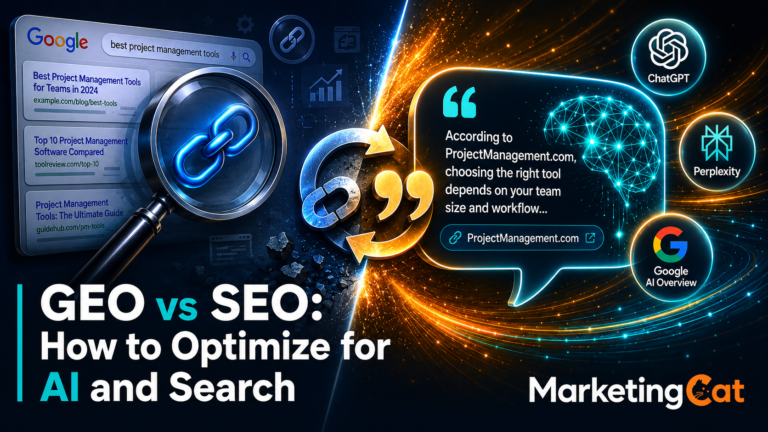
SEO optimises for clicks by ranking content in search engine results pages. AI search optimisation — commonly called Generative Engine Optimization (GEO) — focuses on becoming a cited, trusted source within LLM-generated answers. GEO requires structured data, entity clarity, open content access, and third-party validation that AI agents can parse and trust. Traditional backlinks still matter, but citation frequency in credible external corpora matters more.
How can I improve chatgpt visibility B2B brands without a massive budget?
Start with FAQ schema markup on key landing pages, make case studies and whitepapers publicly accessible without gates, optimise your LinkedIn Company Page with clear and current specialties, and ensure your website uses semantic HTML that bots can parse without friction. Additionally, publish content that explicitly names your product and company in context, steadily building entity density. These are low-cost, high-impact fixes that require neither enterprise platforms nor expensive agency retainers.
Do Hong Kong data residency rules affect AI search visibility?
Yes, indirectly but meaningfully. If overly restrictive geofencing or firewall configurations make your content inaccessible to global