What is Generative Engine Optimization (GEO)? SEO Guide
AI-referred web sessions jumped 527% year-over-year in early 2025. Most Hong Kong CMOs celebrated. Then they noticed the traffic wasn’t following. Their content was getting cited inside ChatGPT and Perplexity answers — and users simply never clicked through. Central’s premium office towers are full of marketing teams optimising for a metric that no longer moves the needle.
Key Takeaways
- Generative Engine Optimization (GEO) targets AI-powered answer engines like ChatGPT and Perplexity, not traditional search results — requiring citation-worthy content blocks instead of keyword density.
- AI-referred sessions jumped 527% year-over-year in early 2025, yet 50% of cited content is under 13 weeks old, creating a brutal citation decay cycle Hong Kong enterprises are unprepared for.
- GEO demands source attribution markup, statistical hooks in the first 150 words, and platform-specific formatting that differs dramatically between Perplexity’s academic style and ChatGPT’s conversational synthesis.
What is Generative Engine Optimization (GEO)?
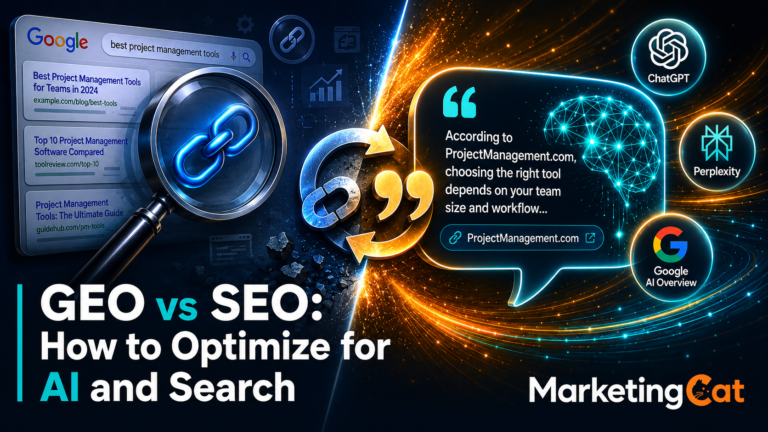
Generative Engine Optimization is the practice of structuring digital content so that AI-powered answer engines — ChatGPT, Perplexity, Google AI Overviews, Claude, Gemini — cite your brand when synthesising answers. Traditional SEO optimises for clickthrough from a ranked position. GEO optimises for citation inside a generated answer that may never send the user to your website.
The financial stakes are not abstract. McKinsey projects AI-powered search could impact $750 billion in revenue by 2028, while Gartner predicts traditional search engine volume will decline 25% by 2026. Closer to home, a January 2026 survey by the Hong Kong Productivity Council found 68% of local enterprises now use AI assistants for vendor research — up from 23% in mid-2024. Hong Kong’s B2B buyers moved faster than most Western markets. Most agency retainers haven’t noticed yet.
What most Hong Kong marketing teams misunderstand: GEO is not “SEO for AI.” Fundamentally different content architecture is required. Traditional SEO rewards comprehensive topic coverage across 2,000+ words. GEO rewards discrete, citation-worthy fact blocks that stand alone when extracted. Your 15-paragraph thought leadership piece performs poorly in generative engines because AI models can’t cleanly attribute a single claim to your brand when the insight is buried in paragraph nine.
GEO vs. SEO: Why Ranking #1 Isn’t Enough Anymore
The mechanics have shifted. Traditional SEO optimises for a moment — the searcher sees your blue link, decides to click, lands on your page. GEO optimises for the answer itself. The AI model surfaces your data point inside a synthesised response, often with a small attribution link the user will never touch. Traffic to your site becomes secondary. The citation is the product.
Consider a Hong Kong fintech company ranking #1 for “digital payment trends Asia Pacific.” In the old model, that delivered 800 monthly clicks. In the GEO model, ChatGPT and Perplexity cite their research across 12,000 queries per month — but send only 90 clicks. Brand exposure is 15x higher. Traffic is 90% lower. Most analytics dashboards aren’t measuring the first number at all.
Content structure has inverted completely. SEO content flows like an essay: introduction, context, main points, conclusion. GEO content flows like a database — lead with the statistical claim, provide source attribution, offer one sentence of context. Research shows GEO strategies can boost AI visibility by up to 40%, but only when content is reformatted for extraction, not expansion.
The Citation Decay Problem Nobody Warns You About
Fifty percent of content cited in AI answers is less than 13 weeks old. That single statistic should terrify every content strategist in Quarry Bay. Your February research report gets heavy citations through April, then falls off a cliff in May as newer sources replace it. Hong Kong’s regulatory environment accelerates this cycle — HKMA policy updates, SFC guidance revisions, and cross-border data rules change quarterly, making older content not just stale but potentially wrong in the eyes of AI fact-checking layers.
Traditional SEO could coast on a strong evergreen piece for 18 months. GEO forces a quarterly content refresh mandate or you disappear from answers entirely. The Wan Chai agencies still selling annual retainers based on “evergreen pillar content” are either adapting fast or watching their clients quietly shift budget to performance marketers who understand the new decay curve. Most are doing neither.
The Core Ranking Factors for AI Search Engines
Generative engines don’t rank. They select. When a user asks ChatGPT about Hong Kong data localisation compliance requirements, the model isn’t choosing from ten blue links. It’s scanning its training corpus and real-time retrieval layer for the most authoritative, clearly attributed, recently published fact that answers the specific sub-question.
Four factors dominate this selection process. First, source attribution markup. AI models heavily weight content that includes explicit author credentials, publication dates, organisational affiliation, and cited sources within the text itself. A blog post stating “According to a 2025 HKMA report…” with a hyperlink dramatically outperforms one that says “Recent studies show…” with no link. Attribution must live in the sentence, not a footnote.
Second, statistical density in the opening block. Generative engines extract the first 150–200 words of a page more frequently than any other section. Burying the data point in paragraph six makes it invisible to most AI retrieval systems. The Hong Kong Tourism Board’s 2025 visitor arrival reports get cited constantly because they front-load the headline figure in the first sentence of every release. That’s not accident. That’s architecture.
Third, structural clarity over stylistic flow. AI models parse HTML semantic tags — lists, tables, definition blocks, blockquotes — far more effectively than prose paragraphs. A comparison table of Hong Kong versus Singapore corporate tax rates gets extracted cleanly. A beautifully written narrative covering the same ground gets ignored because the model can’t isolate a single citable fact.
Fourth, answer-query alignment at the sentence level. Enterprise marketing teams write for executives who’ll read the full whitepaper. Generative engines need content written for someone who will only ever read one extracted sentence — and that sentence must be comprehensible without surrounding context. Pronouns like “this approach” or “these findings” kill citability. The referent is lost the moment the sentence is extracted.
How to Optimise for ChatGPT, Perplexity & Google AI
The platforms are not interchangeable. Each generative engine has distinct content preferences that most marketers treat as identical — and that gap separates competent GEO from high-performance GEO.
Perplexity behaves like an academic research assistant. It strongly prefers content with inline citations, favours longer-form authoritative sources over blog posts, and pulls heavily from domains with established topical authority. A 3,000-word research paper from a Hong Kong university gets cited far more often than a 500-word agency blog on the same topic. Perplexity’s citation style includes visible source links in every answer, making it the highest-value platform for driving referral traffic — though that traffic converts poorly because users are in research mode, not buying mode.
ChatGPT synthesises more aggressively and rarely provides source links unless explicitly asked. Recency and conversational clarity take priority over academic rigour. For ChatGPT optimisation, content should read like a well-informed colleague explaining something at a whiteboard — direct statements, minimal jargon, clear cause-and-effect logic. Content published in the last 30 days gets disproportionate weight, which favours Hong Kong enterprises that publish frequent, time-stamped updates over those relying on static pillar content.
Google AI Overviews sit between traditional search and pure generation. They pull heavily from already-ranking content in the top 10 organic results, then reformat into a synthesised answer block. Traditional SEO factors — domain authority, backlink profile, Core Web Vitals — still matter significantly for AI Overview inclusion. But Google’s AI strongly favours list-based and table-based content over paragraph-based explanations. A “5 Key Considerations” list outperforms a narrative essay covering the identical five points every time.
Before and After: Rewriting SEO Content for GEO Citation
Most Hong Kong enterprise blogs fail GEO because they were written for human readers who’ll spend three minutes on the page, not AI extractors that spend three milliseconds per paragraph.
Before (Traditional SEO): “Understanding the regulatory landscape is essential for any fintech operating in Hong Kong. Over the past few years, the Securities and Futures Commission has introduced a number of new guidelines aimed at improving consumer protection and market transparency. These changes have significant implications for how companies structure their compliance programs.”
After (GEO-Optimised): “The Hong Kong Securities and Futures Commission introduced 14 new fintech compliance guidelines between January 2024 and December 2025, according to the SFC’s February 2026 regulatory update. The most significant change requires all licensed virtual asset platforms to implement real-time transaction monitoring by June 2026. Companies failing to meet this deadline face potential licence suspension.”
The difference is surgical. The GEO version leads with a specific, verifiable number, attributes the source in the same sentence, provides a concrete deadline, and includes a consequence. Every sentence stands alone as a citation. The SEO version sounds authoritative to a human reader but offers nothing an AI model can cleanly extract and attribute. This transformation is genuinely painful for marketing teams trained to write for engagement — GEO content feels stilted when read straight through, and that discomfort is precisely the point. You’re no longer writing for someone who reads sequentially. You’re writing for an AI that will extract sentence seven, pair it with fragments from four other sources, and synthesise an answer that mentions your brand once in a list of three citations. The entire performance contract between writer and reader has changed, and most content briefs in Hong Kong haven’t registered that yet.
Measuring GEO Success: Tracking Zero-Click Citations
Hong Kong marketing teams are flying blind. Their analytics stack was built for a click-based world — Google Analytics tracks sessions, SEMrush tracks rankings, and neither tells you how many times ChatGPT cited your research in the past 30 days without sending traffic. That measurement gap is why most enterprises still don’t take GEO seriously. They can’t see it, so they assume it doesn’t exist.
Three imperfect signals work in practice. First, branded search volume spikes that correlate with AI answer inclusion. When your company gets cited in a ChatGPT answer about Hong Kong employee benefits compliance, you typically see a 15–30% increase in branded search volume 48–72 hours later. Users read the AI answer, note your brand, then search for you directly. Monitor Google Search Console for unusual branded query surges — they’re your proxy metric for citation frequency.
Second, referral traffic from AI platforms where it exists. Perplexity and Google AI Overviews do send referral traffic — small but measurable. Tag these sources separately in GA4. AI referrals typically carry 40% higher bounce rates and 60% lower time-on-site than organic search traffic because users already have the answer and are simply verifying the source. That’s not a quality problem. The user journey has fundamentally changed.
Third, manual citation audits. Labour-intensive but necessary until better tools emerge. Twice monthly, have someone query ChatGPT, Perplexity, and Gemini with 10–15 high-value questions your content should answer. Screenshot citations. Track frequency over time. Note which competitors appear alongside you. Hong Kong’s larger enterprises are now hiring junior analysts specifically for this task — an AI citation monitoring role that didn’t exist 18 months ago and carries no MPF contribution history whatsoever.
The Compliance Layer Most Teams Ignore
Hong Kong’s Personal Data (Privacy) Ordinance creates a GEO trap most marketers haven’t considered. When AI models cite your content and include your source link, they’re effectively republishing a fragment in a new context you don’t control. If that fragment contains personal data, makes claims about individuals, or references proprietary research with restricted usage terms, you may have a compliance exposure. The AI platform isn’t bound by your terms of service.
Any content intended for GEO citation should assume it will be excerpted without surrounding context. Don’t rely on disclaimers three paragraphs down. Eliminate phrases like “as mentioned above” — they break on extraction. For financial projections or performance data, every relevant sentence must include date and scope: “Q3 2025 results,” not “recent results,” because the AI will cite it in 2027 when it’s no longer recent at all. The legal framework is still catching up to the technology, and that gap is your liability.
Frequently Asked Questions
What is the main difference between SEO and GEO?
SEO optimises content to rank in search results and drive clickthrough traffic. GEO optimises content to be cited inside AI-generated answers, where the user may never visit your site. The primary metric shifts from organic traffic to citation frequency within synthesised responses. SEO rewards comprehensive long-form content. GEO rewards discrete, extractable fact blocks with clear attribution. A piece can perform well under one framework and poorly under the other — which is why Hong Kong enterprises need parallel optimisation strategies rather than treating them as interchangeable.
Which AI platforms should Hong Kong B2B companies prioritise for GEO?
Perplexity currently delivers the highest citation visibility for Hong Kong B2B content, particularly across professional services, legal, and financial sectors where users are conducting research. Google AI Overviews matter if your target audience still begins research with traditional Google Search. ChatGPT has the largest global user base but provides less consistent source attribution and lower referral traffic. For most Hong Kong enterprises, prioritise Perplexity first for citation visibility, Google AI second for maintaining existing search presence, and ChatGPT third for broader brand awareness. Budget allocation should follow where your specific buyers research — not where the largest total user base happens to live.
How do I make existing content GEO-friendly without a complete rewrite?
Start by adding a citation-optimised summary block in the first 150 words of every high-value page — three to four sentences that lead with your key statistic, include the date, name the source, and could stand alone if extracted. Then convert at least one major prose section into structured format: a comparison table, a bulleted list of criteria, or a definition block. Add visible source attribution for any third-party data — inline links formatted as “according to [Source Name]” rather than footnotes. Update publication dates site-wide and add author bylines with credentials where missing. Finally, eliminate weak referential phrases: change “this approach” to “behavioural segmentation,” change “recent studies” to “2025 research by [Name],” change “these findings” to “the survey results.” These changes take two to three hours per page and immediately improve extractability without a full content rebuild. The complete rewrite follows during your normal refresh cycle.
Does Hong Kong’s regulatory environment create specific GEO compliance risks?
Yes — particularly around data localisation requirements and the Personal Data (Privacy) Ordinance. When AI platforms cite your content, they’re excerpting and republishing it in a context you don’t control. If your content includes performance data subject to SFC disclosure rules,