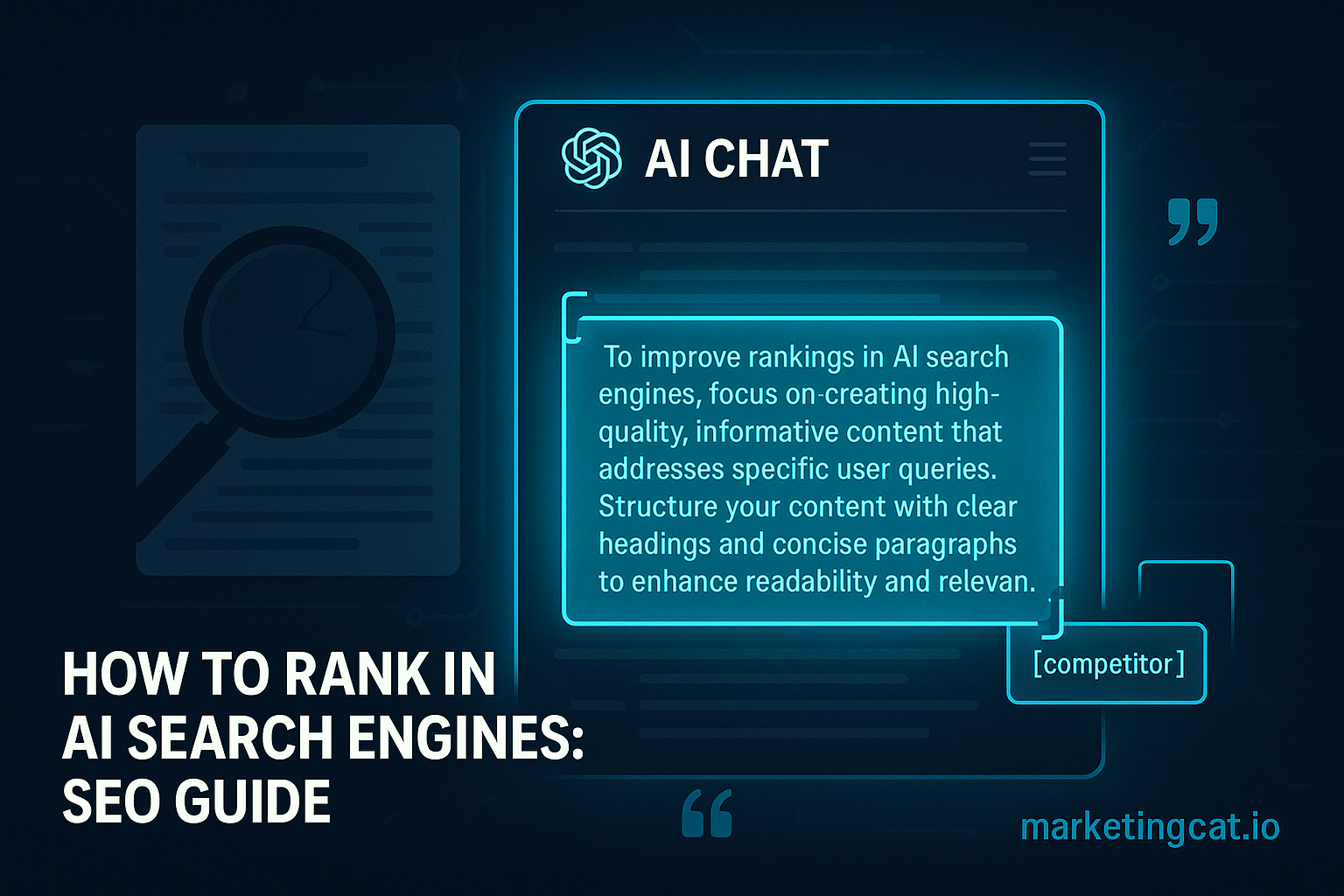
How to Rank in AI Search Engines: SEO Guide
Traditional search volume will drop 25% by 2026, and Hong Kong’s Central marketing teams are still arguing about keyword density. Meanwhile, ChatGPT is answering your customers’ questions and citing your competitor instead. The unit of ranking is no longer the page. It’s the chunk—a 40–60 word semantic unit that either earns an AI citation or disappears entirely.
Key Takeaways
- AI search engines rank 40–60 word semantic chunks, not entire pages—your current SEO structure is invisible to them
- 84% of Google queries now trigger AI-generated results, making chunk-level optimization non-negotiable for Hong Kong B2B brands
- Entity alignment and authoritative citations increase AI visibility by up to 40%, but most HK enterprises still write for humans alone
Why Traditional SEO Fails in the AI Search Era
Your 2,500-word pillar content strategy was built for a crawler that reads HTML like a filing clerk. Google rewarded title tags, H1 hierarchy, and keyword placement. That infrastructure still exists. It’s increasingly irrelevant.
AI search engines—ChatGPT, Perplexity, Google’s AI Overviews, Bing Chat—don’t read your page that way. They extract meaning at the paragraph level, sometimes the sentence level. They’re hunting for semantic units that answer specific questions cleanly. If your content isn’t structured as discrete, cite-able chunks, the AI skips you entirely.
Most Wan Chai agencies are still running 2019 SEO playbooks and wondering why their retainers are shrinking. Teams spend two months building a 3,000-word guide, optimise it for Yoast, get it ranking on page one — then watch ChatGPT cite their rivals instead. The reason is structural. 84% of Google queries now trigger AI-generated results. If your content isn’t built for extraction, you’ve already forfeited most of your addressable search traffic.
Hong Kong enterprises face a specific friction point here. Many enterprise sites still run CMS templates from 2018. These systems produce long-form content optimised for desktop readability and Flesch scores — not AI parsing. The prose reads well to a human. To a large language model trying to extract a 50-word answer about cross-border payment solutions or MPF compliance deadlines, it’s opaque.
The Entity Gap Hong Kong Enterprises Miss
Most local B2B content treats keywords like isolated targets. Write “digital transformation” fifteen times, call it optimised. But AI search engines map entities — people, companies, concepts, regulations — and the relationships between them. Mention the Hong Kong Monetary Authority without linking to a Wikidata entity or providing regulatory context, and the AI won’t confidently cite you.
AI engines cross-reference claims against known entity graphs. When you write “HKMA issued new guidelines,” the model checks: does this source correctly identify HKMA as Hong Kong’s central banking institution? Is the date plausible? Does the claim align with other authoritative sources? Fail the confidence threshold and you get no citation. Simple as that.
Master Chunk-Level Ranking to Win AI Citations
The average text chunk selected by AI search engines runs 40–60 words. Not 500. Not 150. That’s two to three sentences. If you can’t deliver a complete, cite-worthy answer in that window, you won’t rank.
Consider this bad chunk structure:
“Our platform helps businesses manage their customer relationships more effectively. We offer a range of features including contact management, email automation, and reporting dashboards. Many Hong Kong SMEs struggle with fragmented systems that don’t integrate well. By consolidating these tools into one interface, teams can work more efficiently and focus on growth.”
That’s 68 words and says nothing verifiable. No AI will extract it. Now consider this instead:
“Hong Kong SMEs using integrated CRM platforms report 34% faster sales cycles compared to teams using fragmented tools, according to a 2025 HKTDC survey. The efficiency gain comes from eliminating duplicate data entry across email, contact management, and reporting systems.”
47 words. Specific claim, data point, named source, causal explanation. Therefore, it’s cite-worthy. ChatGPT can extract it verbatim. Perplexity can link to it. Google’s AI Overview can surface it as a featured snippet.
The Formatting Template AI Engines Prefer
One structure works consistently across ChatGPT, Perplexity, and Google AI Overviews:
Claim + Data + Source in 40–60 words:
“[Specific claim]. [Supporting statistic or evidence]. [Attribution or source context].”
Example:
“Cross-border payment failures cost Hong Kong exporters an estimated HK$890 million annually in 2025. Most failures occur during currency conversion between HKD and RMB due to mismatched banking protocols, according to InvestHK trade finance data.”
The structure: Problem (payment failures) → Scale (HK$890M) → Cause (currency conversion) → Source (InvestHK). A complete semantic unit. An AI can cite it with confidence.
Yet most Hong Kong enterprises write like this:
“Payment processing is a critical concern for businesses engaged in cross-border trade. Various factors can contribute to transaction failures, including technical issues, regulatory compliance challenges, and currency conversion complexities. It’s important to work with experienced partners.”
47 words of nothing. No AI will touch it.
Perplexity vs. Google AI Overviews: What Actually Differs
Perplexity prioritises recency and source diversity. It wants content published within the last 90 days and prefers citing multiple sources per answer. Optimising for Perplexity means updating cornerstone content quarterly and including 3–4 outbound links to authoritative sources within each section. Think research brief, not landing page.
Google AI Overviews, by contrast, still favour domain authority and structured data. PageRank matters here. Schema markup matters. FAQ schema, HowTo schema, Article schema — implement them properly and Google’s AI is more likely to extract and cite you. Adding authoritative citations increases AI search visibility by up to 40%, according to Princeton University research.
ChatGPT sits in the middle, valuing clarity and entity precision above all. Define your entities clearly — people, organisations, regulations, relationships — and ChatGPT cites you. Stay vague, and it ignores you even if your domain authority hits 70.
Optimize for Entities, Not Keyword Density
Keyword density is a relic. AI engines parse semantic meaning, not word frequency. They care whether your content addresses the same concept as the user’s query — not whether you repeated an exact phrase eight times.
Entity optimisation means making content machine-readable at the concept level. When you mention “HKMA,” either link to an authoritative source or provide inline context: “the Hong Kong Monetary Authority, the city’s de facto central bank.” That signals precisely which entity you’re referencing. Don’t assume the AI will infer it.
A concrete checklist for entity alignment:
- Every organisation mentioned should link to its official website or Wikipedia page on first reference
- Every regulation mentioned should include the year it was enacted or last updated
- Every data point should be attributed to a named source — not “studies show” or “research indicates”
- Every geographic reference should be specific: “Hong Kong’s Central district,” not “the city centre”
Most Hong Kong B2B sites fail the third point catastrophically. Claims like “businesses report increased efficiency” — no source, no date, no sample size — won’t get cited. AI engines can’t verify them, so they don’t touch them.
The Citation Penalty Hong Kong Marketers Ignore
Make a claim without a source and AI search engines penalise you twice over. First, they won’t cite your content because they can’t verify it. Second, they downweight your domain’s authority for future queries — sites that consistently make unsourced claims get flagged as low-confidence.
This is particularly brutal for Hong Kong fintech and regtech companies. You’re operating in a high-trust vertical where compliance claims must be bulletproof. A product page that says “fully compliant with HKMA guidelines” without linking to the specific guideline or regulation number gets ignored by ChatGPT. Worse, it might cite a competitor who does provide that context. And in a market where HKMA scrutiny is intensifying, vague compliance language isn’t just bad for AI visibility — it’s a credibility liability.
How to Track Your AI Search Traffic and Mentions
Google Analytics won’t tell you when ChatGPT cites your content. Standard referral tracking doesn’t work because most AI engines don’t pass referrer data. You need different measurement infrastructure entirely.
Start with brand mention tracking. Tools like Brand24, Mention, or Talkwalker can track when your company name appears in AI-generated responses, though none of them are perfect. Set alerts for your brand name plus high-value keywords — “[Your Company] + Hong Kong + [core solution]” — and manually audit appearances in ChatGPT and Perplexity results. It’s unglamorous work. Do it anyway.
Also monitor zero-click search behaviour in Google Search Console. If impressions are rising but clicks are flat or declining, Google’s AI Overview is surfacing your content without sending traffic. You’re getting cited but not clicked. That’s not necessarily bad — it signals AI visibility — but it does force a rethink of conversion strategy.
The Hong Kong Data Gap Nobody Talks About
Local enterprises face a measurement challenge that US-built analytics tools weren’t designed for. Most AI search analytics platforms don’t account for Hong Kong’s bilingual search behaviour or the role of WeChat and WhatsApp as research channels. When a procurement manager in Quarry Bay researches your SaaS platform, they might start in Google, move to ChatGPT, verify in a WhatsApp group, and convert via a WeChat Mini-Program demo. Standard analytics captures none of that journey — and the cross-border data rules that govern what you can even collect make the picture murkier still. This is a genuine blind spot, and the vendors selling AI analytics dashboards in Central mostly haven’t solved it.
The workaround: UTM tagging on every cite-able chunk. Add a short-link UTM to each section you’re optimising for AI extraction. When someone clicks through from a ChatGPT conversation, you’ll know which chunk drove it. Manual. Tedious. Currently the only reliable way to connect AI citations to pipeline.
What to Track Weekly
- Brand mentions in ChatGPT and Perplexity — manual search, 15 minutes per week
- Google Search Console impressions vs. clicks — flag queries with >10% drop in CTR
- Referral traffic from “unknown” or “direct” sources that correlate with AI search spikes
- Conversion rates from high-dwell-time traffic — AI-driven visitors typically research longer before converting
One Hong Kong B2B SaaS company saw 300% growth in “direct” traffic in Q1 2026. Their marketing lead assumed tracking error. It wasn’t. ChatGPT was citing their pricing page in response to “[industry] cost comparison Hong Kong” queries — but without referrer data, it looked like direct. They only caught it by manually searching their own brand in ChatGPT and finding the citations. Most companies never run that check.
Frequently Asked Questions
What is the main difference between traditional SEO and AI search optimization?
Traditional SEO optimises entire pages for keyword relevance and backlink authority. AI search optimisation targets chunk-level content — individual 40–60 word semantic units that language models can extract and cite with confidence. The shift is from page-level ranking to paragraph-level extraction. AI engines also prioritise entity clarity, source attribution, and recency over domain authority and meta tags. You’re no longer writing for a filing system. You’re writing for a research assistant that needs to verify every claim before citing you.
How does AI search optimization differ for Google AI Overviews versus ChatGPT?
Google AI Overviews still rely on traditional SEO signals: domain authority, structured data markup, existing PageRank. FAQ and HowTo schema improve your citation odds meaningfully. ChatGPT, by contrast, prioritises clarity and entity precision regardless of domain authority — a well-structured, clearly sourced answer from a newer site can outrank an established brand if the content is more cite-worthy. Perplexity favours recent content published within 90 days and source diversity. For Hong Kong enterprises, that means running multiple optimisation strategies depending on which AI engine your target audience actually uses.
What specific formatting should I use to rank in AI search engines?
Structure content as discrete 40–60 word chunks following this template: Claim + Data + Source. Each chunk should stand alone as a complete semantic unit. Open with a specific claim, support it with a statistic or named evidence, attribute it to a specific source — all within three sentences. Avoid vague transitions and filler. Use entity-rich language: name specific organisations, reference exact regulations with dates, link to authoritative sources. AI engines extract content that requires no additional context to verify.
Are there specific Hong Kong regulatory considerations for AI search optimization?
Yes. Content making claims about financial services, healthcare, or legal compliance must cite specific HKMA, SFC, or government regulations by name and date to pass AI confidence thresholds. Vague claims like “compliant with Hong Kong standards” won’t be cited — AI engines can’t verify them. Bilingual content also creates entity ambiguity: referencing “金管局” without clarifying it’s the HKMA means English-language AI models may not make the connection. Always provide both English names and entity links on first reference. Cross-border content referencing Mainland China regulations should also explicitly distinguish between HKSAR and PRC jurisdictions — without clear geographic markers, AI engines conflate them more often than your legal team would be comfortable with.