How to Automate Your B2B Sales Funnel
Automating a B2B sales funnel requires more than picking software—it starts with mapping your process. This guide covers every stage, from lead capture to sales-marketing handoffs, with a vendor checklist built for Hong Kong teams.
Meowket's take Most useful for Hong Kong B2B sales or marketing leads building their first automated pipeline.
Automating a B2B sales funnel means using software to handle lead capture, scoring, nurture sequences, CRM task triggers and sales-marketing handoffs—so deals move forward on consistent rules rather than individual memory. For Hong Kong teams, the challenge is structuring those workflows to cover WhatsApp alongside email and phone, since WhatsApp conversations are invisible to CRM systems unless integration is configured, according to SleekFlow’s September 2026 Hong Kong B2B CRM guide. This guide walks through each stage in the order you’ll implement it, with a vendor checklist and a phased rollout plan for teams starting from scratch.
Key Takeaways
- According to Salesforce’s State of Sales Report, cited by Highspot (January 2026), B2B sellers spend only 40% of their time actually selling—automating repetitive tasks such as CRM updates, routing and follow-ups can free sellers from some of that admin work.
- SleekFlow’s September 2026 guide estimates that a B2B team with 30 active client relationships can generate 150–300 WhatsApp interactions a week that never reach the CRM unless integration is configured.
- SleekFlow’s guide sets out a three-phase rollout for Hong Kong SMEs: set up the CRM and funnel stages, add email sequences and WhatsApp integration, then compare results with the baseline from before the CRM.
What B2B Sales Funnel Automation Actually Covers
B2B sales automation is the use of software to handle repetitive sales tasks—lead routing, CRM data entry, follow-ups and meeting scheduling—so reps spend less time on admin and more time selling, as the Activepieces B2B sales automation guide (December 2025) defines it. The workflow connects your CRM, outreach tools and communication channels so that triggers—a form fill, a stage change, a reply—kick off the right next action automatically.
Graph8’s 2025 Sales Automation Trends Report, cited by Highspot, found that 75% of organisations globally use sales automation in some form. Highspot lists CRM updates, lead routing, meeting scheduling, follow-up and content recommendations among the most common use cases.
For Hong Kong B2B teams specifically, deal values range from HKD $10,000 to millions, cycles span weeks to months, and multiple decision-makers are typically involved at the same company, according to SleekFlow’s September 2026 Hong Kong B2B CRM guide. That context shapes every automation decision: sequences need to handle long cycles, CRM records need to track relationships at company level, and workflows must cover WhatsApp alongside email and phone.
Before You Build: Map Your Funnel First
Automation applied to a poorly defined process produces faster errors. SleekFlow’s guide recommends a specific sequencing: define the process, then choose the tool.
- List every stage a deal passes through from first contact to signed contract.
- Define the specific action that moves a deal from one stage to the next.
- Identify what activity must be logged at each stage.
- Specify the management reports you need to see.
- Choose the CRM that most naturally represents that real process.
Skipping this step results in configuring a CRM around the software’s default assumptions rather than your actual sales process. A CRM with only 50% activity-logging compliance produces sales forecast figures that are almost meaningless, as SleekFlow’s guide notes—so getting team adoption right from the start matters as much as the technology.
Step 1: Automate Lead Capture and Enrichment
The first automation layer covers the top of the funnel—before a rep opens their inbox. When a prospect fills in a demo request form, the system should create a lead record in the CRM, route it to the right rep, and fire an alert, all within seconds. Activepieces describes this as real-time automation: workflows fire the moment a trigger happens, not on a nightly batch or the next time someone checks a queue.
For enrichment, when a lead submits only an email address, automation can append company size, industry, revenue band and location automatically—so the rep opens a record that’s already useful.
Info-Tech CRM, a Hong Kong CRM vendor, says its ads integration captures leads from Google Ads and Meta Ads automatically, which saves a manual step if those are your lead sources. Pricing for Info-Tech CRM is not stated in our sources.
Step 2: Set Up Lead Scoring So Reps Work the Right Accounts
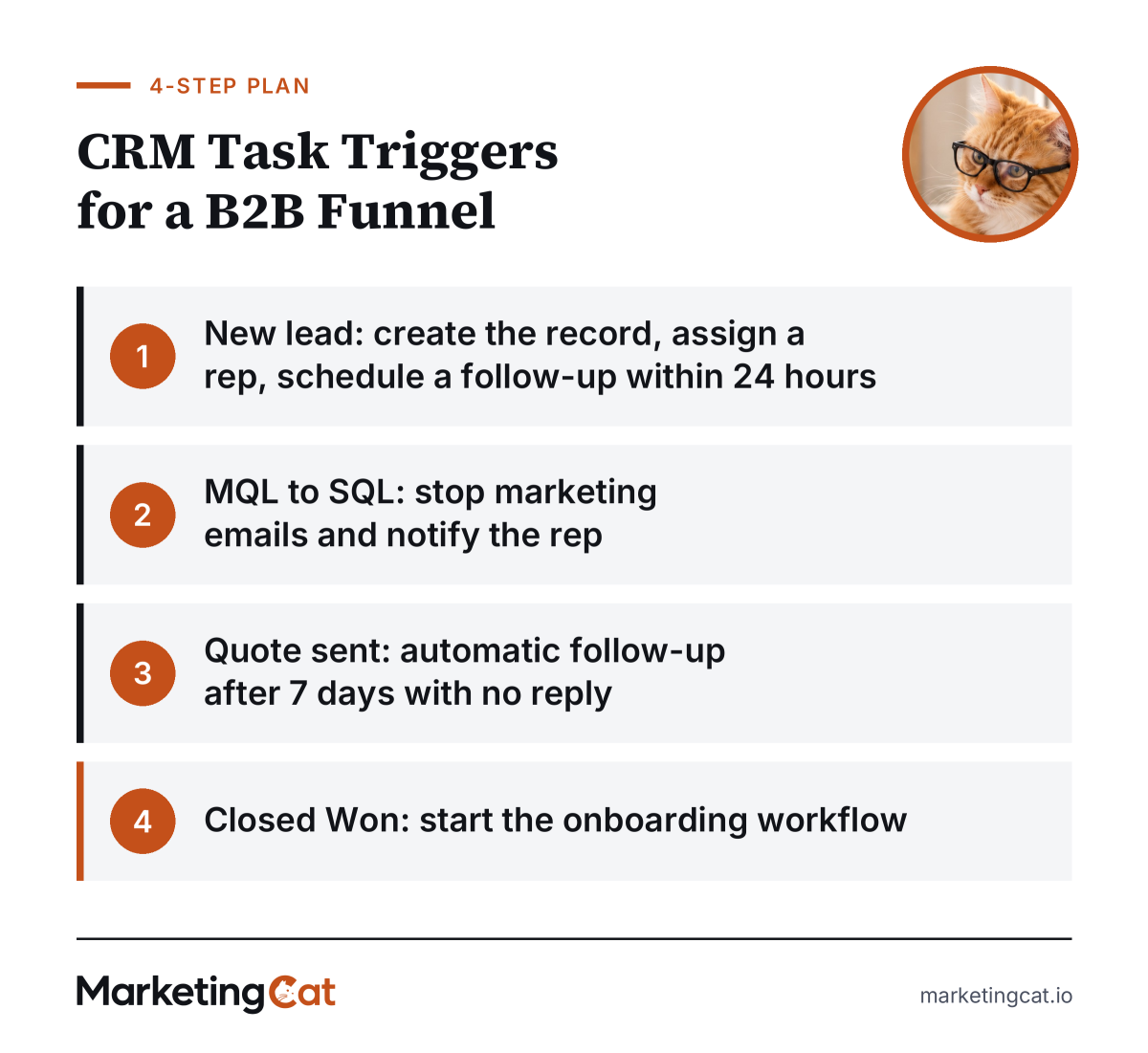
Lead scoring uses two signal types to prioritise the pipeline. Fit rules score who a lead is—a CFO title might add +20 points, a student profile might subtract 15. Intent rules track what they do—a pricing page visit adds +10, a whitepaper download +15, an email open +2. Once a lead crosses a threshold (say, 50 points), the system promotes them from marketing-qualified lead (MQL) to sales-qualified lead (SQL), stops marketing emails and notifies the assigned rep, as the Activepieces guide illustrates. (This is an illustrative model; actual thresholds should be calibrated to your deal data.)
The practical value for Hong Kong teams: reps stop wasting calls on low-fit contacts and focus on accounts that have shown real intent.
Step 3: Build Automated Nurture Sequences—and Handle Bilingual Touchpoints
Once a lead is captured and scored below the SQL threshold, automated sequences keep them engaged until they’re ready for a sales conversation. SleekFlow’s guide gives a typical trigger: a deal moves to “Quotation Sent” with no reply after seven days, and the CRM sends a follow-up email template automatically.
For Hong Kong B2B teams, buyer channels include email, phone, WhatsApp and LinkedIn. The research does not cover how to structure automated sequences that switch language based on a contact’s preference or channel—so if this matters for your market, test it explicitly in a trial before committing to a platform.
One practical approach is to tag contacts in the CRM with their preferred language and channel at the point of lead capture, then build separate sequence branches for English and Chinese. Keep the personalisation logic in the CRM record rather than in the messaging tool, so it travels with the contact as they move through the funnel.
WhatsApp: The Biggest Automation Gap in Hong Kong CRM
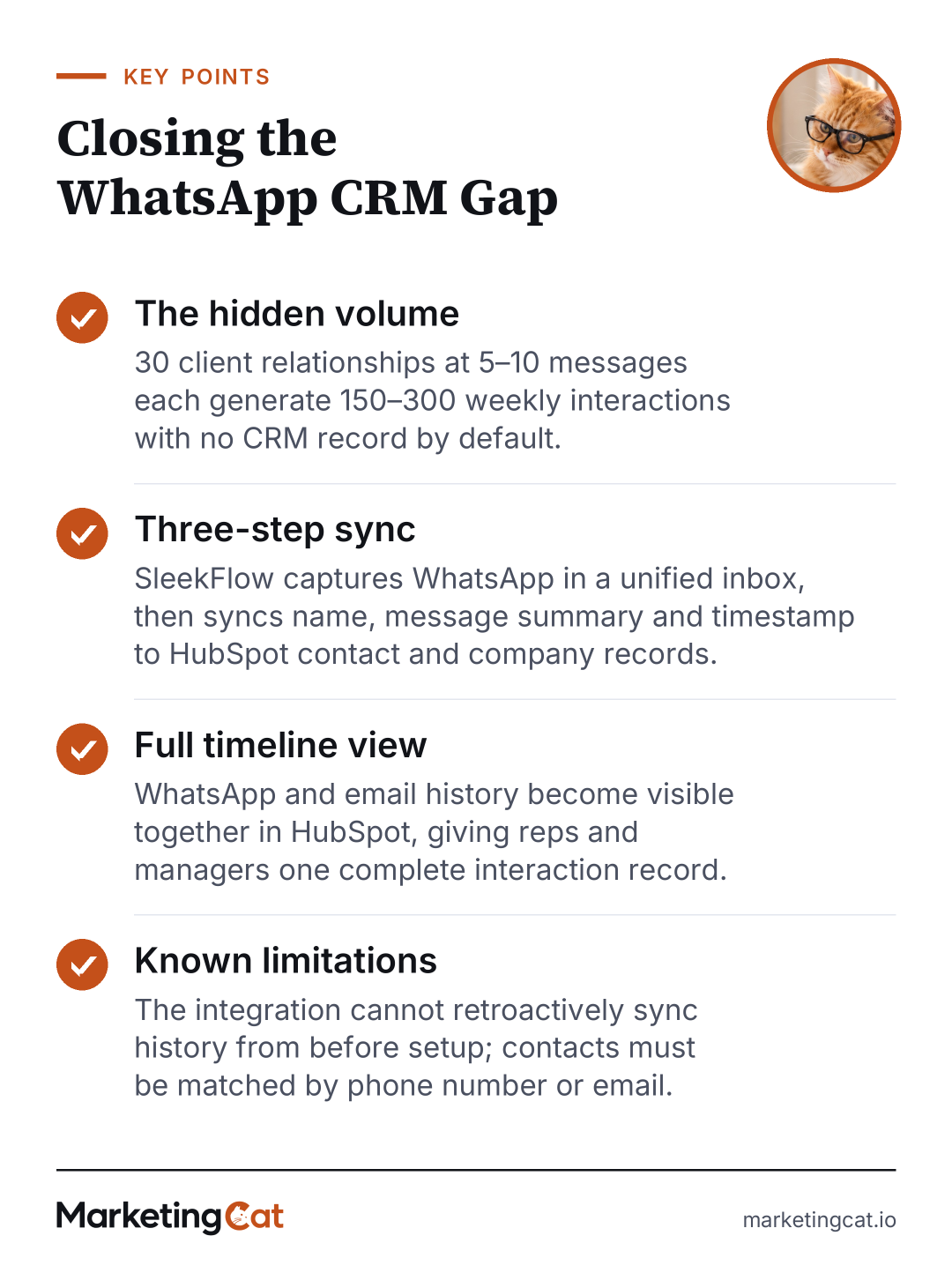
SleekFlow’s guide puts the issue plainly: WhatsApp conversations default to being invisible to CRM systems. A B2B team with 30 active client relationships, each exchanging 5–10 WhatsApp messages per week, generates 150–300 interactions per week with no CRM record unless integration is configured.
SleekFlow’s integration with HubSpot works in three steps: WhatsApp conversations are captured in a unified inbox, contact name, message summary and interaction timestamp are synced to the corresponding HubSpot contact and company record, and the full WhatsApp and email timeline becomes visible in HubSpot. One limitation: the integration cannot retroactively sync history from before it was set up, and contacts must be matched by phone number or email—manual matching may be needed if a client’s WhatsApp number isn’t recorded in HubSpot as the primary phone.
On LinkedIn outreach: LinkedIn’s policy prohibits third-party software—including bots, crawlers and browser plug-ins—that scrapes or automates activity on its platform, including automated connection requests and message sending. Accounts using such tools may be restricted or shut down. Staying within a daily sending limit does not make a prohibited tool permitted. Sales Navigator is LinkedIn’s own paid prospecting product. Our sources do not cover compliant LinkedIn automation workflows that fit within these rules, so treat LinkedIn as a manual channel or use Sales Navigator.
Step 4: Configure CRM Task Triggers for the Sales Team
CRM task triggers translate stage changes into rep actions automatically. Common examples from the Activepieces guide: a signed contract flips the stage to “Closed Won” and kicks off onboarding tasks the same minute; a demo request routes to the right rep and fires a Slack ping within seconds; a pricing-page visit by an existing lead moves them into a hot-lead sequence immediately.
Highspot’s January 2026 blog notes that ideal automation tools include automatic activity capture to eliminate manual CRM updates, AI-driven lead scoring, real-time deal-health visibility, workflow automation that triggers follow-ups and alerts, and personalised outreach at scale.
For teams using AI features to draft follow-up emails or summarise call notes: before entering customer or prospect data into generative AI tools, follow the PCPD’s March 2025 checklist for employee use of generative AI—use only internally approved tools, limit and anonymise personal data before input, and ensure a human reviews AI outputs.
Step 5: Define the Sales-Marketing Handoff Rules
A clean handoff requires a shared definition of what makes a lead sales-ready, agreed in writing before automation is built. The research does not cover how to negotiate MQL-to-SQL definitions or SLA response times for Hong Kong teams with limited RevOps resources—so this step requires internal alignment first.
Practically: agree on the lead score threshold for SQL promotion, the maximum hours before a rep must make first contact, and what happens if the rep doesn’t act. Build these rules into CRM workflow triggers—not into informal team norms—so they’re enforced consistently regardless of who is on leave. Info-Tech CRM, for example, automatically reassigns leads when the assigned rep is on leave, syncing with HR leave data.
Choosing a Platform: A Vendor Checklist for Hong Kong Teams
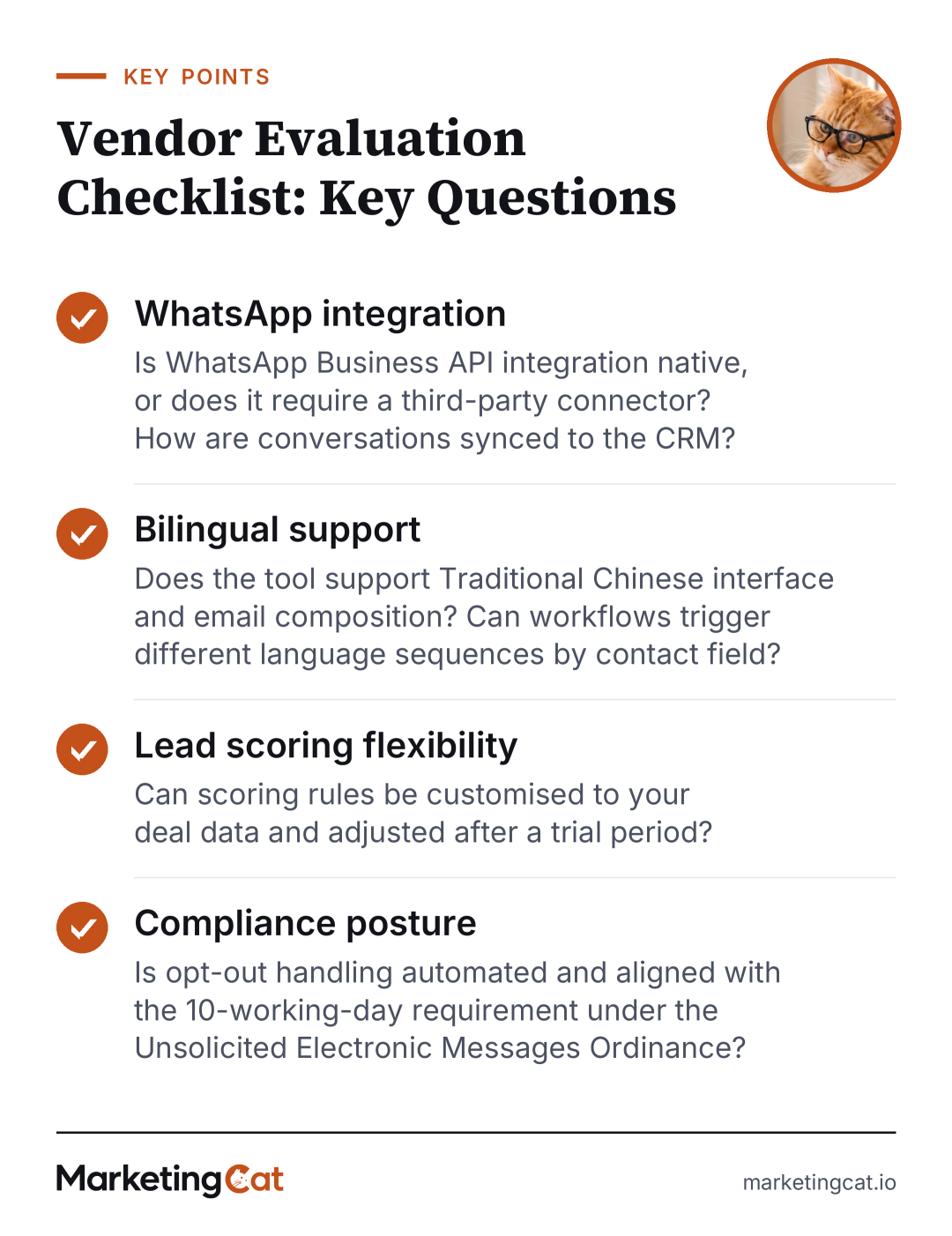
Vendor Evaluation Checklist for Hong Kong B2B Teams
This comparison is based on the sources reviewed; MarketingCat has not tested these tools. Use this checklist when evaluating any CRM or automation platform.
- WhatsApp integration: Does the platform capture WhatsApp conversations natively or via a connector, and does it sync message history to the CRM record in real time?
- Bilingual support: Can the platform send, store and display Traditional Chinese content accurately? Does it support language-branching in automation sequences? (Our sources do not compare Cantonese AI features across tools—test this in a trial.)
- Lead scoring flexibility: Can you configure both fit-based and intent-based scoring rules without developer support?
- Hong Kong data coverage: For outbound prospecting tools, does the database include adequate Hong Kong company and decision-maker records? Our sources do not address this—ask the vendor for a sample pull of your target segment before signing.
- Compliance posture: What does the vendor’s data processing agreement say about where data is stored, how long it is kept and whether it is used for model training? Does the platform keep consent records and handle opt-outs and unsubscribe requests the way the PDPO and UEMO require? Your company keeps these obligations whatever the vendor offers; this is not legal advice.
- Implementation cost: What is the total cost including setup, training, and ongoing administration—not just the per-seat headline price?
To compare running costs, use our CRM cost calculator for HubSpot and Salesforce licences and our WhatsApp Business API cost calculator for Meta’s message charges in Hong Kong.
Compliance: PDPO, UEMO and Automated Outreach
Automated nurture sequences and follow-up emails are subject to Hong Kong law. Under PDPO Part 6A, using personal data for direct marketing generally requires prior notice to the individual and their consent before the first use; opt-out requests must be honoured. Passing or selling personal data to another company for its own direct marketing is subject to stricter requirements. Marketing sent to someone in their work capacity, for products only their organisation will use, may fall outside Part 6A—the PCPD assesses each case on its facts. The PDPO’s data protection principles apply regardless.
Commercial emails and SMS with a Hong Kong link must also comply with the UEMO: include clear sender information, provide an unsubscribe facility with a statement, honour unsubscribe requests within ten working days, avoid misleading subject headings, and not send to numbers on the Do-not-call Registers without consent. The government has said the UEMO is technology-neutral and also covers commercial messages sent through instant-messaging apps such as WhatsApp, in a January 2016 reply to the Legislative Council. The UEMO and PDPO are separate laws—one automated message may need to satisfy both. How these rules apply depends on the circumstances; this is not legal advice.
A Phased Rollout for Teams with Limited Martech Resources
SleekFlow’s September 2026 guide provides a three-phase CRM rollout roadmap for Hong Kong SMEs.
Phase 1: Configure funnel stages and custom fields in the CRM, import existing contacts and company records, train all users. Target: 50% of active deals recorded in the CRM.
Phase 2: Configure email sequence templates and auto-follow-up for the three most repeated sales actions. Connect WhatsApp integration so conversations sync to CRM records. Target: 80% of new deals entered in the CRM within 24 hours of first contact.
Phase 3: Generate the first monthly pipeline review report from CRM data. Compare win rates and deal cycle length against the baseline from before the CRM. Identify which funnel stages are systematically stalling and use that data to optimise the sales process.
Running a reliable pilot means keeping inputs consistent—use the same lead source and sequence for the test group, log what was tried, and wait long enough for deals to progress before drawing conclusions.
For a broader look at how automation applies to content and demand generation, see our guide on content marketing automation with n8n and our coverage of B2B lead generation strategies for Hong Kong.
The practical next step this week
Start with the process, not the platform. Before evaluating any tool, write down every stage your deals currently pass through and what action moves them forward. If you can’t do that in an hour, the team doesn’t yet have a shared definition of the funnel—and no automation will fix that. Once the stages are agreed, you’ll know exactly what triggers and sequences to build, and vendor demos will become genuinely comparable rather than guided tours of features you may never use.
Frequently Asked Questions
How do I automate WhatsApp follow-ups in a Hong Kong B2B sales funnel without losing the personal touch?
The most practical approach is to use a platform—such as SleekFlow connected to HubSpot—that captures WhatsApp conversations in a unified inbox and syncs them to the CRM record, so reps see the full history before they follow up. Keep the follow-up message itself personal rather than sending automated WhatsApp blasts. The sources reviewed do not cover WhatsApp Business API template rules, so check them with your provider. Commercial WhatsApp messages also fall under the UEMO, and under the PDPO’s direct-marketing rules where personal data is used.
Which CRM is best for a Hong Kong B2B SME with no dedicated administrator?
SleekFlow’s September 2026 guide recommends HubSpot for most Hong Kong B2B SMEs with fewer than 100 sales staff, citing its free tier (core CRM features for unlimited users at USD $0) and its integrations with Google Workspace, Outlook and, through SleekFlow, WhatsApp. It describes Pipedrive as easier to pick up than HubSpot or Salesforce for teams that need only pipeline and activity management, at about USD $14/user/month. These prices come from SleekFlow’s guide, not each vendor’s own pricing page—verify before purchasing. The sources reviewed do not compare Cantonese-language AI features across any of these tools.
What is a realistic lead scoring threshold for a B2B sales team to start with?
There is no universally correct threshold—it depends on your deal volume, average cycle length, and how many leads your reps can handle. The Activepieces guide uses 50 points as an illustrative example, combining fit signals (job title) and intent signals (page visits, content downloads, email opens). The right approach is to set an initial threshold, run it for one full sales cycle, then compare the conversion rate of leads promoted to SQL against those that were not, and adjust. Treat the first threshold as a hypothesis, not a final rule.
Can I automate LinkedIn outreach as part of a bilingual Hong Kong B2B sequence?
Not with third-party automation tools. LinkedIn’s policy prohibits bots, crawlers and browser extensions that automate activity on its platform—including automated connection requests and message sending—and may restrict accounts that use them. Staying within a daily limit does not make a prohibited tool permitted. Sales Navigator is LinkedIn’s own paid prospecting product. The sources reviewed do not cover compliant workflow options that integrate LinkedIn outreach into a broader automated sequence; check any tool you consider against LinkedIn’s current terms before use.
How long does it typically take to see results from B2B sales funnel automation?
The sources reviewed do not provide timelines for measurable results from automation, and results vary by funnel complexity, data quality and team adoption. What the research does indicate is that a CRM with only 50% activity-logging compliance produces forecasts that are almost meaningless—so adoption must reach a consistent level before the data is useful for measurement. SleekFlow’s phased roadmap targets 80% new-deal compliance by Phase 2 and generates the first pipeline comparison report in Phase 3; the source does not specify fixed calendar months for each phase. For longer B2B cycles, allow at least one full average cycle length before drawing conclusions.