Are Google AI Overviews Ads Available in Hong Kong? A B2B Guide
As of 3 November 2026, Hong Kong is not on Google’s published list of markets for ads inside AI answers. Here is what that means and how B2B teams should prepare.
Meowket's take Most useful for Hong Kong B2B search marketers deciding what to prepare before ads in AI answers reach the city.

Google now places ads inside AI Overviews and AI Mode answers in a growing list of countries. For Hong Kong B2B advertisers, the first questions are simple: can we run these ads here yet, and do we need a new campaign?
As of 3 November 2026, Hong Kong is not on Google’s published list of markets for ads inside AI-generated answers. When an AI Overview appears in Hong Kong search results, standard Search ads can still show above or below it under the usual rules.
For Hong Kong advertisers, this means there is time to prepare, with no need to rush accounts onto broad match or AI Max. The better first move is to check search terms, landing pages and the conversion data flowing between Google Ads and the CRM, so that any future test can show which traffic produces real pipeline. This guide explains how AI Overviews, AI Mode and AI Max differ, how Google matches ads to AI answers, and what B2B teams can do now.
Key Takeaways
- As of 3 November 2026, Google lists markets such as the US, Australia, Canada, India, Singapore, Malaysia and the Philippines for ads inside AI answers, in English only. Hong Kong is not on the list.
- Standard Search ads above or below an AI Overview are not the same as ads inside the AI answer. Ads above or below the Overview follow existing Search ad rules.
- AI Max is an optimisation feature for Search campaigns, not an ad placement inside AI answers.
- Google does not report AI placements separately, so judge results on qualified leads and pipeline in your CRM.
Do ads appear inside Google AI Overviews in Hong Kong?
Not according to Google’s published list. Google’s help page on ads in AI-powered experiences lists the markets where ads inside AI Overviews and AI Mode run, all in English: the United States, Australia, Canada, India, Indonesia (AI Overviews only), Kenya, Malaysia, New Zealand, Nigeria, Pakistan (text ads only), the Philippines and Singapore. Hong Kong is not included. Google notes that the list may not be exhaustive and that it keeps expanding to more countries, territories and languages.
The list describes where the ads appear, not where the advertiser is based. A Hong Kong firm that runs English campaigns in listed markets such as Singapore or Australia may already be eligible there.
It helps to be precise about where an ad appears:
| Placement or feature | Hong Kong status (checked 3 November 2026) | What to know |
|---|---|---|
| Standard Search ads above or below an AI Overview | Can appear under existing Search ad rules | Google says this applies wherever AI Overviews are available, in all languages; it isn’t a new placement. |
| Ads inside AI Overviews | Hong Kong not on Google’s list | The list covers English only; no Chinese-language timeline has been given. |
| Ads inside AI Mode | Hong Kong not on Google’s list | Google’s 28 October 2026 expansion to ten markets did not include Hong Kong. |
| AI Max | A Google Ads feature, not a placement | Judge it on your existing campaign results. |
Sources: Google Ads Help and Google’s official blog, checked by MarketingCat on 3 November 2026.
In a 28 October 2026 blog post, Google said it was scaling ads in AI Mode to Australia, Canada, India, Kenya, Malaysia, New Zealand, Nigeria, Pakistan, the Philippines and Singapore. It plans to add Brazil, Mexico and the United Kingdom in Q4 2026, and it is launching multiturn ads in the US, which let ads appear in follow-up questions in AI Mode. The announcement does not mention Hong Kong. That reflects Google’s plans on that date, not a permanent position, so watch the help page’s market list for changes.
AI Overviews vs AI Mode vs AI Max
For Hong Kong advertisers, these three names are the easiest to mix up: AI Overviews and AI Mode are parts of Google Search, while AI Max is a Google Ads feature. Search Engine Land noted in October 2026 that the names confuse even PPC specialists.
| Name | What it is | Is it an ad placement? | What Hong Kong advertisers should know |
|---|---|---|---|
| AI Overviews | An AI-generated summary on the search results page | Ads can appear inside it, in supported markets only | Separate ads inside the answer from standard ads above or below it. |
| AI Mode | A conversational AI search experience with follow-up questions | Ads can appear inside it, in supported markets only | Supported markets and languages change, so check the current list. |
| AI Max for Search campaigns | A set of AI optimisation features for Search campaigns | No | It can widen matching and tailor ad text, but it doesn’t guarantee a place inside AI answers. |
On a Google results page, an AI Overview usually sits above the standard results. The AI Mode tab, first in the row under the search box, opens a conversational search where users can keep asking follow-up questions. The two screenshots below show both interfaces:


AI Max doesn’t appear on the results page at all. It is a set of settings in a Search campaign that affects how searches are matched to your ads and how some ad text and landing pages are chosen. Whether an ad can appear inside an AI answer still depends on the markets, languages and other conditions Google supports at the time.
How Google matches searches to ads
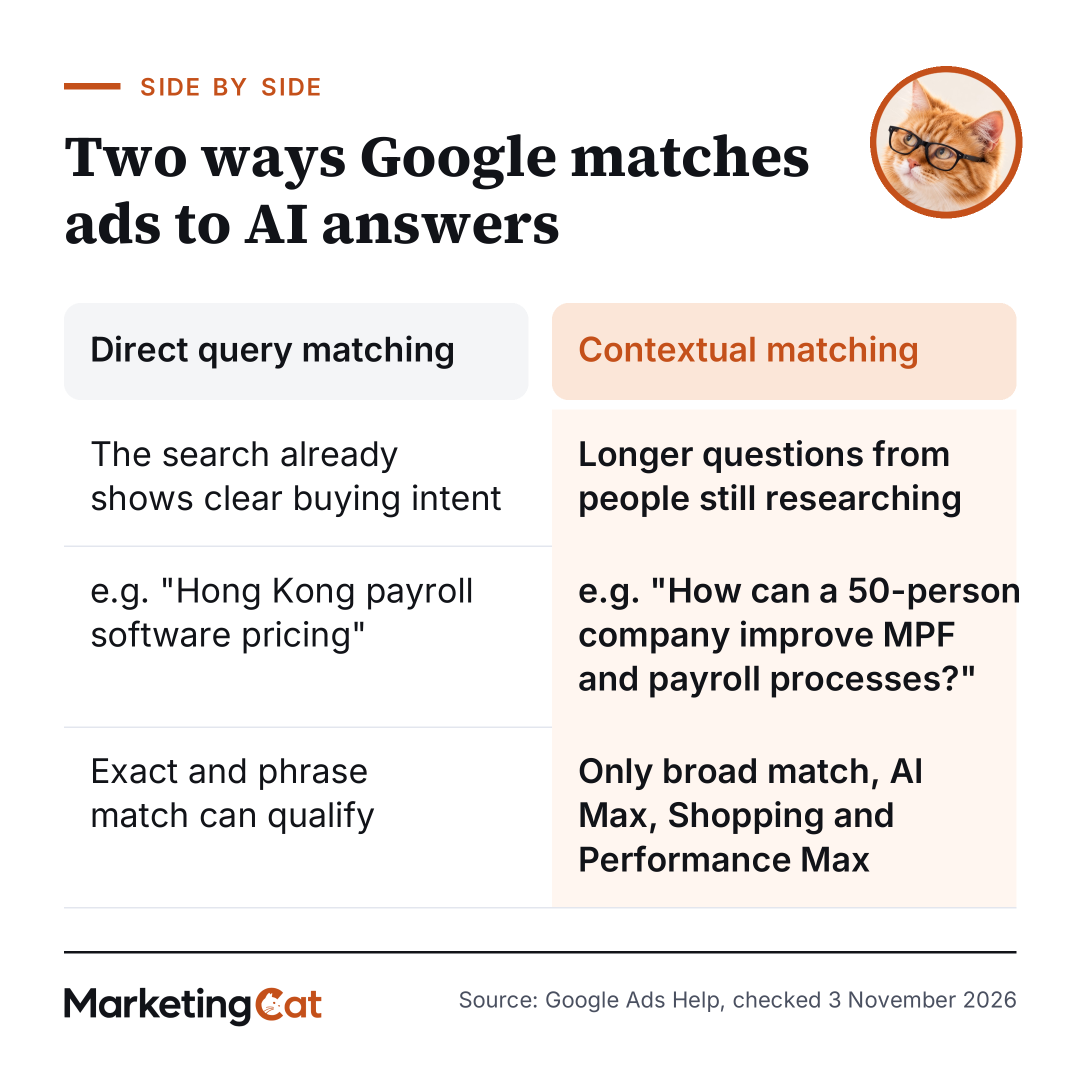
In supported markets, Google matches ads to AI answers in two ways:
- Direct query matching: used when the search itself already shows clear commercial intent, such as “Hong Kong payroll software pricing”.
- Contextual matching: Google considers both the query and the AI response. It is used for longer, exploratory questions, where commercial intent only emerges from the next steps the answer suggests.
Which settings qualify for each type of matching:
| Campaign or keyword setting | Direct query matching | Contextual matching |
|---|---|---|
| Broad match, AI Max for Search campaigns | Eligible | Eligible |
| Shopping, Performance Max | Eligible | Eligible |
| Exact and phrase match | Only for queries with direct commercial intent | Not eligible |
Source: Google Ads Help, checked 3 November 2026.
In short, broad match and AI Max can widen your reach into “still researching” searches, but Google does not promise that an ad will show.
Example: a Hong Kong payroll and MPF software company
Illustrative example, not real campaign results. It assumes ads inside AI answers are available in the market.
The company mainly bids on the phrase-match keyword “payroll software”. It could see two kinds of search:
- “Hong Kong payroll software pricing”: the search shows clear buying intent and contains the keyword, so the phrase-match keyword can qualify through direct query matching.
- “How can a 50-person company improve MPF and payroll processes?”: a research question. If Google treats it as exploratory, the phrase-match keyword doesn’t qualify, and only settings such as broad match or AI Max could reach it.
For this company, someone searching “Hong Kong payroll software pricing” may already be comparing suppliers. Someone asking how a 50-person company can improve MPF and payroll processes may be a finance or HR colleague mapping a process, without a budget yet. So a test succeeds if it produces qualified leads or booked meetings, not more clicks.
What Hong Kong B2B advertisers should do now
Our view: Hong Kong advertisers shouldn’t rework their whole Search strategy just because AI ad formats are expanding. First confirm which placements are live locally, and make sure Google Ads and the CRM can tell valuable leads from low-quality enquiries. Then test broader matching and AI Max in a controlled way.
The checklist below is MarketingCat’s framework. Steps 1, 3 and 4 draw on Google’s documentation; steps 2, 5 and 6 are our recommendations built on it.

AI search ads readiness checklist for Hong Kong B2B teams
- Confirm placement, market and language: Before each review, check Google’s current market list and record the date. Don’t confuse ads inside AI answers with standard ads above or below them.
- Audit conversion goals and lead quality: Make qualified leads, booked meetings or opportunities the main conversions, and import CRM outcomes into Google Ads instead of counting form fills alone.
- Review search terms and negative keywords: Export the last 90 days of search terms and add negatives for job-seeker, free-download, student-homework and consumer queries.
- Check landing pages and asset controls: Make sure service pages state your scope, audience and pricing accurately. If you use AI Max, decide whether to turn on final URL expansion and which headlines and descriptions to pin.
- Run a small test against a baseline: Test broad match or AI Max in one campaign only, keep budget, bid strategy and landing pages unchanged, and log every change with its date.
- Judge on qualified leads and pipeline: Evaluate the test on CRM outcomes. Google doesn’t report AI placements separately, so the result reflects the whole campaign.
Two more points make a test trustworthy:
- Run it long enough to cover your normal sales-cycle lag, such as the time from enquiry to meeting.
- Repeat the comparison before scaling, because one good month can reflect seasonality rather than the setting.
If your team uses generative AI tools to cluster search terms or analyse CRM notes, get internal approval first and follow the PCPD’s Checklist on Guidelines for the Use of Generative AI by Employees (March 2025): enter as little personal data as possible and anonymise it first. Our PCPD agentic AI checklist goes further, and our guide to B2B lead generation in Hong Kong covers the wider funnel.
How to measure results, and what you can’t see
For B2B teams trying to work out a return on AI ads, reporting is the biggest limitation today. Google says impressions, clicks, conversions and cost from ads inside AI Overviews and AI Mode are included in standard campaign reports, and the queries that trigger them appear in the search terms report in aggregate. Under current reporting, even once Hong Kong is added, you wouldn’t be able to see AI placement performance on its own.
- You can see: whole-campaign performance. With AI Max, the search terms report labels the extra queries it brings in with an “AI Max” match type, and a source column shows whether each came from broad match expansion or keywordless matching.
- You can’t see: whether a given impression or lead came from inside an AI Overview or AI Mode answer.
If your account runs both English and Chinese ads, note a change to language settings as well. Google’s language targeting help page says that, starting September 2026, the campaign-level language setting is being removed from Search campaigns. Ads match based on the language of the ad, and Google prioritises ads in the language of the user’s search. Separate English and Chinese ad groups still help you manage copy and landing pages, but they won’t fully isolate language traffic, and they can’t identify AI placements.
AI Max risks and controls
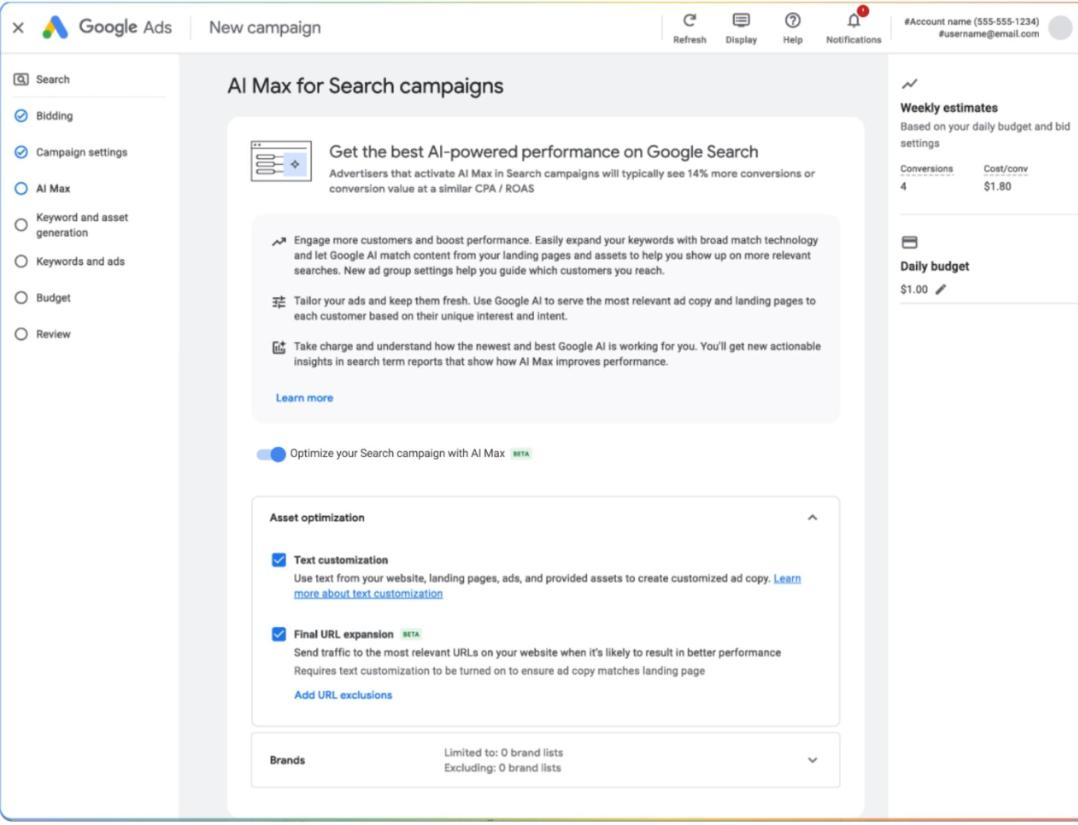
This section is for the PPC specialists who manage account settings. AI Max is switched on in a Search campaign’s settings, where you can then choose text customization (ad copy adapted from your website and existing assets), final URL expansion and brand controls. The image below is Google’s own demo of that settings page from the launch:
- No separate targeting or opt-out: Google says you can’t target ads only to AI Overviews or AI Mode, or opt out of them separately from Search.
- Negative keywords and other guardrails: Google says existing account and campaign guardrails, such as negative keywords and asset pinning, continue to apply to ads inside AI answers.
- Brand and URL controls: AI Max for Search campaigns supports brand inclusions, brand exclusions and URL exclusions, to keep ads away from irrelevant brands and unsuitable landing pages.
- Pinned assets and final URL expansion: When final URL expansion picks a more relevant page, pinned assets aren’t used. Firms that must approve ad copy word for word, such as those in finance or healthcare, should assess this before turning it on.
- Budget: Google’s AI Max page says AI Max won’t be effective if a campaign is limited by budget. Tight B2B budgets are better spent on high-intent terms first.
AI explainers sit outside your control
Some placements show AI explainers: short texts written by Google’s Gemini models that explain how an ad relates to the search. Advertisers can’t write, edit, approve or opt out of them. Google says explainers can draw on the query, the AI response and public sources, including your website, so keep service pages accurate and current.

Advanced settings: tracking templates, ValueTrack and {lpurl}
Check your tracking templates before turning on AI Max or final URL expansion. Google’s AI Max page warns that a tracking template set to a static URL without the {lpurl} tag can send users to that fixed page instead of the selected landing page, and that non-standard {lpurl} formats can cause 404 errors. Google’s recommended patterns are {lpurl}?, {lpurl}& and {lpurl}#, or {lpurl} alone when there are no tracking parameters; see Google’s ValueTrack parameters guide.
Limitations and what to watch next
This guide is based on Google’s documentation and the sources linked above. MarketingCat has not tested ads inside AI answers. The AI Overview and AI Mode screenshots were taken in Japan with an English interface; they illustrate the interfaces only and say nothing about ads in Hong Kong. The AI Max settings image is a frame from Google’s May 2025 launch video, not a screenshot of a MarketingCat account. Google’s help page carries no publication date, Google says it keeps testing ad layouts, and the market list can change at any time.
Watch for three things:
- An update to Google’s market and language list that adds Hong Kong or Chinese.
- The planned Q4 2026 expansion of AI Mode ads to Brazil, Mexico and the UK, and which markets follow.
- Any placement-level reporting for AI answers.
Organic visibility in AI answers is a separate discipline, covered in our guide to AI search marketing in Hong Kong.
While Hong Kong waits, use the time to fix the foundations. This week, export the last 90 days of search terms from your main lead-gen campaign, tag the longer, question-style queries and check what share produced qualified leads. That tells you whether a controlled broad match or AI Max test will be worth running once Hong Kong is added.
Frequently Asked Questions
Do Hong Kong advertisers need a new campaign or extra budget?
No. Google says advertisers don’t need to create new campaigns or set up separate budgets. In listed markets, existing Search, Shopping and Performance Max campaigns are eligible automatically. Hong Kong isn’t on Google’s published list yet, so existing campaigns simply run as normal.
Does spending on Google Ads help my brand appear in the AI answer itself?
Not according to Google. Its help page states that paid advertising does not influence the organic responses generated by Google AI, and that ads are labelled “Sponsored” and visually separated. That is Google’s own statement; we found no independent research testing it. If you want visibility in both places, plan the work separately. Our guide to generative engine optimisation for Hong Kong B2B covers the organic side.
Can separate English and Chinese ad groups show AI placement results?
No. Google combines AI placement data with standard reports, and campaign-level language targeting is being removed from Search campaigns from September 2026. Splitting ad groups or campaigns by language helps you manage copy and landing pages, but it can’t isolate traffic from AI placements.
Which assets do ads inside AI answers use?
Mainly the assets already in your campaigns: headlines, descriptions, images, prices and landing pages, with a “Sponsored” label. Some placements may introduce a group of ads under a shared header such as “You might consider these options”, so each asset should make sense on its own.
Should a Hong Kong B2B team pause campaigns because placement can’t be controlled?
Generally not. You can’t opt out of AI placements separately from Search, Hong Kong isn’t on Google’s list for ads inside AI answers yet, and pausing a campaign also gives up the standard ads that run above and below AI Overviews. Tighten what you can control instead: negative keywords, match types, landing pages and conversion quality.