B2B Lead Generation in Hong Kong (2026): Channels, Compliance & 90-Day Plan
A practical guide for Hong Kong B2B teams: build a target-account list, match channels to jobs, check the PDPO, UEMO and platform rules before outreach, and run a 90-day pilot.
Meowket's take Before buying another contact list or booking another campaign, ask Sales which accounts matter, what makes a contact worth following up, and who owns the next step. More activity won't help if nobody can tell whether a contact became an opportunity.

A Hong Kong B2B team can post on LinkedIn, run search ads and attend events, and still struggle to turn the contacts it collects into qualified sales conversations. The cause may be targeting, follow-up, channel fit or all three.
This guide to B2B lead generation in Hong Kong shows how to build a target-account list, choose channels for different jobs, check the local outreach rules and run a practical 90-day pilot. Throughout, it tracks meetings held and opportunities created, not just the number of contacts collected. For software and prices, see our separate comparison of B2B lead generation tools for Hong Kong teams.
Key Takeaways
- Agree with Sales which accounts matter, what makes a lead worth following up and who owns the next step before adding channels or budget.
- Give each channel a job: LinkedIn and events build familiarity with named people, search and content reach buyers who are already looking, and email or WhatsApp follow up with people on a basis the rules allow.
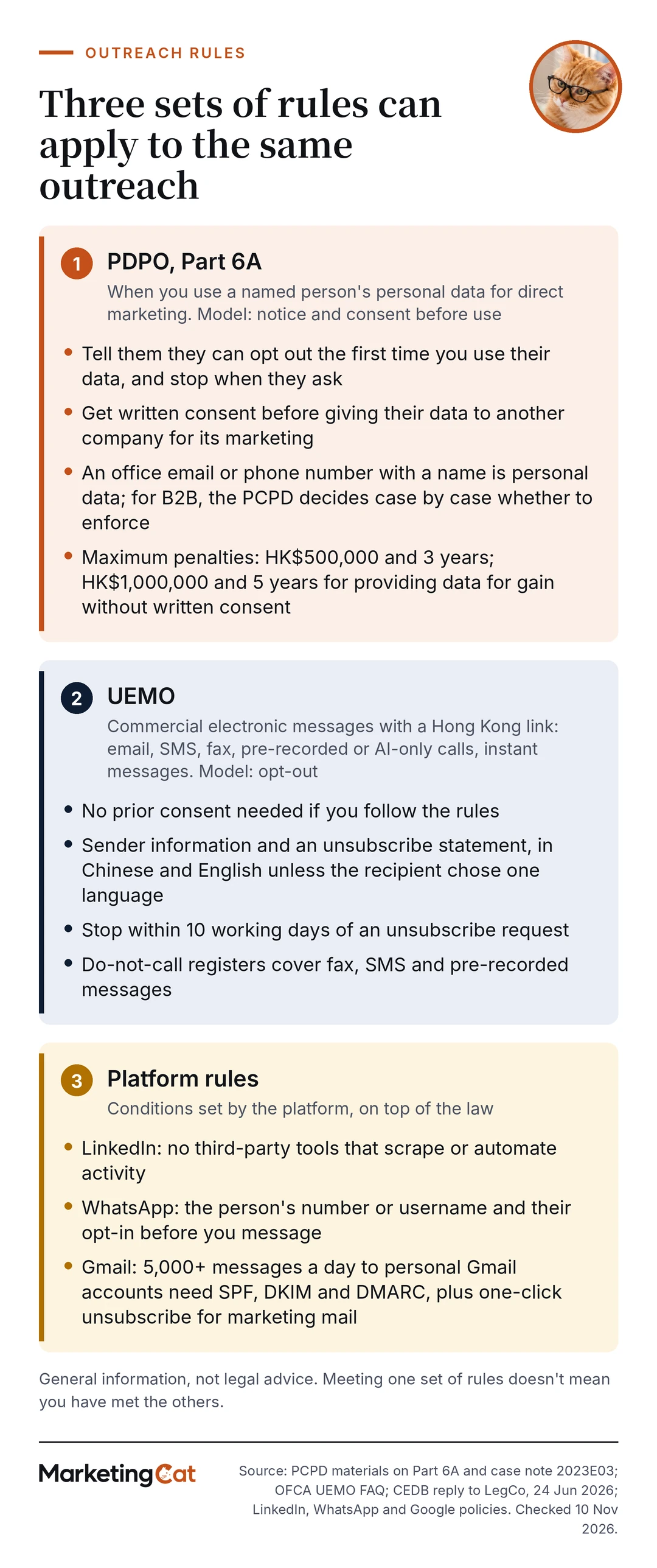
- Three sets of rules can apply to the same outreach: the PDPO’s direct-marketing provisions (Part 6A) when you use someone’s personal data, the UEMO’s opt-out rules for commercial electronic messages, and each platform’s own policy, such as WhatsApp’s opt-in requirement.
- Plan for English and Traditional Chinese. In the 2021 census, 88.2% of people aged five and over said Cantonese was their usual spoken language.
- Treat the first 90 days as a pilot. Judge early demand signals and how well hand-offs work; revenue usually takes longer to show in B2B.
What makes B2B lead generation in Hong Kong different?
Hong Kong has about 360,000 SMEs, over 98% of its business sector as at March 2026, according to a government speech in August 2026. Three features shape lead generation here.
- Defined markets can be listed. If you sell a high-value service to a clearly defined segment, the companies that could buy from you can often be listed by name. That suits an account-based approach: knowing which companies you want, who is involved in buying and what is changing in each account. Broad, low-cost or self-serve offers usually need a wider demand-generation approach as well.
- Two working languages. According to the 2021 Population Census, 88.2% of people aged five and over used Cantonese as their usual spoken language and 58.7% could speak English. These are population figures, not a measure of how B2B buyers prefer to be contacted, but they explain why many teams publish in both English and Traditional Chinese. Material in Simplified Chinese can read as written for the Mainland.
- Rules that overlap. Using someone’s personal data for direct marketing generally requires notice and consent under the PDPO, subject to how the law applies to the case. Commercial electronic messages also have to follow the UEMO’s sender and unsubscribe rules, and platforms add their own conditions. The rules section below separates the three.
Start with the account list and agreed definitions
Many lead generation problems start before the first campaign. Before choosing channels, write down:
- Your ideal customer profile (ICP): industry, company size, location (Hong Kong only, or also the Greater Bay Area), and the events that make a company likely to buy, such as a new office, a funding round, a regulatory change or a new hire in a key role.
- A target account list: the specific companies that fit, with the roles involved in buying. Start with a list your sales team can realistically work, then add to it.
- Who owns follow-up, and how fast: name the person responsible for each new lead and agree a response time, for example one working day.
Agree the stage names with Sales and record them in your CRM. The definitions below are a common starting point; adjust them to your own sales process.
| Stage | Example definition |
|---|---|
| Lead | A named person who has shared contact details or engaged with you |
| MQL (marketing-qualified lead) | A lead at a company that fits your ICP and has shown interest, such as downloading a guide or attending a webinar |
| SQL (sales-qualified lead) | An MQL that Sales has accepted after confirming a real need, a role in the decision and a rough timeline |
| Meeting held | A first sales meeting that actually took place, not just one that was booked |
| Opportunity | A deal Sales is actively working, with an estimated value |
Our HubSpot vs Salesforce comparison and CRM cost calculator help if you don’t have a CRM yet. Where your contact list comes from matters for compliance as well as quality: details you collect yourself, with a clear notice and consent, carry the least risk. The rules section explains why a bought list or public records don’t remove that duty.
Which lead generation channels work for Hong Kong B2B?
No single channel works for every company. The table groups seven common channels by the job they do. Costs are mostly described rather than quoted, because they depend on your market and on how much of the work your team does itself.
| Channel | Best for | Main cost | Hong Kong notes |
|---|---|---|---|
| LinkedIn (personal profiles and company Page) | Building familiarity with named decision-makers before you contact them | Time; Sales Navigator Core is US$119.99/month billed monthly, before any tax (checked 28 October 2026) | NapoleonCat’s headline estimate puts LinkedIn’s addressable ad audience in Hong Kong at about 4.7 million (October 2026); that is not a count of active users or buyers. Post from named people as well as the company Page. LinkedIn doesn’t allow third-party tools that automate activity on its site. |
| Search: SEO and Google Ads | Reaching buyers who are already looking for a solution | Content time (SEO) or cost per click (ads) | Publish in English and Traditional Chinese, and track results through to opportunities as far as your setup allows. See our B2B SEO strategy for 2026 and SEO ROI calculator. |
| Content offers and webinars | Turning readers into named leads who have agreed to hear from you | Time to produce something useful | Where you ask for marketing consent, a Personal Information Collection Statement and a separate, unticked consent box are a sensible default. |
| Events, trade fairs and associations | Meeting decision-makers and partners in person | Booth, sponsorship or membership fees, plus staff time | Trade fairs, chambers of commerce and industry associations give you face-to-face access to buyers and partners. Business cards and badge scans are still personal data. |
| Partners and referrals | Borrowing trust from someone the buyer already knows | Referral fees or reciprocal work | Agree in writing how leads are shared. Providing personal data to another company for its marketing needs the person’s written consent first. |
| Email to named contacts | Following up after an event, a download or a clear trigger | Low cash cost; setup time for the domain and lists | The UEMO’s sender and unsubscribe rules apply, and so does the PDPO when you use a named person’s data. Authenticate your sending domain. |
| WhatsApp Business | Fast follow-up with people who have opted in | Per-message fees on the WhatsApp Business Platform | WhatsApp’s policy requires opt-in before a business messages someone, and commercial WhatsApp messages can also fall under the UEMO. Estimate fees with our WhatsApp API cost calculator. |

For many small and mid-sized B2B teams, a workable starting mix is LinkedIn activity from two or three named people, one content offer in both languages, and one event or association each quarter, with email or WhatsApp follow-up where the rules allow. Add paid search or LinkedIn ads once you know which messages lead to meetings.
The rules to check before any outreach
This section is general information, not legal advice. Three sets of rules overlap, and meeting one does not mean you have met the others. Ask your privacy or legal adviser to review your outreach workflow before you launch.
1. PDPO: using personal data for direct marketing (Part 6A)
Before using someone’s personal data for direct marketing, a company must tell them the prescribed information and get their consent (CLIC, University of Hong Kong). The first time it uses their data for marketing, it must also tell them they can opt out, and it must stop when they do. Using personal data in direct marketing without consent, or ignoring an opt-out, carries a maximum fine of HK$500,000 and up to three years’ imprisonment. Providing personal data to another party for its direct marketing needs the person’s written consent; doing so for gain without it carries up to HK$1,000,000 and five years (PCPD).
Public records are not an exception. In a case summarised by Mayer Brown in October 2025, a debt collection agency took a person’s name and home address from District Court filings and mailed him a promotional letter without notice, consent or an opt-out notice. It pleaded guilty to two offences and was fined HK$5,000.
B2B marketing has an important nuance, and it is an enforcement approach rather than a legal exemption. In case note 2023E03, the PCPD says an office phone number or email address combined with a person’s name is personal data, even when it comes from a business card or company website. Whether it enforces Part 6A depends on how the data was collected (for example, in the person’s official capacity), whether the product is for company or private use, and, if it could be either, whether the marketing targets the company or the individual. In clear-cut cases where the data was collected in an official capacity and the product is clearly only for the company’s use, it says enforcement is generally not appropriate; in other cases, comply with Part 6A. Either way, the PDPO’s data protection principles still apply. If a directory says its contacts may only be used for business purposes, follow those terms.
Where you do ask for marketing consent, a separate, unticked consent box is a sensible default: it records a clear choice that you can show later.
2. UEMO: commercial electronic messages
The UEMO covers commercial electronic messages with a Hong Kong link, such as emails, text messages, faxes and pre-recorded calls. It is an opt-out regime: according to OFCA, a sender doesn’t need prior consent if it follows the rules, which include:
- giving accurate sender information and an unsubscribe statement, in both Chinese and English unless the recipient has indicated one language (a name and address can be in either language);
- providing an unsubscribe facility and stopping within ten working days of a request;
- not sending faxes, text messages or pre-recorded messages to numbers on the Do-not-call registers without consent;
- not using misleading email subject lines or hiding the caller number.
The UEMO’s opt-out model doesn’t override the PDPO: if an email uses a named person’s personal data for direct marketing, Part 6A can apply as well. The government has also said the UEMO is technology-neutral and covers commercial messages sent through instant messaging apps (reply to the Legislative Council, January 2016).
For calls, the government’s June 2026 reply to the Legislative Council says pre-recorded calls are covered whether the voice is human or AI-generated, unless they involve person-to-person interactive communication, and that a call run entirely by AI is covered. Live, person-to-person calls are outside the UEMO; for those, the government relies on a voluntary scheme covering 12 associations in seven industries, such as finance, insurance and telecoms. The PDPO still applies when you call a named person using their personal data.
3. Platform rules
- LinkedIn doesn’t allow third-party software, including bots and browser extensions, that scrapes or automates activity on its site. Staying under a daily limit doesn’t make such a tool allowed. Our tools comparison covers what to ask vendors.
- WhatsApp: the WhatsApp Business Messaging Policy (updated September 2026) says a business may contact someone only if they have given it their phone number or username and it has their opt-in permission. This is a platform condition on top of the law.
- Email: Google’s sender guidelines require all senders to authenticate with SPF or DKIM, and require anyone sending about 5,000 or more messages a day to personal Gmail accounts to authenticate their domain with SPF, DKIM and DMARC and offer one-click unsubscribe for marketing messages. Google asks all senders to keep the spam complaint rate below 0.1% and never reach 0.3%. Business inboxes on Google Workspace don’t count towards the 5,000, but the same practices protect deliverability.
If you use AI tools to write or run outreach, also see our checklist on the PCPD’s agentic AI guidance.
In-house, agency or hybrid?
An in-house team builds relationships and product knowledge that stay with the company, but it usually takes months to build a pipeline. An agency adds capacity quickly, but the results depend on where its data comes from and on whether it hands you meetings or just names. A common middle path is a hybrid: the in-house team owns the account list, the messaging and every sales conversation, and an agency handles defined tasks such as event logistics, ad management, content production or appointment setting with your approved scripts.
Before signing with a lead generation agency, ask:
- Where does your contact data come from, and how was consent for direct marketing obtained?
- Do you use any tools that automate activity on LinkedIn?
- Who owns the contact list and the conversation history when the contract ends?
- Do you charge per lead, per meeting booked or per meeting held, and how do you define each?
- Can we approve every message template, in English and Traditional Chinese, before it is sent?
- How do you record opt-outs and pass them to us?
- What is the minimum term, and how do we exit?
How to measure lead generation
Judge each channel by what it contributes to sales: target accounts reached, conversations started, meetings held, opportunities created and, over time, closed revenue. Opens, clicks and follower counts show activity, not demand.
Connecting a lead to its source takes more than tagging links. Our UTM link builder labels each campaign link, so your analytics can classify the visit. To see the source on a CRM record, the chain usually runs:
campaign link → landing page → analytics session → form that captures the source fields → CRM source field → de-duplicated contact and account → follow-up activity → opportunity report
Each step can break. People may visit directly, decline cookies, switch devices, or meet you first at an offline event, and several people from one company may be involved. Decide whether you report first touch, last touch or both, label gaps honestly, and log event and referral sources by hand. Our guide to automating the B2B sales funnel covers lead scoring and follow-up sequences.
Example: an 80-account pilot
This is an illustrative plan for a fictional company, not market evidence. It shows the planning inputs and the fields to track; it doesn’t predict results.
| Element | Illustrative plan for a Hong Kong B2B cybersecurity services firm |
|---|---|
| Target accounts | 80 named mid-sized companies (50 to 500 staff) with Hong Kong operations and high compliance needs |
| Roles | IT manager, finance lead and, where relevant, procurement |
| Channels | Weekly LinkedIn posts from the founder, one checklist in English and Traditional Chinese, one industry association event |
| Consent and rules | Record how each contact was collected and what they agreed to, per channel; test the forms and the unsubscribe process before launch |
| CRM stages | Lead → MQL → SQL → Meeting held → Opportunity |
| What to track | Meetings held, opportunities accepted by Sales, channel cost, and the time from a new lead to first follow-up |
| Reviews | Day 30: is the workflow running? Day 60: are the leads and replies the right quality? Day 90: continue, adjust or pause each channel |
A 90-day lead generation pilot
This plan assumes a small team without a lead generation programme yet. Adjust the order to your own pipeline gaps, and treat the result as an early read rather than proof of return: B2B sales cycles often run longer than 90 days, and small lead numbers can’t support firm conclusions.
90-day B2B lead generation pilot for Hong Kong
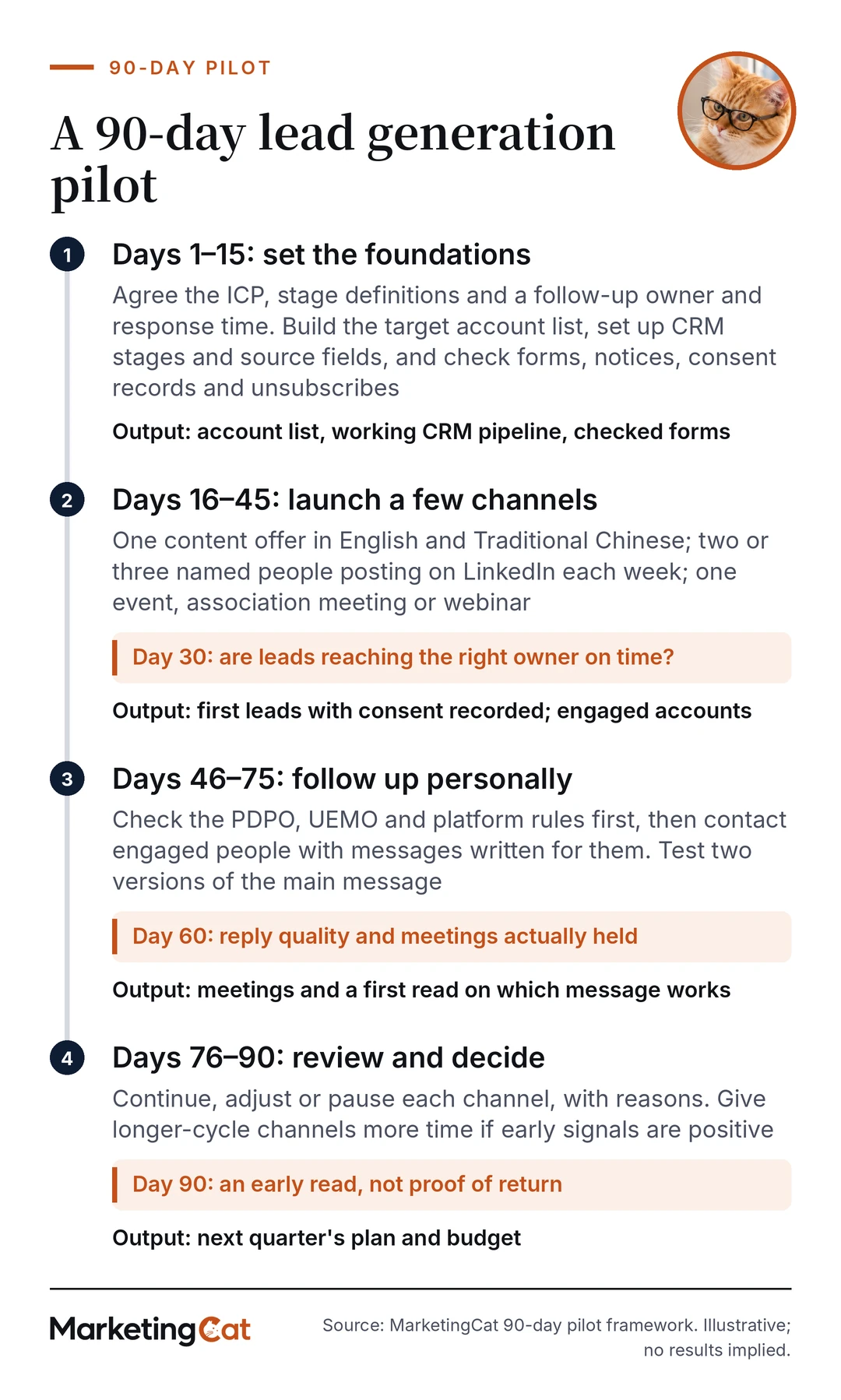
- Days 1 to 15: set the foundations. Agree the ICP, the stage definitions and a follow-up owner and response time with Sales. Build the first target account list, set up CRM stages and source fields, and check your forms, notices, consent records and unsubscribe process. Output: an account list, a working CRM pipeline and checked forms.
- Days 16 to 45: launch a small number of channels. Publish one useful content offer (a checklist, template or short guide) in English and Traditional Chinese, have two or three named people post on LinkedIn each week, and book one event, association meeting or webinar. At day 30, check that leads reach the right owner on time. Output: the first leads, with consent recorded, and a list of engaged accounts.
- Days 46 to 75: follow up personally. After confirming the contact method meets the PDPO, the UEMO and the platform’s rules, contact engaged people at target accounts with messages written for them. Test two versions of your main message on small groups; our article on testing sales messages before launch shows one approach. At day 60, review reply quality and meetings actually held, not just booked. Output: meetings and a first view of which message works.
- Days 76 to 90: review and decide. For each channel, decide whether to continue, adjust or pause, and write down why. Put more into channels with early evidence of meetings and opportunities, and give channels with longer sales cycles more time if the early signals are positive. Output: a plan and budget for the next quarter.
Is there government funding for lead generation?
As of 10 November 2026, we found no open government scheme aimed at local lead generation. According to the government’s February 2026 reply to the Legislative Council, the Technology Voucher Programme approved 38,440 applications, benefiting 35,805 enterprises and organisations, and stopped accepting new applications after 31 December 2024. If a vendor quotes TVP funding, check the date.
Cyberport’s Digital Transformation Support Pilot Programme, which subsidised online promotion and customer management systems for SMEs in food and beverage, retail, tourism and personal services, shows as closed for applications. In a speech on 4 November 2026, the government said it will enhance the programme with matching subsidies for AI and cybersecurity solutions, without giving a date. For marketing in markets outside Hong Kong, see our guide to the BUD Fund.
Last verified: 10 November 2026, against the sources linked in this article, including OFCA’s UEMO guidance, PCPD materials on Part 6A, and Legislative Council replies of 25 February and 24 June 2026.
Frequently Asked Questions
What is the best lead generation channel for B2B in Hong Kong?
There isn’t one best channel. For many small and mid-sized B2B companies, LinkedIn activity from named people, search and content in both languages, and in-person events or associations work well together, with email or WhatsApp used for follow-up where the rules allow. Compare channels by meetings held and opportunities created, and keep the ones that work for your buyers.
Is cold emailing legal in Hong Kong?
Two sets of rules apply. The UEMO is an opt-out regime: you can send a commercial email without prior consent if you include the required sender information and an unsubscribe facility and honour unsubscribe requests. Separately, if you use a named person’s personal data for direct marketing, the PDPO generally requires notice and consent first. The PCPD has said it generally won’t enforce that in clear-cut cases where the data was collected in the person’s official capacity and the product is clearly only for their company’s use, but it decides case by case. Get advice before running cold email at scale.
Can we buy a B2B contact list in Hong Kong?
You can buy one, but buying it doesn’t give you consent to market to the people on it. Ask the seller how each contact agreed to receive marketing from your company, check the answer with your adviser, and test the list’s coverage on a sample of your own target accounts before paying for the whole list.
How long does B2B lead generation take to show results?
A 90-day pilot can show whether your workflow runs and which channels produce replies and meetings. Revenue usually takes longer, since B2B sales cycles often run for months, so judge channels on early demand signals first and on revenue over a longer period. Search and content tend to take longest to build, but well-maintained content can keep bringing in leads for longer.
Should our outreach be in English or Chinese?
Use the language your buyer works in, and test both if you’re unsure. Written Chinese for Hong Kong should use Traditional characters and local wording, and calls or videos in Cantonese can reach people that English-only campaigns miss. Our bilingual marketing glossary helps with local terms.