HubSpot vs Salesforce: Costs, Features & CRM Fit for Hong Kong B2B
A CRM licence looks affordable until reps stop updating it and someone has to rebuild the reports every month. Here’s how HubSpot and Salesforce compare for a Hong Kong B2B team on sales seats, marketing automation, WhatsApp and full cost, with each category priced separately.
Meowket's take The CRM with the most features isn't automatically the best. Ask first who will update and maintain it every day; without that owner, even the most expensive system can leave sales and marketing working apart.

A CRM licence looks affordable until sales reps stop updating it, marketing leads fail to reach the right owner, and someone needs to rebuild management reports every month. For a Hong Kong B2B team, is HubSpot or Salesforce the better fit once implementation, administration, marketing automation and WhatsApp integrations are included?
This guide compares list prices for sales seats and marketing automation separately and gives you a practical pilot scorecard. It is a desk-based review of the vendors’ own pricing pages and documentation, plus attributed third-party estimates, not a first-hand product test.
Key Takeaways
- Price each category separately. For sales seats, HubSpot Sales Hub Professional lists at US$90 a seat a month billed annually, plus a required one-time onboarding fee of US$1,500; Salesforce Sales Cloud Pro Suite lists at US$100 a user a month, billed annually. The two vendors’ tiers don’t map one to one.
- Marketing automation is priced separately. HubSpot Marketing Hub Professional starts at US$800 a month billed annually (3 seats and 2,000 marketing contacts included, plus US$3,000 one-time onboarding). Salesforce’s B2B automation package Account Engagement+ Growth+ starts at US$1,250 per org a month, billed annually, with 10,000 contacts, while Starter Suite and Pro Suite already include some marketing features.
- Both vendors document WhatsApp and multi-currency features, but each depends on the edition, an add-on or, for HubSpot’s WhatsApp, the connection method. The bigger differences usually come from who runs the system, implementation fees and admin staffing, so pilot both with the same script before signing an annual contract.
HubSpot vs Salesforce for B2B: what should you compare?
The platforms differ most in who runs them, how flexible the data model is, where marketing automation lives and how long implementation takes. CRM consultancy Scalable Operations, which works with both platforms, said in November 2026 that both can support B2B sales; in its view, teams that choose wrong usually haven’t decided who will maintain the CRM day to day.
| Criterion | HubSpot | Salesforce |
|---|---|---|
| Day-to-day owner | A process-minded sales ops or marketing ops person can run most of it (Scalable Operations) | Usually needs a dedicated admin, in-house or outsourced (Scalable Operations) |
| Custom objects | Need an Enterprise subscription of any Hub (HubSpot documentation) | Custom objects, fields and relationships are core (Scalable Operations) |
| Marketing automation | Marketing Hub shares the CRM’s system | Starter Suite and Pro Suite include some marketing features; advanced automation sits in products such as Marketing Cloud or Account Engagement |
| Needs Marketing Hub or Service Hub Professional or Enterprise; standard or coexistence connection | Documented for Enterprise or Unlimited edition (Sales Cloud now sells Core and Advanced in their place), plus a Digital Engagement or Contact Center Digital add-on | |
| Multi-currency | Supported on Starter, Professional and Enterprise, with currency limits by plan | Documented for Enterprise, Performance, Unlimited and Developer editions (mostly older edition names) |
| Implementation cost estimate for Hong Kong teams | No local estimate in our sources | HKD 100,000–500,000 in consulting fees and 3–6 months for a 20-rep team (SleekFlow estimate) |
How do the prices compare? Split sales seats from marketing automation
The most common mistake is to put Salesforce’s sales plans and HubSpot’s Marketing Hub in the same row. One is priced per user; the other is a monthly plan that includes a set number of seats and marketing contacts. They buy different things. All prices below are US dollar list prices before tax, checked on the vendors’ own pricing pages on 6 November 2026. Prices change, so rely on a written quote before you sign.
Table A: sales seats (CRM)
| Plan | List price (US$) | Billing and conditions |
|---|---|---|
| HubSpot Sales Hub Free | 0 | Up to 2 users |
| HubSpot Sales Hub Starter | 7 (new-customer offer, paid annually) / 10 (new-customer offer, paid monthly); undiscounted 20 | Per seat a month; offers for new customers only |
| HubSpot Sales Hub Professional | 90 (paid annually) / 100 (paid monthly) | Per seat a month; paying monthly still commits you for a year; required one-time onboarding 1,500 |
| HubSpot Sales Hub Enterprise | From 150 | Per seat a month; required one-time onboarding 3,500 |
| Salesforce Free Suite | 0 | Listed in the edition comparison; check its limits |
| Salesforce Starter Suite | 25 | Per user a month, billed monthly or annually |
| Salesforce Pro Suite | 100 | Per user a month, billed annually |
| Salesforce Core / Advanced / Max | 195 / 395 / 550 | Per user a month, billed annually; AI can be added to Core and above |
Sources: HubSpot Sales Hub pricing and Salesforce Sales Cloud pricing. The tiers don’t map one to one: HubSpot Professional and Salesforce Pro Suite are each vendor’s second paid tier, but they include different features, so compare the features you need rather than matching plan names.
Table B: marketing automation
| Plan | List price (US$) | Billing and conditions |
|---|---|---|
| HubSpot Marketing Hub Starter | 7 (new-customer offer); undiscounted 20 | Per seat a month; 1,000 marketing contacts |
| HubSpot Marketing Hub Professional | 800 (paid annually) / 890 (paid monthly) | A month, with an annual commitment; 3 seats and 2,000 marketing contacts included; required one-time onboarding 3,000 |
| HubSpot Marketing Hub Enterprise | From 3,600 | A month; 5 seats and 10,000 marketing contacts included; required one-time onboarding 7,000 |
| Salesforce Starter Suite / Pro Suite | See Table A | Include some marketing features, such as Dynamic Email Marketing in Starter Suite |
| Salesforce Account Engagement+ Growth+ | 1,250 | Per org a month, billed annually; 10,000 contacts; B2B marketing automation including Marketing Cloud Next Growth Edition; SMS and WhatsApp are add-ons |
| Salesforce Marketing Cloud Next Growth / Advanced | 1,500 / 3,250 | Per org a month, billed annually |
Sources: HubSpot Marketing Hub pricing, Salesforce Account Engagement pricing and Salesforce marketing pricing. HubSpot’s price rises with your marketing contact count. Whether you need a separate Salesforce marketing product, and which package applies to a new customer, depends on the campaigns, lead scoring and journey automation you need, so confirm it with Salesforce.

Beyond the licence, what else will you pay for?
Comparing licences alone understates the real cost. Ask vendors or partners to quote each of these lines for a three-year cost sheet:
- Licences: priced on your actual seat count, with the billing term and any minimum commitment.
- Marketing automation: from Table B, including the price once your marketing contact count grows.
- One-time onboarding: HubSpot’s required onboarding on Professional and Enterprise plans, plus partners’ consulting and data migration fees.
- Administration: in its September 2026 Hong Kong B2B CRM guide, vendor SleekFlow puts an in-house Salesforce administrator at HKD 40,000 to 60,000 a month, or an outsourced fee instead.
- Integrations: connection and usage fees for WhatsApp, ERP and quoting systems.
- Support: whether a higher support plan is included.
On implementation, SleekFlow estimates HKD 100,000 to 500,000 in consulting fees and 3 to 6 months for a 20-person Hong Kong sales team moving to Salesforce. Amroar’s June 2026 pricing guide estimates US$8,000 to 25,000 for a mid-market HubSpot sales and marketing implementation and US$40,000 to 120,000 for Salesforce, without stating the scope of the Salesforce figure. These are single-vendor or consultant estimates, not market benchmarks, and SleekFlow sells WhatsApp integrations. Get quotes for both platforms from at least two local partners before you compare.
A dedicated administrator isn’t automatically required, either. A small, simple Salesforce org can be supported by an outsourced partner, and a complex HubSpot setup still needs someone responsible for it. Decide staffing by data volume, process complexity and governance needs, not by the platform’s name.
To build that three-year cost sheet for your own team size, use our CRM cost calculator.
Which platform makes marketing-to-sales handoffs easier?
When leads come mainly from content, ads and email, HubSpot keeps Marketing Hub and the CRM in one system, so there are fewer connections to build when marketing passes leads to sales. Salesforce’s Starter Suite and Pro Suite include some marketing features, but more advanced automation is a separate product, so a pilot should confirm how leads cross between products and who maintains that link.
B2B handoffs are hard because one account involves many people. Forrester’s January 2026 State of Business Buying release says the typical buying decision includes 13 internal stakeholders and nine external influencers; it’s a global figure, not Hong Kong data. Your CRM should link the contacts from one company to a single account. For the handoff design itself, see our guide to automating your B2B sales funnel.
How do WhatsApp conversations reach the CRM?
Without a suitable integration, WhatsApp conversations don’t reach the CRM. Both vendors offer official options, each with edition requirements:
- HubSpot: according to HubSpot’s documentation, connecting WhatsApp needs Marketing Hub or Service Hub Professional or Enterprise; Sales Hub alone doesn’t include it. You must use a WhatsApp Business account. When a sender’s number matches a contact’s phone number, the conversation is logged to that contact. From HubSpot, more than 24 hours after the contact’s last reply, you can only restart the conversation with an approved message template. HubSpot documents two ways to connect a number, with different requirements and limits. During the pilot, try your chosen method on a test number before moving any number customers already use.
- Standard connection: conversations from before the connection aren’t synced, and the number’s messages no longer appear in the WhatsApp mobile or web app, so reps work from HubSpot instead. Template messages are capped at 1,000 a month, shared by all connected WhatsApp business accounts.
- WhatsApp coexistence: according to HubSpot’s coexistence guide (updated 17 September 2026), the same number keeps working in the WhatsApp Business App while messages sync both ways with HubSpot. HubSpot imports conversation history from the last 180 days, but earlier images and videos appear only as placeholders. Template messages can only be sent from HubSpot, not from the phone, and voice notes can’t currently be sent from the HubSpot inbox. Setup needs admin access to the company’s Meta Business Manager, plus Super Admin rights in HubSpot.
- Salesforce: according to Salesforce’s documentation, WhatsApp messaging is available in Enterprise and Unlimited editions for Service or Sales with the Digital Engagement or Agentforce Contact Center Digital add-on, and outbound WhatsApp messages need a further add-on or message credits. Salesforce’s pricing page lists Contact Center Digital at US$75 a user a month, billed annually. The help page still uses Salesforce’s older edition names: the Sales Cloud pricing FAQ says Core replaces Enterprise Edition and Advanced replaces Unlimited Edition. A new name doesn’t guarantee the same features, so get written confirmation of which current suite and add-ons give you WhatsApp messaging.
- Third-party connectors: vendors such as SleekFlow integrate with both platforms. SleekFlow says its HubSpot integration can’t sync conversations from before it went live and matches contacts by phone number or email, so manual matching may be needed if a client’s WhatsApp number isn’t the primary phone number in HubSpot.
SleekFlow works through a scenario of 30 active client relationships, each exchanging 5 to 10 WhatsApp messages a week, which adds up to 150 to 300 untracked interactions a week. That’s the vendor’s own scenario, not survey data. In a pilot, compare native features with connectors on sync scope, message history, contact matching, consent records, phone-number migration and total channel charges.
Multi-currency reporting: both support it, so test it by edition
If your team deals in Hong Kong dollars, renminbi and US dollars, multi-currency reporting is a must-test item. According to HubSpot’s documentation, Starter, Professional and Enterprise accounts can use multiple currencies, with limits that vary by plan; exchange rates can be entered manually or updated automatically, and deal totals and reports convert to the company currency. Salesforce’s documentation lists multiple currencies for Enterprise, Performance, Unlimited and Developer editions, with advanced currency management needed for dated exchange rates. Most of those are older edition names, so, as with WhatsApp, get written confirmation of which current suite includes multi-currency.
Documentation on both sides doesn’t mean the reports behave the same way. In the pilot, use real HKD, CNY and USD deals to test the rate source, the conversion date and the consolidated report, and ask the partner to confirm that the edition in your quote includes the feature.
What Hong Kong rules apply to CRM-driven marketing?
Using a CRM doesn’t remove your team’s obligations as a data user and as a sender. Under Part 6A of the Personal Data (Privacy) Ordinance, the PCPD’s direct marketing guidance says data users must first tell people how their data will be used for direct marketing (the intended use, the kinds of data and the classes of goods or services) and get their consent. The first time they use the data for direct marketing, they must tell the person they can opt out, and they must stop if the person does. Giving data to another organisation for its own marketing faces stricter rules. The PCPD says marketing to someone in their work capacity, for products meant only for their organisation, may fall outside Part 6A; it judges each case on its facts, and the data protection principles still apply.
Separately, OFCA’s UEMO guidance covers commercial electronic messages with a Hong Kong link. Under the UEMO, senders must:
- provide clear and accurate sender information
- include an unsubscribe facility and statement
- honour unsubscribe requests within ten working days
- not message numbers on the Do-not-call Registers from the tenth working day after registration, unless the registered user has consented
- not hide calling line identification when sending from a telephone or fax number
- not use misleading email subject headings
In a January 2016 reply to the Legislative Council, the government said the UEMO also covers commercial messages sent through apps such as WhatsApp. The two laws are separate, and one message may have to meet both. Neither “every B2B prospect must opt in” nor “all B2B messages are exempt” is a safe blanket rule. In the pilot, check how each system or connector records consent, opt-outs and channel-level suppression. How the rules apply depends on the circumstances; this is not legal advice.
How should Hong Kong teams evaluate the two platforms?
The framework below is MarketingCat’s planning aid. It turns the points where sources disagree into checks you can run before you sign, each with an owner and a written output.
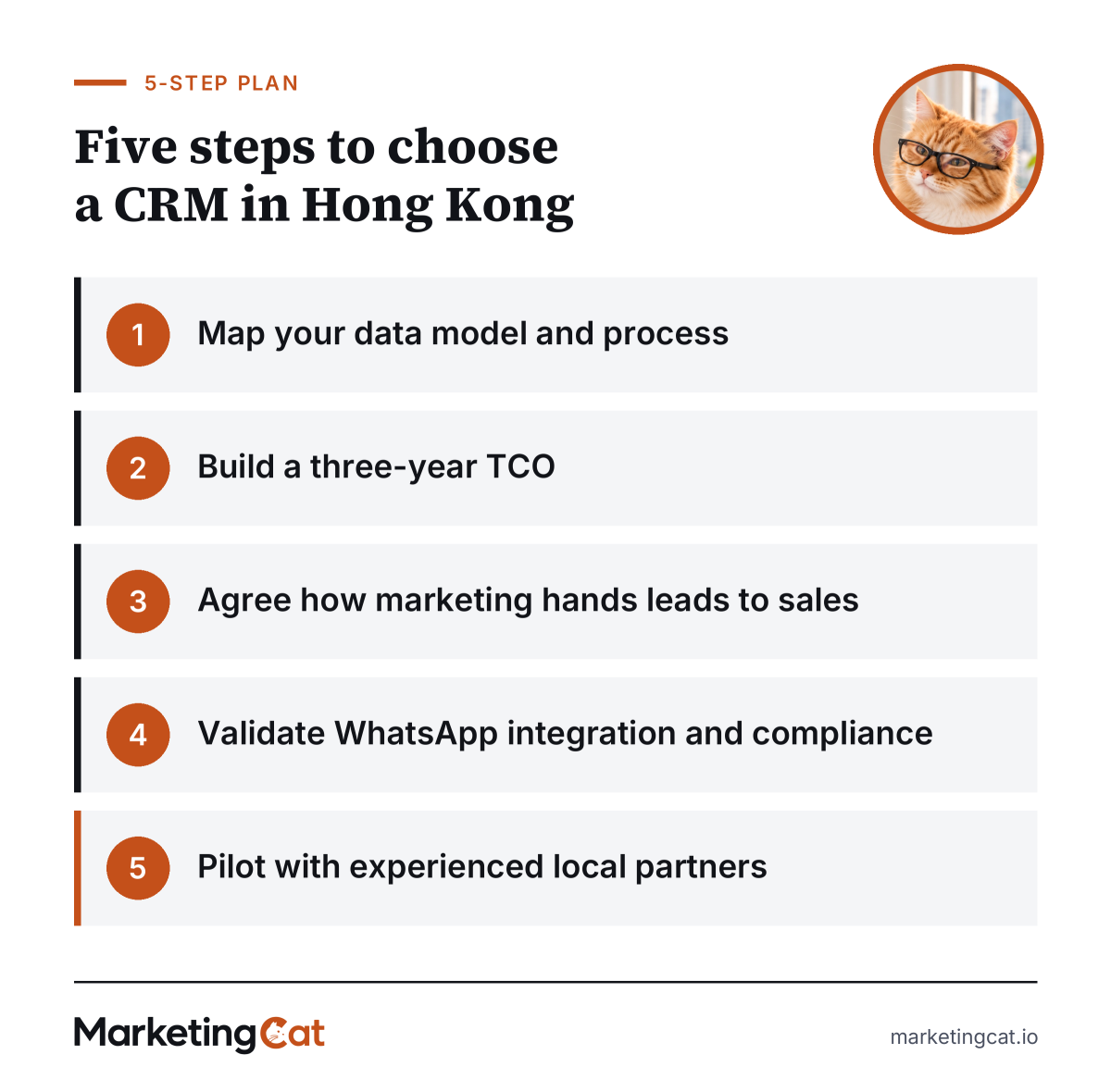
Five steps to choose a CRM in Hong Kong
- Map your data model and process: the head of sales and the operations lead list every record type beyond companies, contacts and deals (such as contracts, equipment or subsidiary levels) and any approval rules, producing a data-model list that shows whether the team needs HubSpot Enterprise or Salesforce’s customisation.
- Build a three-year TCO: finance and the marketing lead get quotes for each cost line above and produce a three-year cost sheet that shows licences, marketing automation, implementation, admin staffing, integrations and support separately.
- Agree how marketing hands leads to sales: the heads of marketing and sales agree in writing on lead definitions, routing rules and owners, and on whether marketing will use the same system.
- Validate WhatsApp integration and compliance: sales ops and the compliance lead test whether the native feature or a connector syncs chats to the right account record, and check consent, unsubscribe and sender settings, producing an integration test log.
- Pilot with experienced local partners: the project sponsor has each shortlisted partner run the same script on the same anonymised data and records the results on the scorecard below, with a decision to sign, revise or stop.
Pilot script: five tasks to test
Ask each platform to complete these tasks live, on the same anonymised data, rather than in slides:
- Create a lead from a web form.
- Create a linked company account with several contacts.
- Route the lead to the right sales rep by rule.
- Log a WhatsApp conversation to the right contact.
- Export a pipeline report built from HKD, CNY and USD deals.
Remove personal data before uploading anything. Repeat the key tests and record every configuration and result.
MarketingCat template: Hong Kong B2B CRM selection scorecard
Score each criterion from 1 to 5 and calculate a weighted total. As a suggested approval threshold, look for a weighted score of 3.5 or more with no criterion below 2; adjust the weights and threshold to your needs. It’s a planning aid, not a validated scoring model.
| Criterion | Evidence to ask the partner for | Weight | HubSpot (1–5) | Salesforce (1–5) |
|---|---|---|---|---|
| Custom objects and ERP integration | A two-way sync demo on your data model | 20% | ||
| Marketing automation and its extra cost | A written quote for the marketing products | 20% | ||
| Admin workload | An estimate of weekly admin hours | 15% | ||
| WhatsApp sync and compliance | A demo of sync, contact matching and unsubscribe handling | 15% | ||
| Multi-currency reporting | A consolidated report from HKD, CNY and USD deals | 15% | ||
| Local partner support | Where the delivery team sits, Cantonese support and a phased timeline | 15% |
Illustrative example: first-year list prices for a 15-rep team
Illustrative example, not real client results. A 10-year-old Hong Kong supplier of industrial machinery and automation components serves 45 active manufacturing clients across the Greater Bay Area. It has 15 sales reps, an average deal size of HKD 180,000 and about 225 WhatsApp touchpoints a week. It assumes up to 13 contacts per client account, at most 585 people in all; that’s a planning assumption, not a claim that every deal involves 13 people.
The subtotals below cover only some list-price items, for products that don’t match feature for feature, so they aren’t a full cost comparison. Read the notes under the table before comparing them.
| Item (US$, list price before tax) | HubSpot | Salesforce |
|---|---|---|
| Sales seats (15, billed annually) | Sales Hub Professional: 15 × 90 × 12 = 16,200 | Pro Suite: 15 × 100 × 12 = 18,000 |
| Marketing automation (billed annually) | Marketing Hub Professional: 800 × 12 = 9,600 | Account Engagement+ Growth+: 1,250 × 12 = 15,000 |
| One-time vendor onboarding | 1,500 + 3,000 = 4,500 | Not listed on the pricing pages |
| First-year list-price subtotal (partial) | 30,300 | 33,000 |
| Sensitivity check: if Salesforce Core is needed | – | Core seats 15 × 195 × 12 = 35,100, plus Account Engagement+ Growth+ 15,000 = 50,100 |
This compares list prices only. It leaves out partner implementation, admin staffing, WhatsApp add-ons or connectors, integrations and support. The capabilities aren’t fully matched either: this company needs multi-currency reporting and WhatsApp, and the HubSpot stack in the example (with Marketing Hub Professional) is documented for both. Salesforce’s documentation lists multi-currency and WhatsApp messaging for Enterprise-level editions, with a messaging add-on, so confirm with Salesforce whether Pro Suite includes them. If a higher suite such as Core is needed, the seat line becomes 15 × 195 × 12 = US$35,100, and with Account Engagement+ Growth+ the subtotal becomes US$50,100, still before WhatsApp add-ons, implementation, admin and support. That’s a sensitivity check on published list prices, not a quote or a confirmed equivalent package. The marketing plans aren’t exact equivalents, either: Marketing Hub Professional includes 3 core seats and 2,000 marketing contacts, and Account Engagement+ Growth+ includes 10,000 contacts; the example’s maximum of 585 contacts fits within both, but more than three marketers using Marketing Hub would need extra core seats. If the company hires a dedicated administrator, SleekFlow’s estimate puts that at HKD 480,000 to 720,000 a year, which could dwarf the licence gap. So put admin, implementation and integration scenarios into the three-year cost sheet as a sensitivity check, rather than judging on first-year licences.
Choose one primary KPI for the pilot. SleekFlow’s rollout roadmap targets 80% of new deals entered in the CRM within 24 hours of first contact, which is a useful reference. Measure your current baseline first, then run the pilot over a full quote cycle. Our guide to measuring B2B SEO ROI covers how to link CRM and closed-deal data to judge marketing.
How to shortlist local partners
HubSpot’s partner directory under its Hong Kong filter also includes firms based outside Hong Kong, such as Australian and Singapore-based agencies. Ask each partner where its delivery team sits and whether it supports Cantonese. Our sources don’t cover Salesforce partners in Hong Kong, so ask Salesforce for a local partner list and compare them on the same scorecard.
Which should you choose?
- Test HubSpot first if your process follows a fairly standard funnel, marketing and sales share one funnel, and no one will run the CRM full-time. SleekFlow also cautions that Salesforce may not suit sales teams of fewer than 20.
- Test Salesforce first if you need multi-level subsidiary accounts, complex approvals or territory rules, or two-way ERP syncs, and you’ll fund an administrator or RevOps resource. SleekFlow also points to Hong Kong arms of multinationals that already run Salesforce globally, and to regulated firms that need audit trails.
- If you’re split, let steps 1 and 2 of the framework decide, and compare both platforms on the same criteria.
- Don’t sign yet if you still can’t say who will run the CRM each week and for how many hours.
What are the limits of this comparison?
Features and prices here come from the two vendors’ own pages, checked on 6 November 2026. A documented feature isn’t necessarily in the edition you buy, or as good in a trial. Implementation, admin salary and WhatsApp figures come from consultancies and integration vendors with commercial interests, and aren’t market benchmarks. We haven’t independently compared the Traditional Chinese interfaces or Chinese-language AI performance. MarketingCat hasn’t tested either platform and has no screenshots of either CRM app in use. The cover shows screenshots of the two vendors’ public pricing pages, captured on 6 November 2026, not of the products themselves.
Feature lists won’t settle this decision; ownership and full cost will. If your process is fairly simple, test whether HubSpot can handle it; if it’s already complex, budget for an administrator and compare Salesforce on the same scorecard. This week, write down who will run the CRM and for how many hours, and list the three reports leadership needs every month. For tools around either CRM, see our roundup of B2B lead generation automation tools, and for the channels and outreach rules that feed the CRM, our guide to B2B lead generation in Hong Kong.
Frequently Asked Questions
Which is cheaper for a small B2B team, HubSpot or Salesforce?
On the list prices we checked on 6 November 2026, HubSpot usually costs less to start: Sales Hub Starter is US$20 a seat a month undiscounted (new customers are offered US$7 paid annually or US$10 monthly), against US$25 a user a month for Salesforce Starter Suite, and both have a free tier. The comparison changes once you add marketing automation: HubSpot Marketing Hub Professional is US$800 a month with an annual commitment plus a required US$3,000 onboarding, while Salesforce’s Starter and Pro Suites include some marketing features and its dedicated B2B automation starts at US$1,250 a month. Price your actual seats, contacts and onboarding over three years before you decide.
Is there a free version of either platform?
Yes, with limits. As of 6 November 2026, HubSpot’s official pricing page lists its free CRM for up to two users and 1,000 contacts, with no time limit. Salesforce’s edition comparison lists a Free Suite at US$0 a user a month, and Salesforce offers 30-day free trials. A free tier is useful for testing whether your team will use a CRM, not for proving that the paid tiers suit your process; check each one’s limits and scope on the vendor’s own page.
Can we pay or be quoted in Hong Kong dollars?
The official pricing pages we checked list US dollars. Salesforce’s currency converter offers US dollars, Australian dollars, British pounds, euros, Japanese yen and Swedish kronor, but not Hong Kong dollars; HubSpot lists US dollars, subject to tax. Ask vendors or local partners for a written quote that confirms the billing currency and who bears exchange-rate risk.
Should we sign monthly or annual contracts?
That depends on the tier. Salesforce bills Starter Suite monthly or annually, and Pro Suite and above annually. HubSpot Sales Hub Professional can be paid monthly, but still commits you for a year. Finish the pilot and the cost sheet before committing to a year, and negotiate add-ons, seat counts and onboarding fees in the same quote.
Are AI features included in the price?
Not always, so check by plan. Salesforce’s pricing page says AI can be added to Core and above, and Max includes Agentforce for Sales. HubSpot plans come with different amounts of HubSpot Credits; Sales Hub Professional includes 3,000. Ask for expected usage and overage charges in the quote.
Do the AI features work in Traditional Chinese or Cantonese?
The sources we reviewed don’t compare Traditional Chinese interfaces or Cantonese AI performance. Add language tests to your pilot script: log a Cantonese call summary, draft a Chinese email and export a report with Chinese company names, and repeat each test. Have a person review any customer-facing output.
Can marketing use HubSpot while sales uses Salesforce?
Yes, but budget for integration and upkeep. If the two systems run side by side, the pilot should confirm lead handoff rules, which way data syncs and who owns the link. Scalable Operations also advises checking whether a problem lies with the platform or the setup before switching; it says many “too complex” complaints come from years of unmanaged customisation.