
BUD Fund 2026: New Markets, Easy BUD Rules & Cash Flow
Qatar and Uzbekistan joined the BUD Fund on 2 November 2026. Easy BUD pays up to HK$150,000, but covers at most 25% of eligible costs and reimburses only after the project ends. Here are the route rules, the marketing costs it can fund and the cash you need.
Meowket's take A grant lowers the cost of a test; it doesn't prove the market is worth entering. Make the business case first, then check which costs Easy BUD can reimburse, and make sure finance can carry the full spend until the money comes back.

Qatar and Uzbekistan joined the BUD Fund’s eligible markets on 2 November 2026, according to the BUD Fund website run by the Hong Kong Productivity Council (HKPC). Easy BUD can now support up to HK$150,000 per approved application. But the government covers at most 25% of eligible costs, and Easy BUD reimburses after the project is completed rather than paying anything in advance. A company may therefore need to fund all of the spending before it receives the grant.
This guide sets out which overseas marketing costs Easy BUD can consider, how it differs from a General Application, and how to plan a first-market test that your finance team can afford even if the reimbursement arrives later than planned. The rules below were checked against HKPC’s current guidance on 9 November 2026.
Key Takeaways
- From 2 November 2026, General Applications and Easy BUD cover Qatar and Uzbekistan, taking the fund to 50 economies. E-commerce Easy still covers only the Chinese Mainland and the ten ASEAN member states.
- Easy BUD pays up to HK$150,000 per application, matched 1:3. Its audit fee is capped at HK$5,000, projects must finish within 12 months, and there is no initial payment: the grant is reimbursed after the final report and audited accounts are accepted.
- Advertising, exhibitions and company websites aimed at the target market are listed Easy BUD measures. Market research and AI tool subscriptions are not, so check each cost line before it enters the budget.
What changed in the BUD Fund on 2 November 2026?
HKPC says the BUD Fund’s geographical scope was expanded to Uzbekistan and Qatar for General Applications and Easy BUD from 2 November 2026. Eight markets had already been added on 15 June 2026: Saudi Arabia, Bangladesh, Egypt, Hungary, Pakistan, Kazakhstan, Mongolia and Brazil. The Guide to Application (General Application), updated to version 11/2026 with effect from 2 November, now lists all 50 economies in Annex 1, including Uzbekistan and Qatar.
For companies looking at the Gulf or Central Asia, Qatar now sits alongside the United Arab Emirates, Saudi Arabia, Kuwait and Bahrain, and Uzbekistan alongside Kazakhstan. E-commerce Easy is a separate route that still covers only the Chinese Mainland and the ten ASEAN member states, so it can’t fund an online store aimed at Doha or Tashkent, though Easy BUD’s online sales platform measure (4.8) can be considered.
One more 2026 change matters for event budgets. HKPC says the SME Export Marketing Fund has been merged into the BUD Fund, and that companies can keep joining exhibitions and events targeting markets outside Hong Kong through Easy BUD.
Easy BUD vs General Application: how do the rules differ?
The two routes share the 1:3 matching ratio, but they differ on the audit fee, the project period, when the grant is paid and what they can fund. Plan an Easy BUD test with the Easy BUD rules, not the General Application timetable. The table draws on the Easy BUD Guidance Notes (version 06/2026) and the General Application Guide (version 11/2026).
| Item | Easy BUD | General Application |
|---|---|---|
| Funding ceiling | Up to HK$150,000 per application, subject to approval | Up to HK$800,000 per project, audit fee included |
| Matching ratio | Both 1 (Government) : 3 (enterprise). The Government covers at most 25% of total approved project cost; the company pays at least 75% in cash. | |
| External audit fee | Up to HK$5,000 per audit, counted within the HK$150,000 ceiling and matched 1:3 | Up to HK$10,000 per audit, matched 1:3 |
| Project period | Must finish within 12 months; no extension beyond that | Must finish within 24 months; no further extension |
| Grant payment | No initial payment. Reimbursed after the final report and final audited accounts are accepted | Optional initial payment of 20% of the approved government funding after the funding agreement is signed, with the balance after completion. Without it, projects of more than 18 months can claim a mid-term reimbursement of up to 50% of the approved government funding |
| What it can fund | Only the measures listed in paragraphs 4.1 to 4.10 of the Guidance Notes, such as advertising, exhibitions and a company website for the target market | Branding, upgrading and restructuring, and promoting sales; fundable costs are listed in Annex 7 of the Guide |
| Who carries out the project | The Hong Kong applicant itself; its entity in the target market may not implement the project | A target-market entity may implement part of the project if the applicant proves an eligible investment relationship |
| When to apply | All year, processed continuously; one application every three months. Results normally within 30 clear working days of a complete application | In batches; the current cut-off is 31 December 2026 (23:59 HKT). One application every three months |
| Shared limits | Cumulative funding of HK$7,000,000 and up to 70 approved projects per enterprise. The total approved funding for approved and ongoing projects across all routes can’t exceed HK$800,000 at any one time. | |
Last verified: 9 November 2026, against the Easy BUD Guidance Notes (version 06/2026, paragraphs 2.1 to 7.2), the Guide to Application for General Application (version 11/2026, effective 2 November 2026, paragraphs 1.3, 1.4, 2.1, 3.1, 3.2, 5.1 and 5.6, and Annexes 1, 2, 7, 8 and 9), the BUD Fund website and the Commerce and Economic Development Bureau’s reply to the Legislative Council of 1 April 2026. HKPC and the Government can change Easy BUD’s arrangements without prior notice, so check the current versions before you budget.
Which overseas marketing costs can Easy BUD cover?
Easy BUD can fund only the measures listed in paragraphs 4.1 to 4.10 of its Guidance Notes, and each must relate directly to developing the business in the target market. The listed measures most relevant to marketing teams are:
- Advertising in the target market (4.1): ads directly related to the project, with the related management fee fundable for up to six months. That covers online advertising in principle, but not every charge. Where the Easy BUD notes are silent, the General Guide applies, and its Annex 8 excludes deposits, bonuses and slotting fees for internet advertising.
- Exhibitions in the target market (4.2): booth rental, design and construction, transport of exhibits not for sale, promotion at the exhibition, and travel and accommodation for Hong Kong staff who attend.
- A company website for target-market sales (4.6): developing or enhancing the applicant’s website is a listed measure. Enhancing an existing company website is capped at HK$100,000 per application. Whether a particular translation, localisation, design or development invoice qualifies still has to be checked against the detailed cost rules.
- Promotional materials (4.7): flyers, brochures, catalogues, photos and videos for the target market, covering only the fees of external agents who design and produce them.
- Other measures: mobile apps (4.5), an online sales platform (4.8), trademark and other IP registration in the target market (4.3), and testing and certification that helps market access (4.4).
Some common marketing costs aren’t on the Easy BUD list. In the General Application’s scope (Annex 2, Promoting Sales), market research and strategy sit under Sales Channel Management, and the use of AI technology, such as sales automation and lead distribution, is a separate item. Neither is a standalone Easy BUD measure. The General Guide also lists subscription fees for generative AI tools among normal operating expenses that won’t be funded (Annex 8). If research or an AI project is central to your plan, look at a General Application. Being within its scope doesn’t automatically make a particular invoice fundable, though: each cost still has to fit Annex 7, avoid the exclusions in Annex 8 and pass the fund’s vetting. Our enterprise AI adoption roadmap covers how to scope such a project and handle customer data under Hong Kong privacy rules.

One rule applies to every line in the budget. Paragraph 1.3.2 of the General Guide bars costs that have received, or will receive, funding from other HKSAR Government schemes, statutory or subvented bodies, authorities in the target market or other sponsors, and applicants must declare such funding. The Easy BUD notes don’t set a different rule, so it applies to Easy BUD too. A booth already part-paid by an organiser’s subsidy needs checking before it goes into a BUD budget.
When is the Easy BUD grant paid, and how much cash do you need?
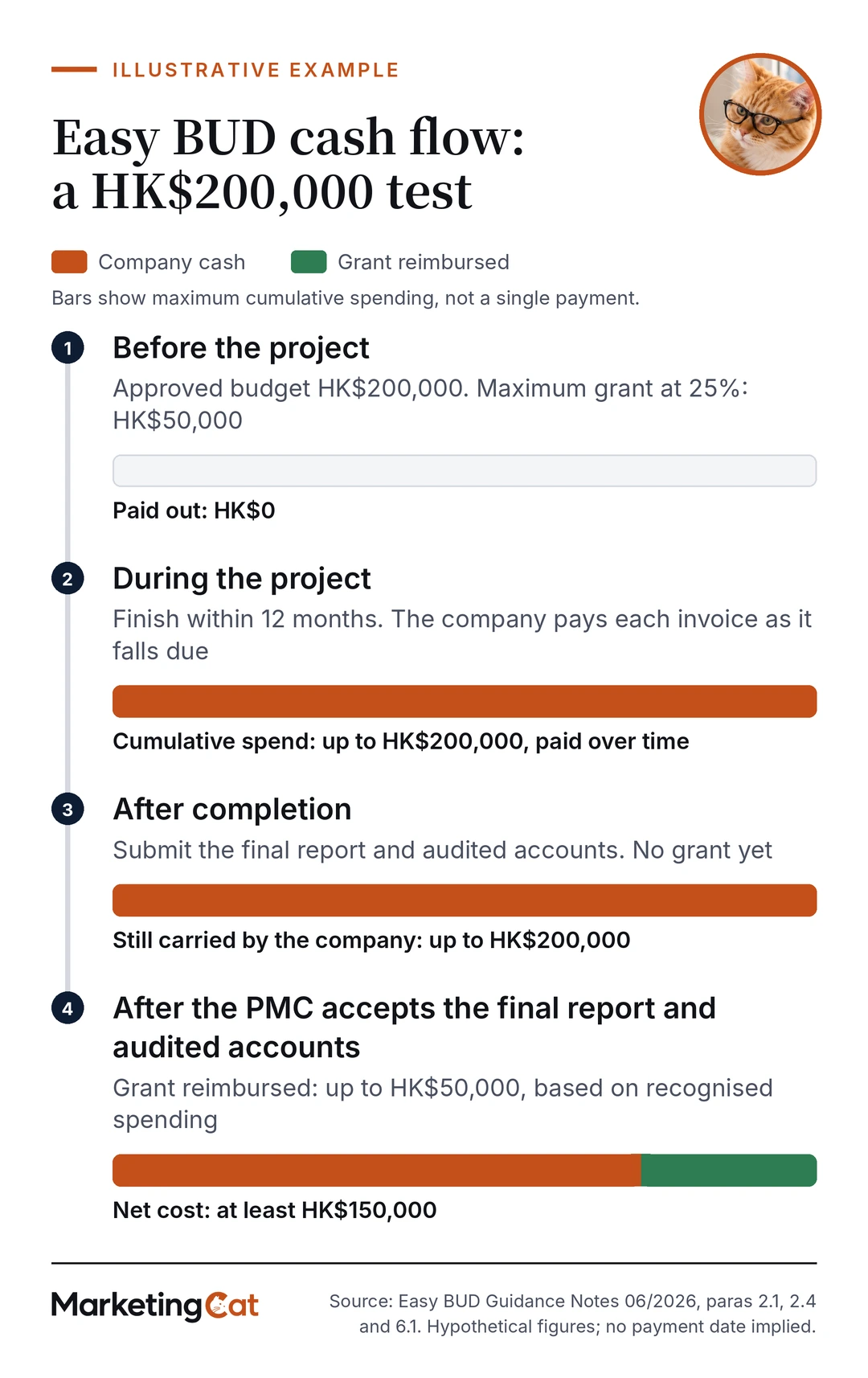
Easy BUD pays nothing upfront. Paragraph 6.1 of the Guidance Notes says there is no initial payment: the grant is reimbursed once the BUD Fund’s Programme Management Committee (PMC) accepts the final report and the final audited accounts, and the PMC sets the final amount from the expenditure it recognises. The company’s eventual share is at least 75% of approved costs. Because the grant arrives only at the end, the company may have to pay up to the full project cost itself before it is reimbursed, so it is prudent to plan cash on that basis. Spending builds up as invoices fall due, and the exact timing depends on supplier payment terms and on when the reimbursement is processed.
General Applications work differently. Applicants can opt for an initial payment of 20% of the approved government funding after signing the funding agreement, with the balance paid at the end (paragraph 5.1 of the General Guide).
Illustrative example, not a real case. A Hong Kong company plans an Easy BUD test with HK$200,000 of approved eligible costs:
- Maximum grant: HK$50,000 (25%), well within the HK$150,000 ceiling.
- Company’s final share: at least HK$150,000.
- Cash to plan for before reimbursement: up to HK$200,000, paid as invoices fall due.
- Project period: the project must be completed within 12 months; the final report and audited accounts follow.
To receive the full HK$150,000 at 25%, total approved project costs, including the audit fee, would need to reach HK$600,000. A company that can’t carry that sum until reimbursement should plan a smaller test.
To plan your own test, download our Easy BUD cash-flow worksheet (Excel). List each invoice by month with its Easy BUD measure and eligibility status. The sheet totals your cumulative spend and expected grant and, once you enter the actual reimbursement, updates the cash left against a buffer you set. It starts with the HK$200,000 example above; replace those rows with your own invoices.
Is Easy BUD enough for a first-market test?
For one or two markets with a clear scope, Easy BUD is often the right size. A broader brand or channel build that needs more than 12 months, or more funding than the HK$150,000 ceiling, fits a General Application better. Demand is real, and so is the paperwork. The Commerce and Economic Development Bureau’s reply to the Legislative Council on 1 April 2026 gave these 2025 Easy BUD figures:
- 1,330 applications received
- 301 approved, with an average grant of HK$68,000 when the ceiling was still HK$100,000
- 324 rejected
- 472 withdrawn, including applications that could not be processed because information was incomplete
These are calendar-year counts, not one cohort of applications, so don’t work out an approval rate from them. The same reply gives the bureau’s own figure instead: an Easy BUD approval rate of 60% as at the end of 2025. It also names the main reasons for rejection, including failing the requirement to have substantive business operations in Hong Kong and not having the licences needed to start business in the target market.

Illustrative example, not a real case. Take a Hong Kong logistics software company testing demand among freight forwarders in Uzbekistan and Qatar, with the HK$200,000 budget above, 60 named target accounts and a six-month campaign. A sensible primary KPI is qualified sales conversations, such as product demos booked with those accounts. Record the baseline before launch, meaning any existing contact with the 60 accounts. Log every conversation in your CRM with its first-touch source, and tag campaign links consistently with our UTM link builder. If you’re still choosing a CRM, see our HubSpot vs Salesforce comparison for Hong Kong B2B.
Keep expectations for six months modest. In an Ehrenberg-Bass Institute article, Professor John Dawes says up to 95% of business clients are not in the market for many goods and services at any one time, and presents the figure as a rule of thumb. Qatar and Uzbekistan are different markets, with different languages, buyers and rules. Localise the positioning, language and proof points for each, and write down each country’s assumptions and any licensing or legal requirements before launch. Keep the core offer and the account list fixed during the test so the results can be compared, record every change, and compare reported engagement with what sales hears from buyers.
At the end of the test, decide whether to:
- Scale into a General Application if the KPI moves and the conversations look like real opportunities.
- Revise the offer or the market if the evidence is mixed.
- Stop if neither market responds.
Our closed-loop guide to measuring B2B SEO ROI shows how to link touches to revenue without overstating credit; the same method works for paid campaigns.
Four steps before you submit
MarketingCat’s framework turns the official rules into four planning steps. It is a planning aid, not HKPC’s checklist. The references show where each rule comes from; the owners and outputs are our suggestions.

Four-step BUD market expansion plan
- Verify Hong Kong operations and the target market. Finance gathers proof of substantive Hong Kong operations. For Easy BUD, that means the latest audited accounts plus MPF records or sales invoices (Easy BUD Notes 3.1). General Applications accept evidence such as employee records, tax returns and contracts (Guide 2.1.2 and Annex 3). Marketing confirms the market is among the 50 economies and checks any licence, qualification or certification the target market requires, since applicants must declare compliance (Easy BUD Notes 3.1). Output: a one-page eligibility note.
- Choose the route by size and timeline. The marketing lead compares the funding the test needs and its length with Easy BUD (up to HK$150,000 of funding, which at 25% means about HK$600,000 of approved costs; 12 months) and General Application (up to HK$800,000 of funding; 24 months) (Easy BUD Notes 2.1 and 2.4; Guide 1.4.1 and 1.4.5). Output: a scope note listing the markets, measures and budget.
- Plan cash flow for reimbursement after completion. Marketing and finance build a month-by-month cash plan in which the company can fund the full spend until reimbursement and expects to carry at least 75% in the end (Easy BUD Notes 2.1 and 6.1). Output: a cash plan signed off by finance, for example in our cash-flow worksheet.
- Assign an internal project owner; verify external advisers. Management appoints a project coordinator and deputy from the company’s own staff, who know the business and can be reached directly. External suppliers and advisers can support the work, but they don’t lead it. Treat any adviser who claims HKPC appointment or endorsement as a warning sign: HKPC says it has appointed none (BUD Fund website). Output: named coordinators and a written role note.
What are the main risks and limits?
The biggest risk is outsourcing what HKPC expects you to own. HKPC, the fund’s implementer, says it hasn’t appointed or designated any consultancy to provide fee-charging services for the BUD Fund and hasn’t endorsed any consultant, and that any firm claiming such status is misleading applicants. Applicants are expected to prepare the application themselves and fully understand it. That doesn’t rule out outside help: Easy BUD itself funds external agents for some measures, such as designing promotional materials. It means the company, not an adviser, owns the application.
The coordinator and deputy must be the applicant’s own staff and can’t hand overall project management to a third party. HKPC may meet, interview or visit them at any stage. An application may be rejected if they can’t be reached directly, fail or refuse to attend a meeting without reasonable explanation, or can’t answer questions satisfactorily.
Three more rules catch companies out:
- One Easy BUD application every three months, whatever happened to the previous one: approved, withdrawn or rejected (Easy BUD Notes 7.2). An application made to get around a funding limit may be rejected (2.6).
- HK$800,000 at any one time. The total approved funding for approved and ongoing projects across all routes, Easy BUD included, can’t exceed HK$800,000 until their final reports are accepted.
- Procurement. The General Guide’s procurement section (5.6) requires probity, anti-collusion and anti-bid-rigging clauses in quotation invitations to suppliers, with templates in Annex 9.
This guide doesn’t cover rules in the target markets themselves, such as data and advertising rules in Uzbekistan or Qatar, and it isn’t financial or legal advice.
The new markets are worth a look, but the grant is the smaller part of the decision. In MarketingCat’s view, the company’s ability to carry the full spend until reimbursement, and the internal time the project needs, should weigh more than the 25% subsidy. This week, ask finance to model a test at your intended size, with the company paying every invoice until the reimbursement arrives. Then check each planned cost line against the Easy BUD Guidance Notes.
Frequently Asked Questions
Does Easy BUD also close on 31 December 2026?
No. HKPC’s cut-off of 31 December 2026 (23:59 HKT) is for the current batch of General Applications and E-commerce Easy applications. Easy BUD applications are accepted all year and processed continuously, so there’s no batch deadline to wait for, although each company can submit only one every three months. The BUD Fund Implementer answers enquiries on (852) 2788 6088 during office hours and at bud_sec@hkpc.org.
How long can an Easy BUD project run?
It must be completed within 12 months, and the project period can’t be extended beyond that (Easy BUD Notes 2.4). General Application projects must be completed within 24 months (Guide 1.4.5).
Our company already has a subsidiary in Qatar. Can it run the project?
It depends on the route. Easy BUD projects must be implemented by the Hong Kong applicant itself; implementation by its entity in the target market isn’t allowed (Easy BUD Notes 2.5). Under a General Application, a target-market entity can implement part of the project if the applicant proves an eligible investment relationship, for example by holding more than 50% of its shares (Guide 2.1.3 and Annex 4). Companies can apply whether or not they already operate in the target market (Guide 2.1.1).
Can we claim for a campaign that has already started?
Usually not. The General Guide says ongoing projects aren’t eligible unless the remaining part can run as a stand-alone project with separate, well-defined deliverables, clear start and end dates, and its own justified budget (1.3.3). The Easy BUD notes don’t set a different rule, so this general requirement applies.
Is the BUD Fund only for SMEs?
No. Both routes are open to non-listed enterprises registered in Hong Kong under the Business Registration Ordinance with substantive business operations here, in manufacturing or services (Guide 2.1.1; Easy BUD Notes 3.1). Easy BUD was set up mainly to help SMEs expand quickly, but its eligibility rule isn’t limited to them. Listed companies are excluded.
Can group companies apply separately to get more funding?
Not under the cumulative cap. Enterprises whose common shareholders hold 30% or more of each, and which share the same business nature, count as one enterprise for the HK$7,000,000 ceiling (Guide 1.4.3). Plan group projects as if they draw on one allowance.


