EMF Merged into BUD Fund: Easy BUD Rules & Cash Flow
Relying on frequent, standalone exhibition claims is no longer an option now that EMF has closed. Here is how to group trade fairs under Easy BUD, avoid the rolling HK$800,000 project limit, and structure upfront cash flow before applying.
Meowket's take Treating Easy BUD like the old fair-by-fair EMF claim process will bottleneck your budget. Bundle your annual regional expos into a unified project early so cash flow and approvals do not stall between events.
The SME Export Marketing Fund (EMF) was folded into the BUD Fund on 1 July 2026. Eligible businesses that used it for trade fairs, trade-press advertising and export websites can consider the BUD Fund’s three tracks for replacement funding: General Application, Easy BUD and E-commerce Easy. Hong Kong funding consultancy FundPilot’s transition guide warns that some EMF activities no longer have an equivalent. Below, MarketingCat maps each familiar activity to a track and sets out a five-step plan for budget holders.
Key Takeaways
- Easy BUD, the closest replacement for single trade fairs, funds up to HK$150,000 per application on a 1:3 matching basis. It pays nothing upfront and reimburses only after the final report and audited accounts are accepted, according to HKPC’s June 2026 Guidance Notes.
- BUD funds business in Mainland China and economies with trade or investment agreements with Hong Kong. Check every target market, including the US, against HKPC’s current list. EMF’s special measures for local-market Hong Kong exhibitions have ended.
- A HK$800,000 limit applies to all approved and ongoing BUD projects at any one time, across all three tracks. This makes bundling fairs into planned projects more important than filing one claim per event.
What changed when EMF merged into the BUD Fund?
EMF has closed, and its export-promotion role has passed to the Dedicated Fund on Branding, Upgrading and Domestic Sales (BUD Fund), which the Hong Kong Productivity Council (HKPC) administers. The Trade and Industry Department announced the consolidation in March 2025. It said EMF would be merged into BUD when its special measures expired on 30 June 2026, so that firms could promote “in the context of upgrading and transformation”. The government’s SME Link portal now tells enterprises to use Easy BUD for exhibitions and activities that target markets outside Hong Kong.
For marketing teams, three changes matter more than the headline ceiling.
- Markets: eligibility depends on the BUD list of target markets.
- Structure: funding follows projects, which can combine several measures.
- Cash: on Easy BUD, the company carries the whole cost until reimbursement.
Which markets still qualify?
In March 2025, the government said BUD supports business in 40 economies that have free trade agreements and/or investment agreements with Hong Kong. HKPC’s BUD Fund homepage has since announced two expansions of the General Application and Easy BUD scope:
- from 15 June 2026: Saudi Arabia, Bangladesh, Egypt, Hungary, Pakistan, Kazakhstan, Mongolia and Brazil;
- from 2 November 2026: Uzbekistan and Qatar.
FundPilot’s article says Brazilian shows fall outside BUD, but HKPC’s own notice lists Brazil from 15 June. Check the current official list rather than any secondary summary, including this one. None of HKPC’s expansion notices in our sources mention the US, so confirm any US-focused fair or advertising against that list before budgeting.

Which BUD Fund track suits a single trade fair versus a wider marketing plan?
Easy BUD fits a single fair or a small bundle that can be finished within 12 months, with a government share of up to HK$150,000. General Application suits a larger, multi-measure export programme; confirm its project-period rules in its current guide. E-commerce Easy is aimed at online selling, so check its geographical scope in its own guide. All amounts are “up to” and subject to approval.
The Easy BUD rules below come from HKPC’s Easy BUD Guidance Notes. The 2026 market additions come from HKPC’s homepage, because the notes don’t contain that list. FundPilot’s figures for General Application and E-commerce Easy are unverified secondary summaries, so we’ve left them out of the table.
| Item | Easy BUD | General Application | E-commerce Easy |
|---|---|---|---|
| Per-project ceiling | HK$150,000 (para 2.1) | Not stated in our sources | Not stated in our sources |
| Assessment time | Under normal circumstances, 30 clear working days from receipt of a complete application with all required documents and clarifications (para 5.1) | Not stated in our sources | Not stated in our sources |
| Initial payment | None; reimbursement after final report and audited accounts (para 6.1) | Not stated in our sources | Not stated in our sources |
| Maximum project period | 12 months, no extension (para 2.4) | Not stated in our sources | Not stated in our sources |
| Markets | Mainland plus agreement economies; 2026 additions per HKPC | Same scope; 2026 additions per HKPC | Not stated in our sources |
| When to apply | All year; one application every three months (paras 7.1, 7.2) | Batches; current cut-off 31 Dec 2026, 23:59 HKT (HKPC) | Batches; current cut-off 31 Dec 2026, 23:59 HKT (HKPC) |
| Matching ratio | 1:3; government up to 25%, firm at least 75% in cash (para 2.1) | Not stated in our sources | Not stated in our sources |
| Audit-fee cap | HK$5,000 per audit, matched and counted in ceiling (paras 2.1, 4.10) | Not stated in our sources | Not stated in our sources |
| Marketing it can fund | Ads, exhibitions, website, apps, promotional materials, online sales platform (paras 4.1–4.9) | Not stated in our sources | Not stated in our sources |
| Who implements | Applicant itself; not its entity in the target market (para 2.5) | Type (ii) projects: applicant itself (HKPC); more detail not in our sources | Not in our sources |
| Shared limits | HK$7m and 70 projects per enterprise; HK$800,000 approved across live projects at any time (paras 2.2, 2.3) | ||
Last verified: 16 November 2026, against HKPC’s Guidance Notes for Applications on Easy BUD (Version 06/2026, paras 2.1–7.3) and HKPC’s BUD homepage. The General Application and E-commerce Easy guides were not reviewed.
The shared HK$800,000 limit shapes the choice of track. Take a company with a large General Application project still open. The Easy BUD notes say that project counts against the limit until its final report is accepted, which can leave little room for an Easy BUD fair in the meantime. Sequence the tracks deliberately. For more on the newly added markets, see our BUD Fund 2026 overseas marketing guide.
How do your usual EMF activities map onto the BUD Fund?
Overseas fairs, trade advertising and export websites still have a route on Easy BUD, subject to market eligibility. Trade missions aren’t a listed Easy BUD measure, and EMF’s special measure for local-market Hong Kong fairs has expired. This mapping is MarketingCat’s checklist. It is built from FundPilot’s comparison with EMF’s nine funding scopes, set against HKPC’s Easy BUD notes.
| Former EMF activity | BUD route | Condition |
|---|---|---|
| Overseas fairs in agreement economies | Easy BUD; check General Application’s exhibition measure in its own guide | Market must be on the current list |
| Trade fairs held in Hong Kong | Check each track’s current guide for its Hong Kong exhibition rules | HKPC’s list of past approved Hong Kong exhibitions is for reference only |
| Hong Kong fairs for the local market only | No equivalent confirmed in our sources; check each track’s guide | EMF’s special measure for these fairs has expired |
| Trade publication and other advertising | Easy BUD (advertisements directly related to the project, para 4.1) | Within eligible markets |
| Export website build or upgrade | Easy BUD (para 4.6); check the other tracks’ guides | Upgrading an existing site: max HK$100,000 per application (Easy BUD para 4.6) |
| Physical or online trade missions | Not a listed Easy BUD measure; check the other tracks’ guides | Easy BUD covers travel and accommodation of the applicant’s Hong Kong staff for an exhibition (para 4.2) |
For Hong Kong fairs, check what the applicable track’s guide asks an application to show. HKPC publishes a list of Hong Kong exhibitions approved in the past. HKPC says the list is for reference only and that every application is assessed on its own merits.
What Easy BUD lists as fundable
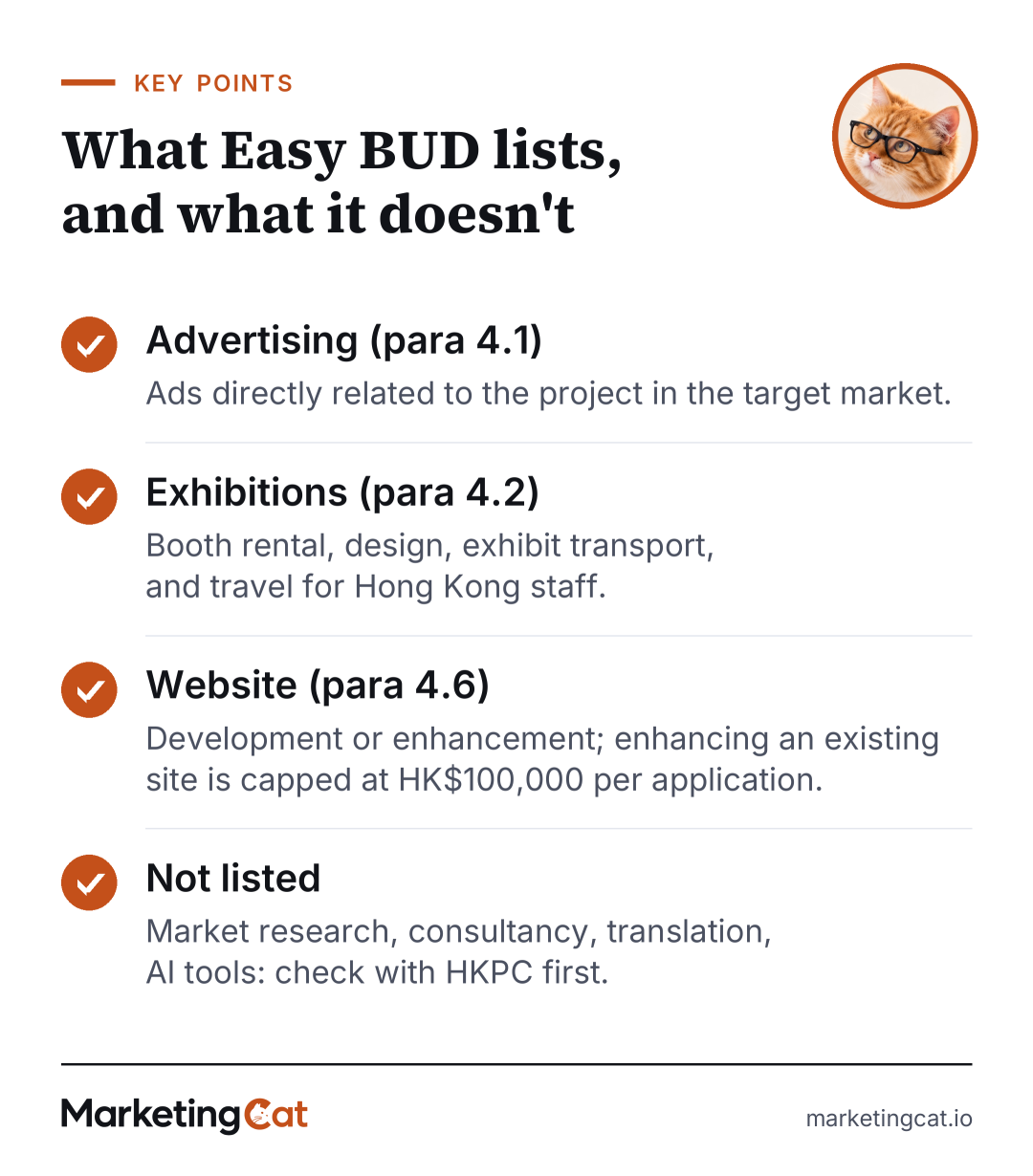
Paragraph 4 of the Easy BUD notes sets out the full funding scope. Each measure must relate directly to developing your business in the target market. In summary:
- Para 4.1: advertisements directly related to the project in the target market, with management fees for up to six months.
- Para 4.2: exhibitions in the target market. This covers booth rental, design and construction, transport of exhibits not for sale, and in-exhibition advertising. It also covers travel and accommodation for the applicant’s Hong Kong staff.
- Para 4.3: patent, trademark, design, utility model and copyright registration, capped cumulatively at HK$600,000 per enterprise.
- Para 4.4: testing and certification that eases market access, covering only external agents’ fees.
- Para 4.5: mobile apps that promote products or services in the target market.
- Para 4.6: company website development or enhancement. Enhancement of an existing site is capped at HK$100,000 per application.
- Para 4.7: flyers, posters, catalogues, photos and videos, covering only external agents’ design and production fees.
- Para 4.8: an online sales platform, with management fees for up to six months.
- Para 4.9: a combination of the above.
- Para 4.10: one external audit, capped at HK$5,000.
Several common marketing costs are missing from that list. Market research, strategy consultancy, translation and localisation, and AI tools are not listed. Travel that isn’t tied to an exhibition isn’t listed either. HKPC says it now gives more targeted support to BUD projects with AI elements, but our sources don’t detail it. Check these items with HKPC before budgeting for them.
What changes in planning, paperwork and timing?
Plan fewer, larger and earlier applications, owned by your own staff. Easy BUD allows one application every three months, whether the previous one was approved, withdrawn or rejected (para 7.2). Paragraph 2.6 adds that an application may be rejected if it is made to get around a funding limit. Splitting one campaign into several small claims is therefore a risk.
Paperwork starts with eligibility. Easy BUD is open to all non-listed enterprises registered in Hong Kong with substantive business operations here, not only SMEs. Applicants must show their latest audited accounts plus either MPF records or sales invoices (para 3.1). At the end of a project, reimbursement depends on a final report and audited project accounts (para 6.1).
HKPC’s homepage sets out ownership rules. The applicant must name its own staff as project coordinator and deputy coordinator. These staff cannot hand responsibility for managing the project to a third party. HKPC says it has not appointed any consultancy to provide fee-charging services. It also says applicants should prepare their own applications and fully understand them, and that false or incomplete information can lead to rejection or revocation. You can still use agencies for the work itself, such as booth design or ad buying. Your team, however, must own the application.
A five-step transition plan for budget holders
The framework below is MarketingCat’s planning aid, not an HKPC list. Steps 3 and 5 reference paragraphs of the Easy BUD notes. Steps 1 and 2 draw on HKPC’s market notices and FundPilot’s track comparison.
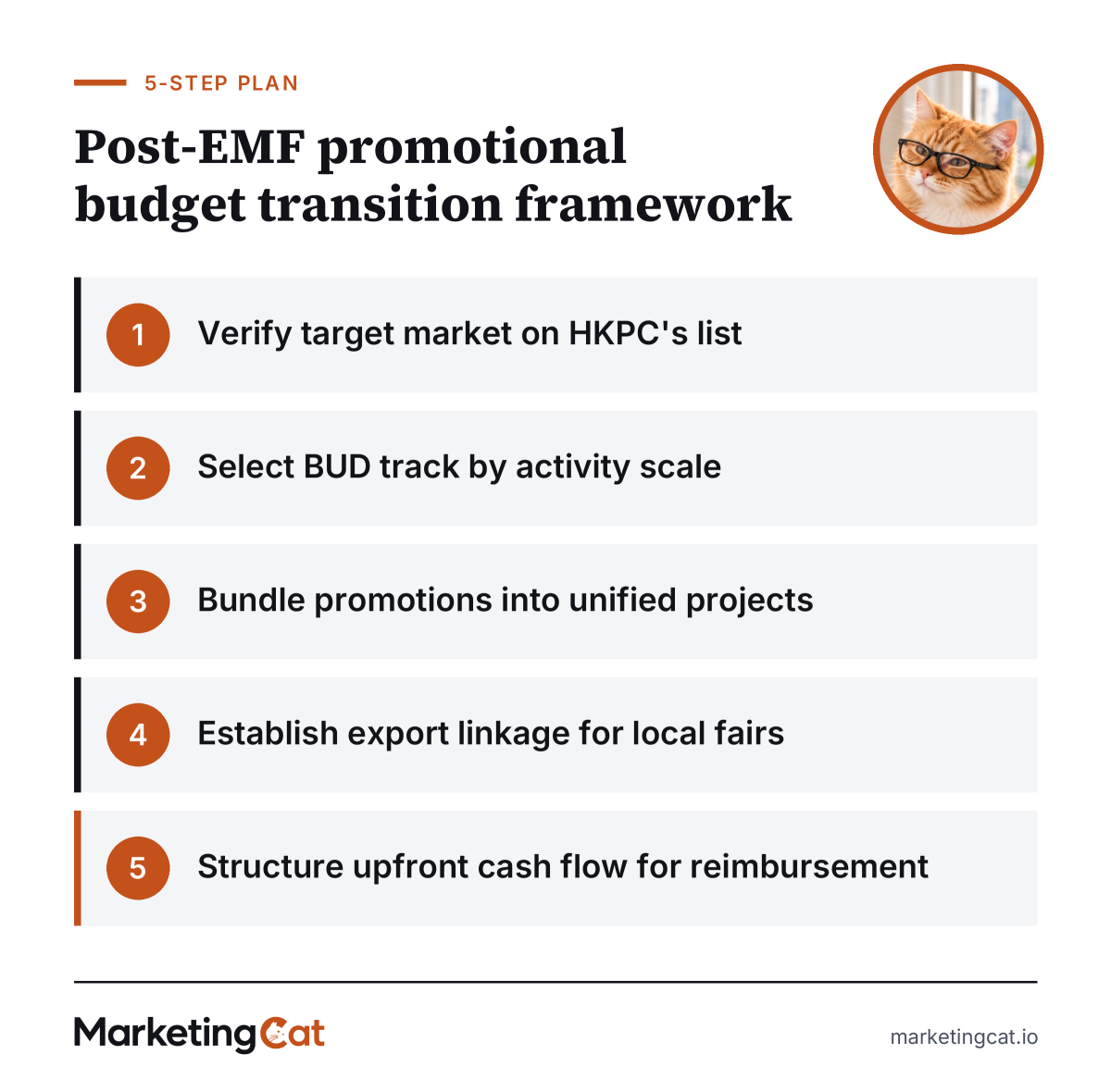
B2B Post-EMF Promotional Budget Transition Framework
- Verify target market against HKPC’s eligible-market list: the marketing manager checks every planned fair and ad market against HKPC’s current list of Mainland, free-trade and investment-agreement economies. The output is a signed-off eligibility sheet that flags any uncovered spend.
- Select BUD track by activity scale: the budget holder records a track decision, choosing Easy BUD for activity finishing within 12 months. General Application for longer programmes and E-commerce Easy for online selling are provisional choices until each track’s own guide confirms its duration and market rules.
- Bundle standalone promotions into unified projects: the marketing lead groups related fairs, ads and collateral into one project plan using the combination measure (para 4.9), with no artificial splitting (para 2.6).
- Establish export linkage for local exhibitions: as a MarketingCat precaution, the sales lead writes a one-page rationale showing how each Hong Kong fair builds business in a named target market.
- Structure upfront cash flow for reimbursement: for Easy BUD, the finance manager approves a cash plan that funds the firm’s 75% share and the full cost until reimbursement (paras 2.1, 6.1). Check the other tracks’ matching and cash-flow rules in their own guides.
Illustrative example: two fairs on Easy BUD
Illustrative example, not a real company or result. A Hong Kong B2B precision tooling manufacturer moves its regional trade show budget from EMF to Easy BUD to exhibit at industrial expos in Tokyo and Bangkok. That is two target economies, both within the markets FundPilot lists. The figures work like this:
- Total project budget: HK$200,000.
- Maximum government share at 25%: HK$50,000, well under the HK$150,000 ceiling, provided all costs are approved and recognised.
- Company’s cash share at 75%: HK$150,000.
- Audit fee: capped at HK$5,000, matched 1:3 and counted towards the ceiling.
- Deadline: the project must be completed within 12 months.
The prudent planning assumption is that the firm finds the full HK$200,000 first, because Easy BUD pays only after completion. Japan and Thailand also need their own positioning, language and legal checks, so the two fairs aren’t directly comparable.
How to judge whether it worked
In MarketingCat’s view, one primary KPI keeps the review honest. Use qualified opportunities associated with each fair, against a baseline from the last comparable edition. Judge it over a window that matches your sales cycle, not the 12-month project period. Scale up to a General Application if both markets produce pipeline. Revise or drop a market that doesn’t. Our Hong Kong B2B lead generation guide covers how to set that baseline.
What the sources don’t settle, and what to watch
This article relies on HKPC’s Easy BUD Guidance Notes (Version 06/2026) for Easy BUD rules. The General Application and E-commerce Easy guides (both dated 202611 on HKPC’s application page) were not in our research. FundPilot, a consultancy, summarises them, so check those guides directly. TID’s own EMF guidance was not in our research either. The EMF comparisons rely on FundPilot’s account and the government’s March 2025 announcement.
HKPC also reserves the right to change Easy BUD requirements at any time without notice. Our sources don’t say whether costs incurred before approval are recognised. This is not legal or financial advice. HKPC’s BUD Fund homepage recorded two added markets on 2 November 2026. Watch it and the TID’s BUD Fund page for further expansions.
EMF rewarded frequent, small claims. BUD rewards a planned export programme with clear market logic and cash set aside in advance. Teams that keep filing fair by fair risk running into the three-month rule and the HK$800,000 limit. This week, list every 2027 fair and ad market. Check each one against HKPC’s current market list, and decide which ones belong in a single Easy BUD project.
Frequently Asked Questions
Can we still claim EMF funding for an activity that ended before EMF closed?
Check with the TID, because our sources don’t include TID’s original EMF claim deadline or any exception rules. If you believe a claim was filed in time or is still pending, contact the TID’s EMF Branch on 2398 5127, the enquiry number given in the government’s March 2025 announcement.
Is Easy BUD only for SMEs?
No. HKPC’s Guidance Notes open Easy BUD to all non-listed enterprises registered under the Business Registration Ordinance that have substantive business operations in Hong Kong. Applicants must prove this with their latest audited accounts plus either MPF records for employees or sales invoices/receipts. They must also declare that they meet the licensing or certification requirements of each target market throughout the project period.
What happens if a fair is postponed beyond the Easy BUD project period?
Plan around it carefully, because the room to adjust is limited. HKPC’s notes say each Easy BUD project must be completed within 12 months with no further extension. A change request that extends the period by more than six months is also not allowed. Other changes follow General Application practice. If a fair’s dates are uncertain, confirm General Application’s project-period rules in its own guide before treating it as an alternative.
Does BUD give extra support for marketing projects that use AI?
Possibly, but the details aren’t in our sources. HKPC’s homepage says that from 15 June 2026 it offers more targeted funding support for BUD projects with AI elements. The Easy BUD funding scope doesn’t list AI tools as a separate measure. Ask the BUD Secretariat on 2788 6088 which track and measure an AI-driven campaign would fall under before you build it into a budget.