GTA 6 Marketing Strategy: A Five-Step Launch Framework
GTA VI launched on 19 November after years of tightly rationed reveals. Here’s how a Hong Kong B2B team can borrow that launch pattern on a small budget: a five-step framework, a launch scorecard and IP checks for newsjacking.
Meowket's take Stop spreading creative spend across weekly teasers. Pour your production budget into one thorough asset that answers every stakeholder's questions, then lock the release date.
Grand Theft Auto VI launched on 19 November 2026 on PS5 and Xbox Series X|S. The day before, Yahoo Finance reported that pre-orders had passed US$1.65 billion, according to an estimate from market intelligence firm Sensor Tower. For Hong Kong B2B marketers, the GTA 6 marketing strategy offers a useful pattern for a product launch or annual event: release a few big assets, leave long gaps between them, fix a date, and let customers and the press do much of the talking. This article turns that pattern into a five-step framework a small team can run, and adds a checklist for referencing the launch without IP trouble.
Key Takeaways
- The headline pre-order figures are third-party estimates. Sensor Tower put pre-orders at more than US$1.65 billion the day before launch, and Take-Two hasn’t published an official number.
- An Inc. column credits the launch to scarcity, patience and community-driven hype. Los Angeles magazine reports one example: pre-sales surged after a 27-minute “Extended Look” featurette premiered on Netflix in August. The game then launched on 19 November, the date Rockstar set after its second delay.
- Hong Kong teams can borrow the approach but not the brand. Keep GTA names, logos, key art and screenshots out of ads, and avoid any wording that implies a partnership.
What happened at the GTA VI launch?
GTA VI went on sale on 19 November on PS5 and Xbox Series X|S, the first new game in the series in 13 years. There’s no disc at launch: boxed copies contain a download code, Video Games Chronicle reported in June.
Los Angeles magazine compares the pre-order figure with roughly US$800 million in pre-sales for GTA V in 2013, a game it says has since sold more than 235 million units. It also reports projections that GTA VI could reach US$3 billion to US$4 billion before the end of 2026, which is a forecast, not a result.
The launch date has history. In a May 2025 Take-Two investor release, the company said the game, expected in autumn 2025, was now planned for 26 May 2026. Chairman and CEO Strauss Zelnick said the company supported “Rockstar Games taking additional time to realize their creative vision”. In November 2025 Rockstar moved it again, to 19 November 2026, and in May 2026 Reuters reported that Take-Two had reiterated that date even as it forecast annual bookings below Wall Street estimates. The game launched on schedule.
What does the GTA 6 marketing strategy actually show?
In MarketingCat’s reading, the reported featurette, the launch schedule and the commentary point to three things B2B teams can copy: concentrated long-form assets, a committed date and audience-driven buzz. Commentators describe the approach in similar terms. An Inc. contributor column from November 2026 credits “scarcity, patience, and community-driven hype”.
One long asset can do the heavy lifting
The 27-minute Extended Look featurette, released on Netflix on 27 August 2026, is the clearest example. Los Angeles magazine reports that pre-sales surged once it dropped. That’s a timing link, not proof that the featurette caused the jump. Even so, it suggests how much attention a single long asset can hold.
Paid media was expected too
The sources reviewed don’t disclose how much Rockstar or Take-Two spent on paid media. Fan news site Rockstar Intel reported in May 2026 that Take-Two’s CEO called the marketing “significant” and different from GTA V’s. The same report anticipated advertising online and across social media. So the lesson isn’t “skip ads”. The lesson is to put your budget into a few assets worth talking about, then let ads amplify them, if you use ads at all.
A fixed date gives everyone a reason to wait
After two delays, the 19 November date held and the game launched on schedule. For a buyer, a confirmed date turns vague interest into a calendar entry. For a sales team, it sets the deadline for follow-up. The delays also show the cost of announcing too early: every postponement has to be explained.

Why does this work for a B2B launch with a small budget?
Most business buyers aren’t in the market on your launch day. The Ehrenberg-Bass Institute’s 95-5 rule of thumb (John Dawes, May 2021) says up to 95% of business buyers are out of the market for many goods and services at any one time. Only about 5% are in the market in a given quarter. A memorable launch moment is meant to build recall among out-of-market buyers, so they think of you when they do start looking.
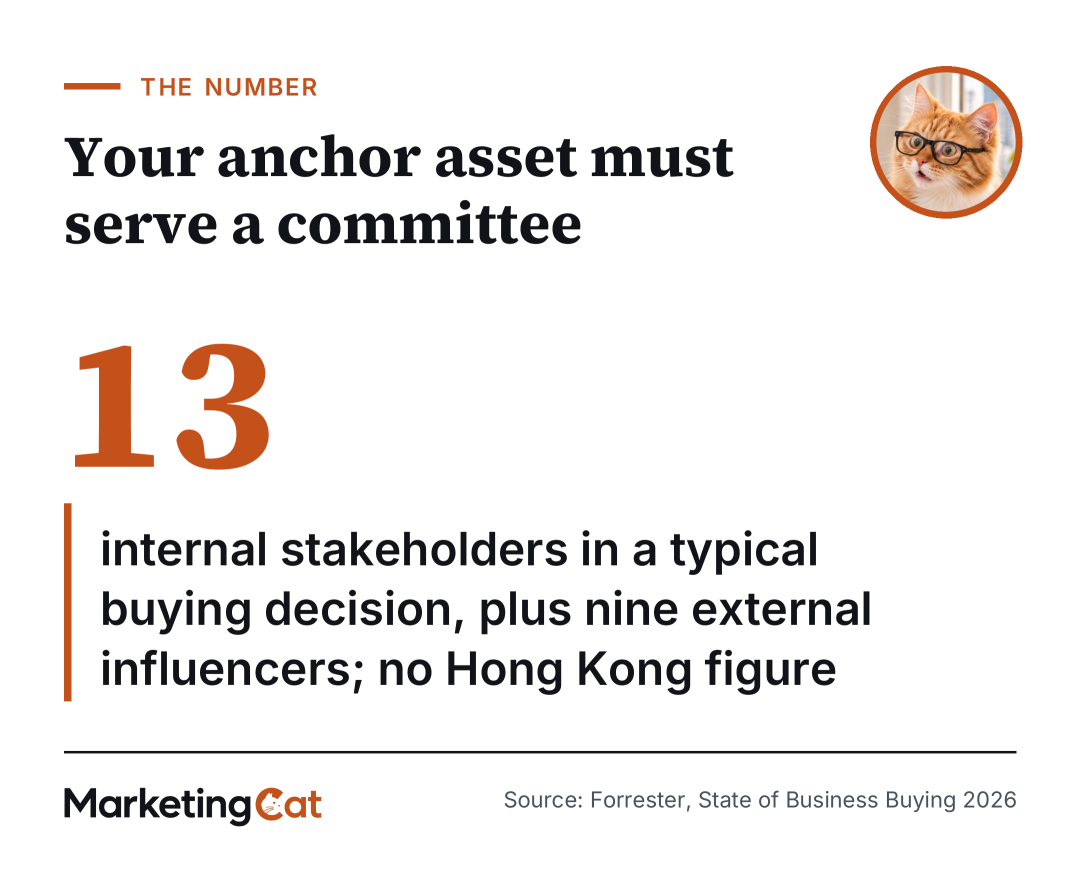
The anchor asset also has to serve a committee, not one reader. Forrester’s State of Business Buying 2026 release says a typical buying decision includes 13 internal stakeholders and nine external influencers. It gives no Hong Kong figure. A 90-second teaser can’t answer questions from finance, IT and operations at once, but a long walkthrough with a chapter for each role can. Our LinkedIn B2B content strategy guide covers how to cut it into supporting posts afterwards.
How can a Hong Kong B2B team apply it?
Start with the date and the anchor asset, because they decide the budget and the calendar. The silence, the advocacy and the compliance steps follow from those two decisions. Each step below names an owner and a written output. Treat the framework as a planning aid, not a proven model.

The Event-Led Launch Framework for B2B Marketers
- Impose content silence before launch. The head of marketing signs off a dated calendar that pauses low-value organic posts and keeps only essential customer and service updates (MarketingCat advice).
- Consolidate budget into anchor assets. Product marketing owns one long-form walkthrough, with a written brief mapping each chapter to a buying-group role (MarketingCat advice).
- Commit publicly to a date you can keep. The product lead and CMO record a go/no-go decision, and the date is announced only after delivery risks have been reviewed (MarketingCat advice).
- Empower user communities to drive buzz. Customer success produces a list of beta customers and partners who have agreed to preview the product and share honest reviews on launch day (MarketingCat advice).
- Apply Hong Kong IP compliance boundaries. Marketing operations completes the newsjacking checklist below, and legal signs it off before any topical creative goes live (based on Intellectual Property Department guidance).
A worked example
Illustrative example, not real client results. A Hong Kong B2B logistics software company is launching an enterprise AI dispatch platform to third-party logistics firms across APAC. It pauses routine posts for 45 days. It puts a HK$80,000 production budget into a 12-minute featurette with chapters for operations, IT and finance. It gives 30 VIP accounts an exclusive preview. Its target is 50 sales opportunities linked to the launch.
The cost lines to budget for are:
- featurette production
- preview session hosting
- staff time across marketing, product and customer success
- legal review
- any optional paid amplification
Invite only relevant contacts who have agreed to hear from you, and check Hong Kong privacy and electronic-message rules with your compliance team before you send anything.
For measurement, take your last launch as the baseline. Use one primary KPI: opportunities associated with the launch in the CRM. Judge it over a window that matches your sales cycle, not the 45-day silence. Views of the featurette are reach, not pipeline. If opportunities trail the baseline at the end of the window, change the asset or the audience before you change the date. Keep a record of what you changed so the next launch is comparable. The closed-loop measurement guide explains how to connect first-touch sources to deals, and our guide to lead generation in Hong Kong covers how to turn launch interest into qualified sales meetings.
MarketingCat’s template: launch scarcity vs fatigue scorecard
| Check | Score 0 (no), 1 (partly), 2 (yes) |
|---|---|
| Pre-launch silence: did the brand pause low-value posts at least 30 days before launch? | |
| Asset concentration: is 70% or more of the content budget in one definitive walkthrough rather than dozens of snippets? | |
| Milestone commitment: is a definitive date locked and communicated across all stakeholder channels? | |
| Buying group coverage: does the anchor asset answer the questions of your actual buying group? (Forrester’s typical 13 internal stakeholders is not an upper limit.) | |
| Advocacy enablement: are beta customers and partners briefed to share reviews on launch day? |
How do you newsjack GTA VI safely in Hong Kong?
You can comment on a global moment without borrowing the brand’s property. The Intellectual Property Department’s leaflet says an idea itself falls outside copyright protection. It also says prior permission should be obtained before using a famous copyright-protected character in a commercial product. So “what a 13-year wait teaches launch teams” is an idea you can write about, while screenshots, key art and trailer clips are the publisher’s copyright material, so ask counsel before you use any of them.
As a precaution, MarketingCat advises keeping the game’s names, logos, key art and screenshots out of commercial ads and social promotions, because using them without permission may create infringement risk. The leaflet says the Customs and Excise Department enforces the criminal aspects of IP infringement. It investigates complaints of trade mark and copyright infringement. The leaflet also notes that rights registered in Hong Kong aren’t automatically protected in the Mainland, so cross-border campaigns need separate checks.
A company name gives no cover either. The IPD’s Trade Marks Ordinance FAQ says registering a business or company name doesn’t give you the right to use it in ways that infringe someone’s trade mark. As a precaution, MarketingCat advises avoiding copy that implies an unauthorised affiliation, endorsement or partnership. This is general information, not legal advice. To check whether a name is registered in Hong Kong, search the IPD’s online trade marks register or ask counsel.
MarketingCat’s newsjacking checklist:
- Trade mark check: Are the game’s and publisher’s names, abbreviations such as “GTA”, and logos excluded from ads?
- Copyright check: Are game screenshots, key art, character stills and trailer clips left out of all collateral?
- No implied affiliation: Does the copy avoid wording that suggests endorsement, co-branding or partnership?
- Original theme adaptation: Is the creative limited to your own style references, such as a neon palette, without copying original elements?
- AI creative verification: If generative AI helped produce the graphic, was it made under your internal AI policy and the PCPD’s guidance?
On that last point, follow the PCPD’s generative AI checklist (March 2025) before drafting launch or topical creative with AI. Get internal approval and use company-approved tools. Remove or anonymise customer and prospect data first. MarketingCat also suggests checking the vendor’s terms on data retention and model training. Have a person approve anything published. Our PCPD guidance checklist goes further.
What to watch next, and the limits of this analysis
Take-Two’s own results, once it reports them, will be the figures to rely on. Every sales number in this article is a press estimate or projection. The sources reviewed include no official Take-Two or Rockstar figure for pre-orders, and nothing on Rockstar’s paid media spend or how it timed its trailers. Rockstar sells to fans who have waited 13 years for a new game in the series. A B2B vendor without that built-up demand should expect a smaller response to scarcity, and should test the approach on one launch before using it everywhere.
The strongest idea here is also the cheapest: say less, make what you say count, and pick a date you can keep. This week, take your next launch or annual event, score your current plan against the five scorecard checks, and cut one low-value content stream so its budget can go into the anchor asset.
Frequently Asked Questions
Can I mention GTA VI in a LinkedIn post about marketing lessons?
The IPD’s leaflet says an idea itself falls outside copyright protection, so the risk lies in using protected material rather than in the topic. An article analysing an idea differs from an ad that uses the game’s name, logo or images to sell your product. Keep official artwork and screenshots out. Avoid any suggestion of partnership. For paid posts, ask legal counsel, because the IPD’s materials are general information rather than advice for your situation.
Does a pre-launch content silence hurt SEO or social reach?
Possibly, and none of the sources reviewed measures this effect. A pause in routine posts may reduce short-term social reach. It doesn’t require taking pages offline or stopping updates to existing content. Keep evergreen pages live, keep answering customers, and pause only low-value posts. Compare organic traffic and engagement with the same period before the pause so you can see what the silence actually cost.
How long should a B2B launch featurette be?
The sources reviewed don’t establish an optimal length for a B2B featurette. Rockstar’s Extended Look ran 27 minutes, but it served an audience that had waited years. The illustrative example in this article uses 12 minutes, with chapters for different buyer roles. Set the length by the questions the buying group needs answered. Then check completion rates by chapter after launch to see where viewers drop off.
What if we have to delay a launch after announcing the date?
Announce the new date once, with a short reason, and don’t keep shifting it. Take-Two’s May 2025 release explained its move in terms of quality and named a specific new date. The lesson for B2B teams is to avoid the situation: commit publicly only after the product team has reviewed delivery risks. Keep the first announcement to a season if those risks remain open.