
B2B Anniversary Marketing: Lessons from McDonald’s Hong Kong
Your brand anniversary can generate views, PR and an expensive celebration — but how do you show its value to the sales pipeline? This guide uses McDonald’s Hong Kong’s 50th anniversary as a case study, then sets out a five-step B2B plan for turning customer stories into measurable opportunities.
Meowket's take Don't make your anniversary campaign a scrapbook about your company. Start with the customers who can tell a credible story about the problems you helped solve, then give sales a clear way to continue the conversation.

A company’s anniversary offers a rare chance to tell its history. But a film, gala or commemorative campaign doesn’t automatically give a prospective customer a reason to engage. For B2B marketing teams, the harder question is how to turn that milestone into stories buyers trust, conversations sales can follow up, and results the business can measure.
McDonald’s Hong Kong provides a high-profile example of a year-long anniversary programme. The Standard reported on 4 November 2026 that its 50th-anniversary activities had won nearly 200 industry awards since 2025, including the Grand Effie. Those awards support a discussion of creative reach and campaign design; they don’t, by themselves, establish financial ROI or predict B2B results. What a B2B firm can borrow is how the programme used different stories and events to reach the public, staff and business partners, and kept that material working for a whole year.
Below, we turn those moves into MarketingCat’s five-step plan and say which parts you can use as they are and which are only inspiration.
Key Takeaways
- The Standard reports that McDonald’s Hong Kong’s 50th-anniversary programme won nearly 200 industry awards. Awards reflect the industry’s view of creativity and execution; they don’t prove a sales return, and the public sources give no budget or revenue breakdown.
- What B2B firms can borrow is the structure (several audiences, content spread across the year), not the citywide activations. B2B buying is a group decision and under the 95:5 rule of thumb most clients are out of the market at any one time, so anniversary content has to keep reaching different roles for a year.
- Measure target-account pipeline as the main KPI, keeping new opportunities, opportunities advanced and closed deals apart, with an evaluation window set by your sales cycle. Before using event lists for email or remarketing, check Hong Kong’s privacy and electronic-messaging rules.
What did McDonald’s Hong Kong do for its 50th anniversary?
McDonald’s Hong Kong didn’t rely on one hero ad. It spread a series of activations across 2025, each aimed at a different audience. Most of the details come from a December 2025 SCMP feature that SCMP labels as produced by an advertising partner. Treat it as the company’s own account, not independent reporting.
- Where it started: Hong Kong’s first McDonald’s opened on Paterson Street in Causeway Bay in January 1975.
- The public: the year began with 50 Ronald McDonald benches placed around the city. On New Year’s Day 2025, a McDonald’s-themed Star Ferry offered free rides across Victoria Harbour, with a separate sailing arranged with Caritas Hong Kong for underprivileged families.
- Staff: more than 8,000 frontline employees attended a three-night annual dinner at AsiaWorld-Expo, including a reunion with colleagues from the first restaurant.
- Business partners: partners were hosted at an Appreciation Dinner at Rosewood Hong Kong, where the hotel’s chefs used McDonald’s ingredients in a fine-dining menu.
- Content: a microfilm, Back to the Beginning in 1975, recreated the opening of the first restaurant and was inspired by the true story of its first Restaurant General Manager. The set was later shown at West Kowloon Cultural District, with part of the proceeds supporting Ronald McDonald House Charities. The Standard separately reports that the 50th-anniversary exhibition at West Kowloon drew more than 30,000 visitors in three weeks.
Outdoor media company JCDecaux said in a February 2025 release that the Paterson Street tram shelter, across the street from the first restaurant, was turned into a classic McDonald’s restaurant. Trade publication Contagious reported in June 2025 that people could scan QR codes on the benches with the McDonald’s app as part of a citywide treasure hunt. Citing figures from the agency, Contagious reported more than 19 million views of the brand videos and more than 2 million people taking part in the bench game. Those are reach and engagement measures, not sales.
How did McDonald’s use anniversary stories to drive PR and brand conversation?
The public material points to four moves a B2B firm can learn from.
One story, many formats. The first manager’s story became a microfilm, the film set became an exhibition, and the exhibition was tied to a charity. A B2B firm can do the same with one customer interview: cut it into a short film, write it up as a case story and share it at a client event.
Places that tell the story. The tram-shelter ad sat opposite the first restaurant, and the benches were spread across the city. Placements like these give media and the public something to talk about and share.
Different audiences, different moments. The public, staff, business partners and the community each had their own event, spread across the year. That makes it a series rather than a one-off campaign.
A private event for business partners. The Rosewood dinner was for partners only, and it is the part of the programme closest to B2B.

When you report results to leadership, don’t treat awards as a business return; they show industry recognition. The sales, footfall and brand-score records mentioned in the advertising-partner feature are also the company’s own account. The sources reviewed don’t give the programme’s budget or media spend, so its return can’t be judged. The feature also notes the scale involved: McDonald’s Hong Kong operates 266 restaurants, employs about 18,000 people and serves around 1 million customers a day. Most B2B firms can’t copy that media weight. They can copy the architecture.
What can B2B firms borrow, and what shouldn’t they copy?
The part worth borrowing is the structure, several audiences reached in stages across a year, not citywide activations such as the Star Ferry. The reason lies in how many people take part in B2B buying, and when.
Forrester’s 2024 State of Business Buying release says an average of 13 people within an organisation are involved in a buying decision. Its 2026 release says the typical decision now includes 13 internal stakeholders and nine external influencers, and more for complex or strategic purchases. The two figures count different groups, so don’t combine or swap them, and neither is a Hong Kong figure. For an anniversary programme, it means the same set of stories has to address the concerns of finance, IT, procurement and outside advisers.
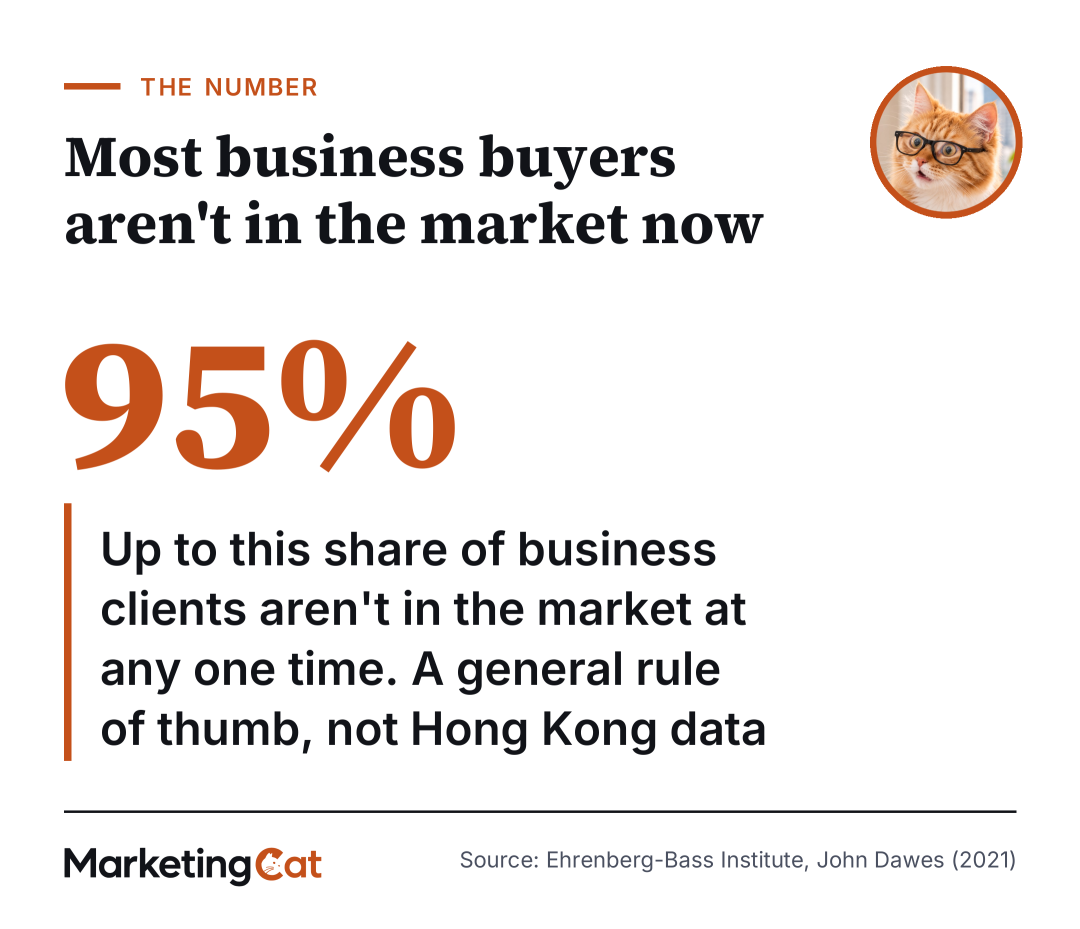
Professor John Dawes’s Ehrenberg-Bass Institute report from May 2021 sets out the 95:5 rule of thumb: for many goods and services, up to 95% of business clients aren’t in the market at any one time, and about 20% enter the market over a year, or roughly 5% a quarter. Dawes presents it as a rule of thumb, not a precise figure, and it isn’t measured Hong Kong data.
If most clients aren’t ready to buy now, a one-off anniversary ad usually reaches them once. Spreading content across the year gives you a better chance of being remembered when an account does move into the market.
The parts of the McDonald’s programme closest to B2B are the partner dinner and the staff stories. Both can be scaled down and pointed at your target accounts.
Five steps for a B2B anniversary: from company story to sales pipeline
The first step isn’t filming or booking a venue. It’s agreeing a pipeline goal; then you schedule content and events across the year and use the CRM to track how target accounts move. The five steps below are MarketingCat’s synthesis. Besides the McDonald’s case and the 95:5 rule of thumb, they draw on three vendor and agency guides, which are advice rather than independent research:
- B2B marketing vendor Pipeline360 recommends auditing existing content before building a strategy.
- Taiwanese engagement-tool vendor FeverSocial sets out a three-stage rhythm: a warm-up one to two months before the anniversary sale period, an on-site sprint, and an evergreen stage that runs all year. It wrote the guide for department-store retail counters, not for B2B.
- Taiwanese events agency UD168 suggests founder-interview videos and content before, on and after the event day.

Five steps for a B2B anniversary programme
- Audit the archive and set a pipeline goal: the marketing lead and head of sales gather old photos, stories and customer cases, choose the target accounts, and write a one-page goal sheet with the primary KPI, the baseline and the consent status of contact data (following Pipeline360’s content audit and FeverSocial’s warm-up stage).
- Gather true stories with founders and customers: the content lead interviews the founder, long-serving staff and long-standing customers who have agreed in writing. Each interview is cut into several versions, and each customer reviews and approves the quotes, photos and use of their name (following the McDonald’s microfilm and UD168’s founder interviews).
- Release in stages on LinkedIn, video and email: digital marketing releases one story a month by buyer role across LinkedIn, the website and email, following a 12-month calendar in both languages. Email goes only to contacts who have agreed to receive marketing (following Pipeline360’s channel advice).
- Host decision-makers from target accounts: the head of sales invites decision-makers from target accounts to a small dinner or roundtable, with an agreed follow-up for every attendee (following the McDonald’s Rosewood dinner and UD168’s client receptions).
- Keep following up and track pipeline in the CRM: marketing operations tags anniversary content and events in the CRM, nurtures or remarkets only to contacts with suitable consent, and reports each quarter on target-account engagement, new opportunities, opportunities advanced and closed deals (following FeverSocial’s evergreen stage and the 95:5 rule of thumb).
A Hong Kong example: a 12-month plan for a 25-year-old IT firm
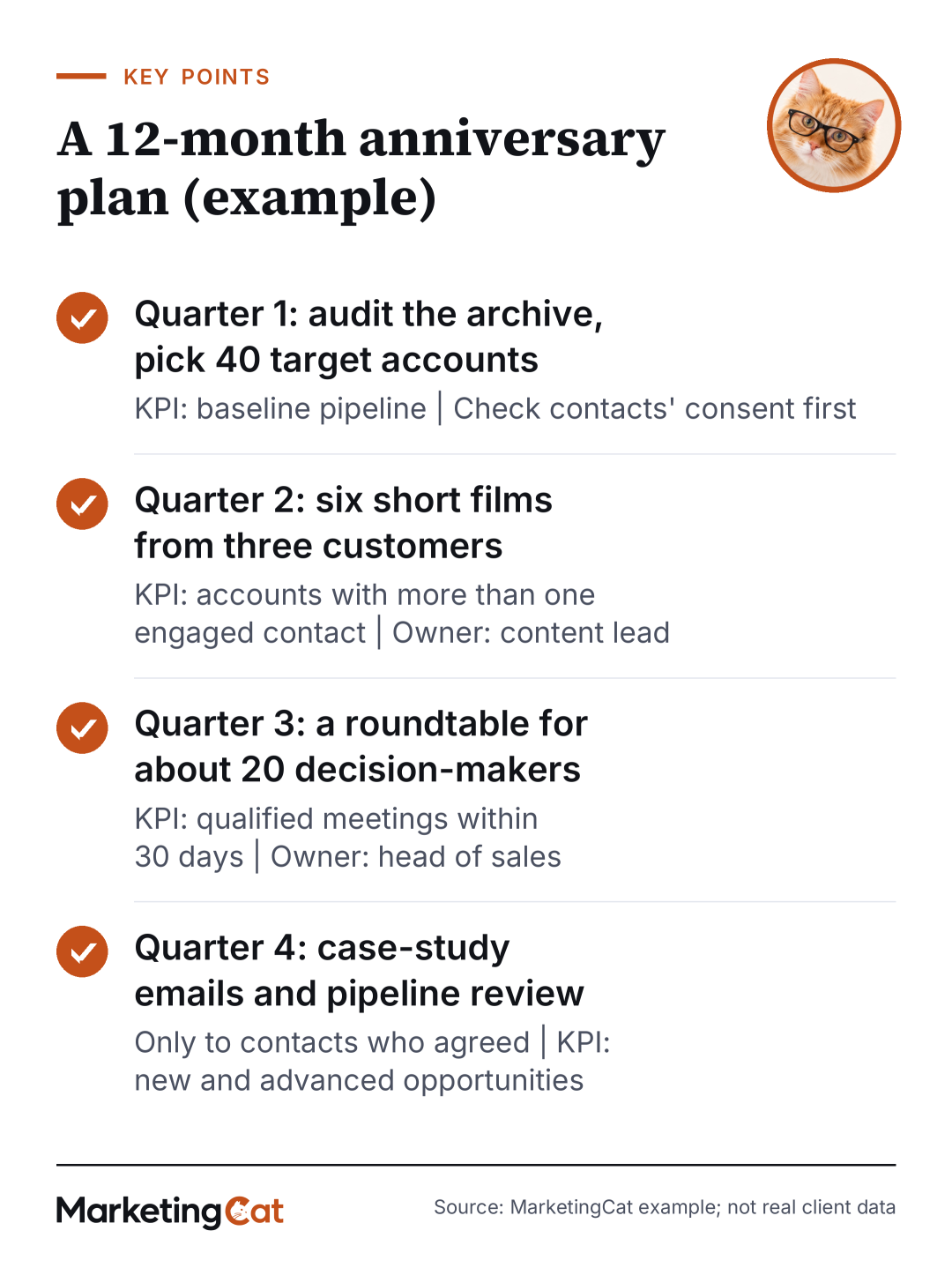
Illustrative example, not real client results. A Hong Kong IT support firm turning 25 sells mainly to the Hong Kong offices of regional banks.
| Quarter | Content and channel | For | Follow-up | KPI | Owner |
|---|---|---|---|---|---|
| Q1 | Gather photos and documents from past system migrations; choose 40 target accounts and set the baseline pipeline | Sales and senior leaders | Check the consent status of contact data | Baseline pipeline | Marketing lead, head of sales |
| Q2 | Three long-standing customers interviewed and cut into six short films, each about a real problem solved for one bank function (IT, compliance, finance); published on LinkedIn and the website with English and Chinese subtitles | Decision-makers in each function | Invitation to book a conversation | Target accounts with more than one engaged contact | Content lead |
| Q3 | Closed-door roundtable dinner for about 20 people | CIOs and department heads | Sales meeting with each within 30 days | Qualified meetings | Head of sales |
| Q4 | Case-study emails; pipeline review with sales | Contacts who agreed to receive marketing and watched a film or attended the event | Sales follow-up with each account | New and advanced opportunities | Marketing ops, sales |
The sources reviewed don’t give production costs. Budget for these cost lines:
- internal staff time, including marketing, sales and senior leaders’ time for interviews and approvals
- filming and editing
- translation, subtitles and bilingual editing
- venue and catering
- paid promotion
- CRM tagging and reporting set-up
A simple budget formula: total cost = internal hours × average hourly cost + outsourced production + venue and catering + paid promotion + tools and set-up. When you review it, remember that pipeline value isn’t revenue and revenue isn’t profit, so don’t set pipeline value against cost and call it a return.
Before you start, our B2B content audit shows how to check which existing content you can reuse.
How can a small team run it in English and Chinese?
The sources we reviewed include no case studies of small-budget Hong Kong B2B firms running bilingual anniversary programmes, so the approach below is MarketingCat’s analysis, not proven practice.
The cheaper route is to film once and publish twice: record each interview in the language the customer or founder speaks most naturally, then subtitle it in English and Chinese rather than reshooting. Written case stories need a native-speaker edit in each language, because a literal translation of a Cantonese interview reads stiffly in English, and the reverse is also true. If a buying group includes both local operations staff and regional head-office members, choose each piece’s main language by role.
When the budget is tight, the client event is the most flexible cost. A 20-person roundtable dinner may reach decision-makers more precisely than a large reception.
What should you check before following up with event contacts?
An anniversary programme uses personal data about customers, attendees and contacts, so follow-up needs a compliance check first.
- Direct marketing: the Privacy Commissioner’s overview of the Personal Data (Privacy) Ordinance says Part 6A requires informed consent before personal data is used for direct marketing. The person must be told of the intended use, the kinds of personal data and the classes of marketing subjects, and of their right to opt out; silence isn’t consent. The PCPD’s guidance on direct marketing adds that marketing sent to someone in their work capacity, about goods or services meant only for their organisation’s use, may fall outside Part 6A; it judges each case on its facts, and the data protection principles still apply.
- Electronic messages: under the Unsolicited Electronic Messages Ordinance, as summarised by OFCA, commercial electronic messages need clear sender information and an unsubscribe facility, and unsubscribe requests must be honoured within ten working days.
- Remarketing audiences: before uploading a CRM list to an ad platform, check where the data came from, what people agreed to, suppression and opt-out lists, retention periods and the platform’s own custom-audience policies.
- Customer stories: get the customer’s approval for quotes, photos, company names and logos before publishing.
Attending an anniversary event doesn’t give you unlimited permission to market to someone. Requirements depend on the data and the type of communication, so have legal or compliance colleagues confirm the approach before you run it. This isn’t legal advice.
How do you measure whether anniversary content builds pipeline?
Use target-account pipeline as the primary KPI and keep three things apart: new opportunities created, existing opportunities advanced, and closed deals. Awards, views and media coverage tell you about reach. They don’t tell you whether buying groups moved.
The programme can run for 12 months, but the evaluation window, or attribution window, should match your sales cycle. If your cycle runs about six months, for example, count opportunities that appear within about six months of an account engaging with anniversary content; that’s an example, so adjust it to your own data. New opportunities, progress and closed deals mature at different speeds, and an opportunity still open at a review isn’t a failure. Set the baseline from the same target accounts’ pipeline in the 12 months before launch. For more on joining up CRM and content data, see our guide on measuring B2B SEO ROI.
In reports, write “opportunities associated with anniversary engagement”, not “deals generated by the anniversary”. Attribution assigns credit; it doesn’t prove the anniversary caused a deal. Comparing accounts that engaged with those that didn’t can help, but the two groups may already differ, and accounts already in talks before launch should be counted separately from newly engaged ones.
| Level | Measure | Baseline | Review |
|---|---|---|---|
| Primary KPI | New pipeline value from target accounts, and number of opportunities advanced | Same list, 12 months before launch | Quarterly, covering at least one full sales cycle |
| Leading | Target accounts with more than one engaged contact | Quarter before launch | Monthly |
| Event | Meetings booked within 30 days of the client event | Past client events | After each event |
| Closed deals | Won value of opportunities associated with anniversary engagement (attributed, not causal) | Previous financial year | Annually |
| Awareness | Media coverage, video views | Same period last year | Quarterly |
MarketingCat template: a planning aid, not a validated model.
MarketingCat’s anniversary content scorecard
Use these five checks to decide whether a proposed piece makes the calendar. Score each from 0 to 2. Out of 10, rework or drop anything under 6. It’s a MarketingCat planning aid, so adjust the threshold if you need to.
| Check | Why it matters |
|---|---|
| Features a customer’s problem, not only company history | Gives buyers a reason to care |
| Speaks to a named role in the buying group | Reaches beyond your usual contact |
| Has a next step sales can use | Links awareness to follow-up |
| Works in both English and Chinese | Avoids a second production cost |
| Stays useful after the anniversary year | Keeps feeding nurture |
Scale, revise or stop?
Before launch, agree a few thresholds with sales: how many target accounts show engagement from more than one contact, how many qualified meetings should follow the client event, whether the CRM data is complete enough to read, and how many opportunities should move forward. Then check each quarter:
- Scale when leading measures beat the baseline and qualified meetings start to appear: add episodes or events.
- Revise when there are views but no response from target accounts: change the angle or the audience.
- Stop or reposition when none of the thresholds has been met by the agreed review point: stop paid promotion and move the budget to formats that are working.
When you test two versions of an invitation email, send them to comparable segments at the same time, log every change, repeat important tests before drawing conclusions, and check against meetings booked rather than open rates. Our guide to automating your sales funnel covers the nurture set-up.
What are the limits of the McDonald’s comparison?
The McDonald’s programme is a Hong Kong consumer campaign, and most of its activation details come from content produced by an advertising partner. The advice the framework draws on comes mainly from consultants, events agencies and software vendors, not independent research.
The research has no Hong Kong data on buying-group size, no McDonald’s budget or media spend, and no local B2B anniversary case with verified pipeline results. Read the five steps as a plan to test with your own CRM data, not a proven model. For the wider follow-up mechanics, see our piece on B2B lead generation in Hong Kong.
Anniversary programmes slide easily into self-congratulation. The McDonald’s example is a reminder to ask of every element, “who is this for?” For a B2B firm, the answer is the decision-makers on your target-account list.
This week, sit down with your head of sales, list 20 moments from your company’s history and 10 long-standing customers who might agree to be interviewed, then check them against your target-account list and pick the three stories most likely to matter to buyers.
Frequently Asked Questions
Is a 10th anniversary worth marketing?
Yes, if the programme fits the material you have. Ten years may not leave much of an archive, but it may leave a full record of customer work. Three to five customers willing to share their stories can carry a quarter’s worth of content. What matters is whether the stories answer buyers’ real problems, not the size of the number. If you can’t name customers willing to take part, a smaller programme is the safer choice.
How far ahead should we start planning?
Usually several months, though the sources give no B2B-specific timeline. FeverSocial’s retail framework starts a warm-up one to two months before the anniversary sale period. Filming customer stories, getting each customer’s approval and producing bilingual edits often take longer. Starting the archive audit two quarters ahead gives the content team room to schedule interviews without rushing customers.
Who should own the anniversary programme?
Marketing should lead it, with sales co-owning the target-account list and the client event, so the content stays tied to accounts sales actually pursues. Communications or HR may own staff-facing elements, as with McDonald’s staff dinner. One person should sign off the calendar and the quarterly pipeline review. Make marketing operations or the CRM administrator responsible for consent records and opt-outs, with compliance colleagues reviewing them.
Should we launch a new logo or product during the anniversary year?
It can work, but it adds risk. Branding agency Ramotion says commemorative identities, product launches and rebrands can use the milestone to communicate progress, and notes that it’s often easier for customers to remember a product tied to an important event. For a B2B firm, a launch tied to the anniversary gives sales a concrete reason to call. A full rebrand can pull budget and buyers’ attention away from customer stories, so decide which one carries the year.
Which channels should anniversary content use?
The ones your target accounts already use. Pipeline360 cites its own research that the most common channels for generating B2B leads are email (66%), paid social (58%), paid search (50%), SEO (47%) and events and webinars (45%). It’s vendor research with no sample described and no Hong Kong breakdown, so treat it as a rough guide.
Can we use AI to organise company archives and customer interviews?
Yes, with internal approval and a tool your company has cleared for this use. Remove personal data before uploading, and ask compliance colleagues to check whether anyone could still be identified once names are removed. Read the vendor’s terms on data retention and model training. Every customer quote you publish must be checked by a person and confirmed by the customer.

