B2B SEO Strategy in 2026: From Pageviews to Pipeline
Your SEO traffic is growing, but are qualified leads? Here is how Hong Kong B2B teams can find the content that actually drives pipeline, with a five-step audit, a 100-point scoring model and a worked example.
Meowket's take In our view, chasing traffic alone in 2026 is the riskier bet. Before chasing another popular keyword, ask your sales team what customers ask most just before they buy. The questions your site can't answer are the pages to write or update first.

A workable B2B SEO strategy for 2026 stops treating organic traffic as the goal. It targets the questions each member of a buying group asks, both in standard Google results and inside AI-generated answers. For Hong Kong teams, that means fewer, deeper pages in English and Traditional Chinese that answer procurement questions with evidence. It also means a regular audit of whether older content still earns its place. This guide gives you a five-step audit, a scoring model and a worked example.
Key Takeaways
- Google says AI Overviews has over 2.5 billion monthly active users and AI Mode over 1 billion (blog post dated 3 June 2026, updated 31 August). Its Search Help lists Hong Kong for both features.
- Forrester found that an average of 13 people within the buying organisation take part in a B2B purchase decision (2024). Plan content by role and buying stage, not by keyword volume alone.
- Search Console now has a Generative AI performance report. It counts impressions in AI Overviews and AI Mode, not enquiries, so pair it with your CRM and judge SEO by qualified enquiries.
What has changed in B2B search in 2026?
AI-generated answers now sit between many buyers and your website. In a blog post dated 3 June 2026 and updated on 31 August, Google said AI Overviews had over 2.5 billion monthly active users and AI Mode had passed 1 billion monthly users. Google gives no country breakdown, so these are not Hong Kong or B2B figures.
Both features are available here. Google’s Search Help lists Hong Kong among the supported countries and territories for AI Overviews and AI Mode, and both lists of languages include Traditional Chinese. That doesn’t mean every query shows an AI answer. It also says nothing about ads inside AI answers, which is a separate question; MarketingCat covers it in whether AI Overviews ads are available in Hong Kong. Run your priority queries in English and Traditional Chinese to see what your buyers see.
In February 2024, Gartner predicted that traditional search engine volume would drop 25% by 2026, due to AI chatbots and other virtual agents. That was a forecast. The sources reviewed for this article don’t measure whether it happened, so treat it as a direction of travel rather than a result.
For SEO teams, the underlying rules haven’t been rewritten. Google’s guide to optimising for generative AI features, updated in July 2026, says SEO best practices continue to be relevant. It also says you don’t need special AI files or markup, and that there’s no requirement to break content into tiny pieces for AI. Clear sections and headings written for people still do the work.
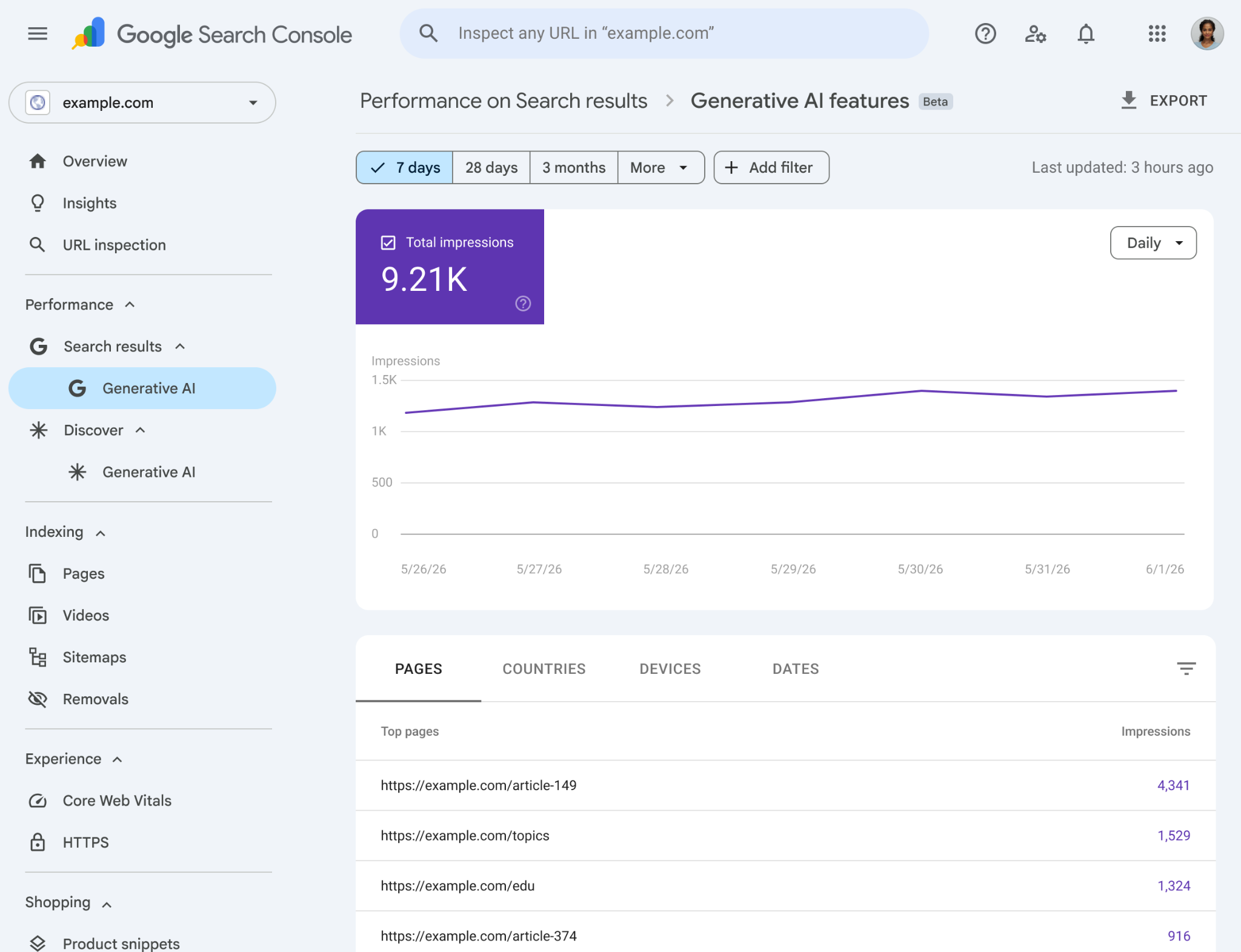
Measurement has improved, but only in part. On 3 June 2026, Google introduced a Generative AI performance report in Search Console, and by 31 August 2026 it had reached all websites worldwide. According to Search Console Help, it shows how often links to your site appeared in AI Overviews and AI Mode, by page, country, device and date. Sites with too few of these impressions may not see the report.
The report is about impressions. It doesn’t show which enquiries or revenue followed, and it doesn’t cover ChatGPT, Copilot or other AI tools. Across AI tools as a whole, Hong Kong agency MarketHK notes that generative engine optimisation (GEO) still lacks a fully unified metric. GEO is the practice of making content and brand signals understandable, verifiable and citable, so AI answers are more likely to mention or recommend you.
Which B2B SEO strategy should a Hong Kong team choose for 2026?
Most teams have three realistic options, and they aren’t mutually exclusive. The table compares them on value, effort and risk. There are no prices because the sources reviewed give none; the cost lines are mainly internal time, writing, translation and tracking.
| Option | Likely value | Effort and cost lines | Main risk |
|---|---|---|---|
| Keep the volume-traffic playbook | Builds awareness with buyers who will evaluate later | Low: existing content calendar and writers | Traffic reports can hide a weak contribution to pipeline |
| Buying-committee, high-intent content | Reaches active evaluators on low-volume, specific queries | Medium: interviews with sales and experts, plus bilingual writing | Low volumes make results slow to read |
| Add a GEO layer | Visibility inside AI answers; Google reports impressions, but there’s no single metric across AI tools | Medium: answer-first writing, plus monthly AI-answer tracking | Noisy measurement and data handling in AI tools |
Two agency guides argue that in B2B, low-volume, high-intent queries can be worth more commercially than broad, high-volume terms. B2B growth agency The Growth Syndicate makes this case in its May 2026 guide, and SEO agency SEO Alive makes a similar case in October 2026. In MarketingCat’s view, the sensible start is the second option on one product line, with the GEO layer added to the same pages. That limits the cost to one cluster and gives a clean comparison against untouched pages.
Choosing buying-committee content doesn’t mean dropping early-stage content. In a May 2021 report, Professor John Dawes of the Ehrenberg-Bass Institute estimated that up to 95% of business buyers are not in the market for many goods and services at any one time, with something like 5% in the market in a quarter. He presents this as a rule of thumb, not a precise figure. Early-stage content has a different job: reaching buyers who will evaluate later. Judge it by whether it leads readers to your evaluation pages, not by sessions alone.

How should bilingual content answer complex procurement questions?
A single enterprise purchase involves many people. Forrester’s 2024 buying research found that, on average, 13 people within an organisation are involved in the buying decision. Its January 2026 release says the typical buying decision now includes 13 internal stakeholders and nine external influencers. Both releases put the number of people inside the buying organisation at 13. The 2026 release also counts nine external influencers, a group the 2024 figure doesn’t include, so quote internal and external figures separately and give each release’s year.
Each person searches with a different question. The Growth Syndicate gives a simple picture: a CFO looks for ROI justification, a technical lead for integration specifications and procurement for vendor compliance. In practice, that turns into questions like the ones below.
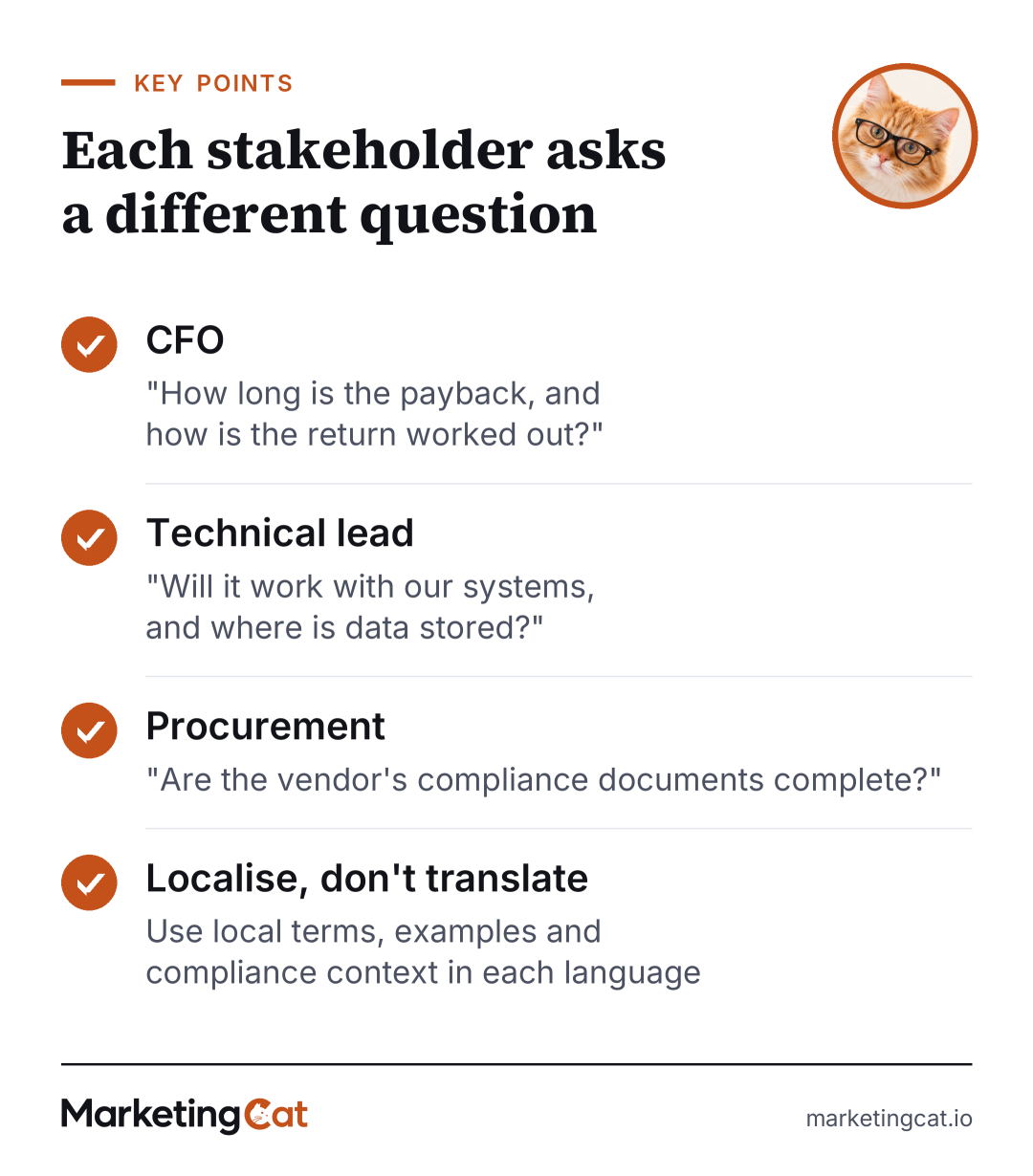
Marketing technology firm awoo’s Traditional Chinese guide, first published in December 2020 and updated in August 2025, sets out four procurement stages:
- describing the need
- searching for suppliers or solutions
- selecting a supplier and signing a contract
- evaluating performance and satisfaction
The guide suggests that the selection stage needs content buyers can use when they justify a choice internally, such as explanations of why prices differ between suppliers.
Give a buying question its own page when its intent or language really differs from your other pages. Related questions from the same stage can share one page; a page for every role and stage by default tends to produce thin pages that repeat each other. For each language version, match local terms, examples and compliance context rather than translating sentence by sentence, and tell Google about the versions as its guide to localised versions describes, for example with hreflang.
Illustrative example, not a client result. A Hong Kong software vendor sells a system to the Hong Kong office of a regional bank. The regional IT lead may research integration and data security in English, the local finance lead may compare costs and payback in Chinese, and procurement looks for compliance documents. Where those questions differ in intent, they deserve separate pages linked in one topic cluster. Where two of them are close, one page can answer both.
The sources reviewed don’t compare how often AI tools cite Traditional Chinese versus English pages, or which search engines Hong Kong procurement teams favour. Test both languages in your own query tracking rather than assuming parity.
How do you audit legacy content for multi-stakeholder buying journeys?
The audit decides what happens to every existing page: keep it, update it, merge it or retire it. Each decision rests on the page’s job in a buying journey and the evidence that it does that job. MarketingCat’s five steps below combine the agency sources reviewed with Google’s own guidance. Each step has an owner and a written output.

MarketingCat’s five-step content audit
| Step | What to do | Owner | Output |
|---|---|---|---|
| 1. List the questions buyers ask | Collect questions from sales meetings, tenders and support records, and sort them by role and buying stage | Content lead with sales | A question map |
| 2. Review old pages by topic | Group pages under your core offerings and score each one with the model below | SEO lead | A keep, update, merge or retire decision per URL |
| 3. Add real experience and data | Add the method, its limits, bylines, update dates and anonymised project experience | Subject experts, with internal sign-off | An evidence log per page |
| 4. Answer first, then add detail | Open key sections with the answer, then give reasons and conditions, with tables for comparisons | Editor | An updated page template |
| 5. Track AI visibility and pipeline | Combine Search Console’s AI impressions, a fixed AI-answer log and CRM enquiries | Marketing ops with sales ops | A monthly report |
Step 1 follows MarketHK’s advice to build the question map from sales meetings, tenders and support records. Step 4 is about readers: Google says there’s no requirement to break content into tiny pieces for AI, so write clear sections for people rather than special “AI blocks”.
MarketingCat’s scoring model for legacy pages
Score each URL out of 100. The model is a planning aid that makes decisions consistent across a team, not a tested prediction of performance.
| Criterion | Points | What to look for |
|---|---|---|
| Buyer role and stage | 25 | A real question from a stakeholder who matters to the sale |
| Commercial relevance | 25 | Close to what you sell, backed by sales questions, search demand or buyer interviews |
| Quality and evidence | 20 | Accurate, current, with original examples and traceable sources |
| Search and AI visibility | 15 | Organic performance and Search Console AI impressions, read as signals |
| Assisted enquiries | 15 | CRM evidence that the page helped a qualified enquiry, over a window long enough for your sales cycle |
- Keep (roughly 70 or more): accurate, distinct and useful. Refresh the date and sources.
- Update or rebuild (roughly 40 to 69): the question is real, but the page lacks depth, evidence, a language version or a route to the next step.
- Merge: two or more pages answer the same question. Check search intent, links and redirects first.
- Retire (roughly under 40): obsolete, unsupported or off-topic, and only after a technical SEO review of links, traffic and redirects.
Don’t retire a page automatically because it shows no enquiries for a quarter or two. Enterprise sales cycles can be long; SEO Alive puts B2B cycles at 3 to 12 months.
Worked example: five legacy pages
Illustrative example with fictional pages and scores, not client data. A Hong Kong software vendor audits its older content against its main ERP offering:
| Page | Main reader and stage | Score | Decision | Why |
|---|---|---|---|---|
| ERP versus spreadsheets | Finance lead, comparing options | 81 | Keep | Answers a question sales hear every week; refresh the figures and date |
| ERP integration guide | IT lead, evaluating | 66 | Update | Strong intent, but no Traditional Chinese version and no data security section |
| What is ERP? | Early researcher | 48 | Update | Real search interest but generic; add Hong Kong examples and a link to the comparison page |
| Two “ERP trends” posts from 2023 and 2024 | No clear buyer | 34 | Merge | They overlap and are out of date; combine into one current page and redirect the old URLs after an SEO check |
| Office party ideas | No buyer role | 12 | Retire | Unrelated to the offer; check links and traffic first, then retire it after a technical SEO review |
Notice that low scores lead to a review rather than an instant deletion, and that even the strongest page gets a refresh.
Step 1 often draws on sales notes, tender documents and support records. If you put that material into AI tools to cluster questions, get internal approval first and use company-approved tools. Limit and anonymise personal data before you start. Check the vendor’s terms on data retention, model training and access, and keep a person reviewing anything that will be published.
The PCPD’s March 2025 Checklist on Guidelines for the Use of Generative AI by Employees is a useful basis for that internal policy. It covers permitted tools, what information may be entered, anonymisation and human review of outputs. MarketingCat’s checklist on the PCPD’s agentic AI guidance covers related points.
When you rewrite an old page’s title and meta description, check the length and keyword placement in our headline and meta description checker, which handles Chinese titles too.
How should you measure results, and when should you scale or stop?
Choose one primary KPI before you start: qualified enquiries, or sales-qualified leads, from the pilot cluster. As an illustrative plan, set the baseline from the previous six months of CRM data for those URLs, and pick a comparable cluster that you leave untouched. Track organic sessions, impressions and AI impressions as secondary signals only. SEO Alive argues that pipeline metrics should replace traffic metrics.
| What you need to know | Best available evidence | Caveat |
|---|---|---|
| How often Google’s AI features show your pages | Search Console’s Generative AI performance report | Impressions only; sites with few impressions may not see the report |
| Which pages, countries and devices drive those impressions | The same report, by page, country, device and date | Doesn’t show that an enquiry came from an AI answer |
| Whether ChatGPT, Copilot and other tools mention you | A fixed, dated set of queries, run the same way each month | Answers vary between runs; there’s no shared metric across tools |
| Whether organic search creates qualified leads | GA4 plus your CRM, with agreed lead definitions | Attribution is imperfect |
| Whether content influences revenue | CRM opportunity stages | Long sales cycles limit firm conclusions |
For the AI-answer log, MarketHK suggests a fixed set of commercial queries. Record whether your brand is mentioned, which sources are cited and which competitors appear. The log is only worth keeping if you run it with discipline:
- Keep the query wording identical each month, in both languages.
- Run important queries several times to check whether the answers change.
- Keep a dated log of what you changed on each page, and of other site changes.
- Check movements against real enquiries before drawing conclusions.
Review the pilot after two quarters. Judge enquiries and pipeline influence rather than closed revenue, because deals may take longer than the pilot. Scale to a second cluster if qualified enquiries rise against both the baseline and the untouched cluster. Revise the pages if AI impressions or mentions improve but enquiries don’t. If neither moves after a further quarter of fixes, stop and re-examine how you define your target customers. Our GEO vs SEO guide covers where the two disciplines overlap.
To estimate the return from revenue and gross margin rather than rankings, try our B2B SEO ROI calculator.
Limitations and risks of this approach
Much of the strategic advice here comes from agencies and vendor blogs, and some of these firms sell SEO or GEO services; we’ve named them wherever we use their views. At least one agency guide we reviewed quotes steep click-through declines on AI Overview queries from third-party studies, without dates or links to the originals, so this article leaves those figures out. Search Console’s AI report covers Google’s features and impressions only, and none of the sources measures Hong Kong searchers, Traditional Chinese queries or local procurement teams specifically.
Treat the framework and the scoring model as a structured hypothesis that your own CRM data must confirm. Any rebuilt page can still lose visibility if search features change, and no tactic guarantees rankings or citations.
In our view, chasing traffic volume is now the riskier bet for Hong Kong B2B teams. A smaller, evidenced, bilingual library mapped to real buying groups is the more defensible investment. This week, ask your sales team for ten questions customers asked in your last five deals, and check whether one page on your site answers each. Then score your 20 most-visited legacy pages with the model above and choose one product line for the two-quarter pilot.
Frequently Asked Questions
Should we stop publishing top-of-funnel blog posts?
Not entirely. Early-stage content still matters for buyers who will evaluate later, but it needs a clear link to your core offerings. Generic posts on loosely related topics add little and dilute your topical focus. Cut volume and keep the pieces that sit inside a cluster, each linking to deeper comparison, implementation and evidence pages. Then judge them by assisted enquiries rather than by sessions alone.
Do we need a separate GEO agency alongside our SEO agency?
Not necessarily. Google says SEO best practices remain relevant for its AI features, and MarketHK describes GEO as an expanded objective rather than a replacement for SEO. What changes is evidence, answer-first writing and tracking. Many teams can add these to an existing SEO retainer. Ask any agency how it would measure AI visibility and enquiries before you sign.
Does Search Console show leads from AI Overviews?
No. The Generative AI performance report counts impressions: how often links to your site were shown in AI Overviews and AI Mode. To connect that with business results, compare the pages it highlights with your analytics and CRM over the same period, and treat what you find as a signal rather than proof.
Can AI tools write our Traditional Chinese pages?
The sources don’t assess AI writing quality in Traditional Chinese, and procurement content depends on accurate local terms, figures and compliance details. Use AI for outlines or first drafts. Have a fluent subject expert review every claim before publication. Keep client personal data out of the source material, and follow your company’s approved-tools policy when you prepare prompts.