What Is Generative Engine Optimization? A 30-Day Starter Guide
GEO builds on SEO rather than replacing it. Here is what changes, which AI search tools are officially available in Hong Kong, and a 30-day plan a small B2B team can run.
Meowket's take Don't rebuild your website for bots. Google says ordinary SEO still applies, so spend the first month on reachable pages, direct answers and evidence only you can provide.
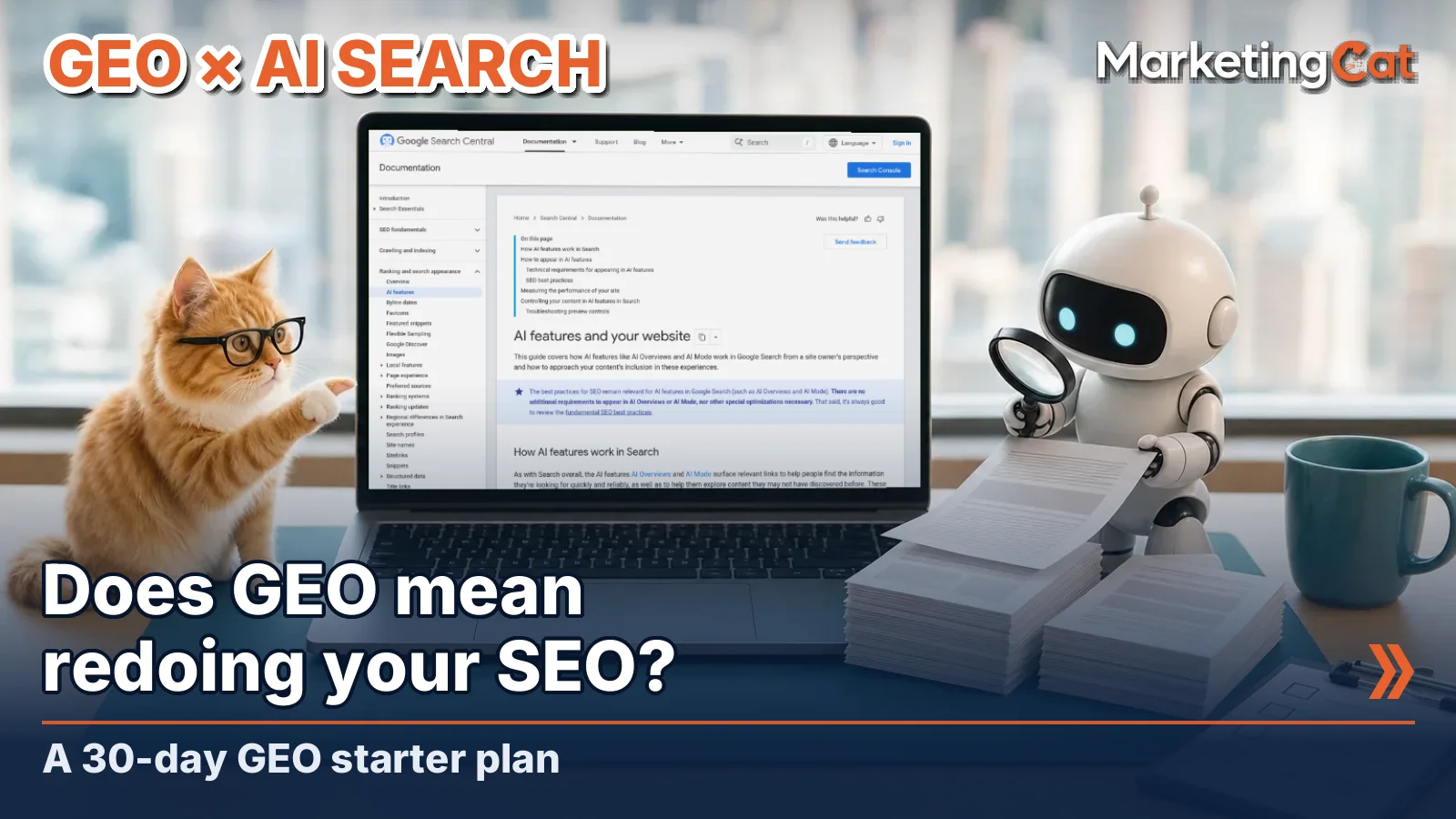
Generative engine optimisation (GEO) is the work of making your pages easy for AI search tools to find, understand and cite when they answer a buyer’s question. It builds on SEO rather than replacing it: Google says ordinary SEO best practice still applies to its AI features, and no special AI files or markup are needed. What GEO adds is a focus on being used inside the answer, through a citation, a link or an accurate mention, not just on ranking for a click. This guide explains the difference, shows which AI search tools are officially available in Hong Kong, and gives a 30-day plan a small B2B team can run.
Key Takeaways
- GEO and SEO share the same foundations: pages that can be crawled and indexed, and content written for people. Google’s guide says you don’t need AI text files, Markdown or special schema.org markup to appear in its AI features.
- Officially, Google AI Overviews, AI Mode and the Gemini app list Hong Kong, and Microsoft’s wording implies Copilot is available here. OpenAI’s ChatGPT supported-countries list does not include Hong Kong, and we found no official country list for Perplexity (all checked 11 November 2026).
- Being eligible to be cited doesn’t mean you will be. Our 30-day plan names an owner, an output and a decision point for each week, and starts with 10 pilot pages.
Platform availability last checked against official help pages: 11 November 2026.
What is generative engine optimisation?
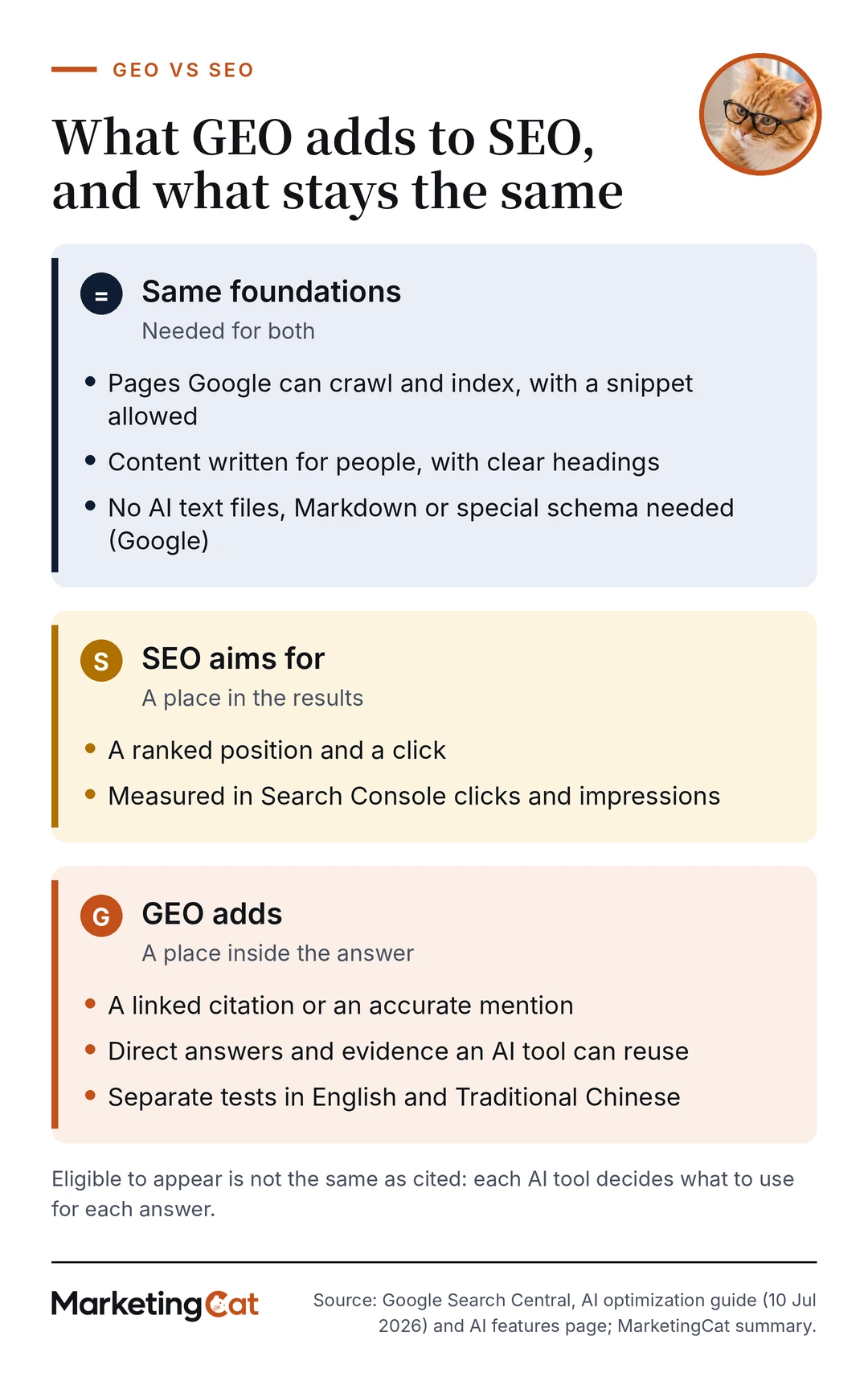
GEO is the practice of shaping your content, and your brand’s presence across the web, so that AI-generated answers find it, represent it correctly and cite it. Traditional SEO aims for a ranked position and a click. GEO aims for a place inside the answer itself.
For a Hong Kong B2B firm the two depend on the same foundations. Google’s AI Overviews and AI Mode draw on pages in Google’s search index, so a page that can’t be crawled or indexed can’t be used. Digitas Hong Kong makes the same point in a September 2026 GEO guide. It calls GEO an extension of SEO, not a replacement, and warns readers against any promise of “guaranteed AI citations”.
| SEO | GEO | |
|---|---|---|
| Main goal | A ranked position and a click | A citation, link or accurate mention inside an AI answer |
| Foundations | Crawlable, indexable pages written for people | The same, plus clear answers and evidence an AI tool can reuse |
| Main Google measure | Search Console Performance report (clicks, impressions) | Search Console Generative AI report (impressions only) |
| Outside Google | Other search engines | Gemini app, Copilot, ChatGPT, Perplexity and others, each checked separately |
One distinction runs through this whole series. A page can be eligible to appear, because it’s indexed and allowed in AI features, and still not be cited. Each platform decides what to use for each answer. Our companion guide on how to get cited in AI search covers what improves the odds.
Do you need to redo your SEO for AI search?
Mostly not, as far as Google is concerned. Google’s guide to optimizing for generative AI features, last updated 10 July 2026, says SEO best practices remain relevant. Sites need no new machine-readable files, AI text files, markup or Markdown to appear in Search, and there’s no special schema.org markup to add. It also says content doesn’t need to be broken into tiny pieces. Pages should use paragraphs, sections and clear headings written for people.
Google’s page on AI features and your website adds that no special optimisations are needed to appear in AI Overviews or AI Mode. Advice to build dedicated “AI answer blocks” is an agency view, not Google guidance. Budget for GEO as an extension of your SEO and content work, not as a separate technical rebuild.
One setting does need checking. In a June 2026 announcement, Google introduced a Search Console control that lets a site choose whether it appears in, and helps ground answers in, its generative AI features. It reached all sites worldwide by 31 August 2026. Google says sites that opt out won’t receive traffic or impressions from those features. The same post says AI Overviews has over 2.5 billion monthly active users and AI Mode has passed one billion monthly users. These are worldwide figures, not Hong Kong or B2B figures.
Which AI search tools are officially available in Hong Kong?
Three of the six tools we checked name Hong Kong in their own documentation, and Microsoft’s wording implies Copilot is available here. The table separates official support from local reports, because a tool that someone can reach from Hong Kong isn’t necessarily supported here. We checked each platform’s own page on 11 November 2026. These lists change, so recheck before you plan around them.
| Tool | Hong Kong status | What the official source says |
|---|---|---|
| Google AI Overviews | Official support | Google Search Help lists Hong Kong; Chinese (Traditional) and English are among the languages. Overviews appear only when Google’s systems judge them helpful. |
| Google AI Mode | Official support; one model is feature-specific | Google Search Help lists Hong Kong and Chinese (Traditional). A newer model inside AI Mode has a narrower country list that doesn’t include Hong Kong. |
| Gemini app | Official support | Gemini Apps Help lists Hong Kong, with “Chinese (Simplified/Traditional/Hong Kong)” among its languages. Google notes the mobile app’s availability may differ. |
| Microsoft Copilot | Official support (implied by exception wording) | Microsoft Support says Copilot is available in over 170 markets; its exceptions name “China (excluding Hong Kong SAR)”. Hong Kong isn’t listed by name. |
| ChatGPT, including ChatGPT search | Not on official list | OpenAI’s supported-countries list does not include Hong Kong. |
| Perplexity | Not verified | We found no official supported-country list. Hong Kong agency DOOD reported in March 2026 that it was accessible locally; that is a local report, not official support. |
Local reports can lag the official lists. DOOD’s March 2026 post also called standalone Gemini “officially unavailable” in Hong Kong, but Google’s Gemini help page now lists Hong Kong. Local experience can also differ from the lists. In a March 2026 Google forum thread, a user reported that the AI Mode button was missing on google.com in Hong Kong when Search was set to English, but appeared in Chinese. That is one user report, and we don’t know whether it still applies. Record your interface language when you test.
The lists above cover organic features. Ads inside AI Overviews and AI Mode are a Google Ads product with their own country list; see our guide to Google AI Overviews ads in Hong Kong. If your buyers sit in Singapore, Sydney or Tokyo, check the tools they use there too.
What research says about how AI tools pick sources
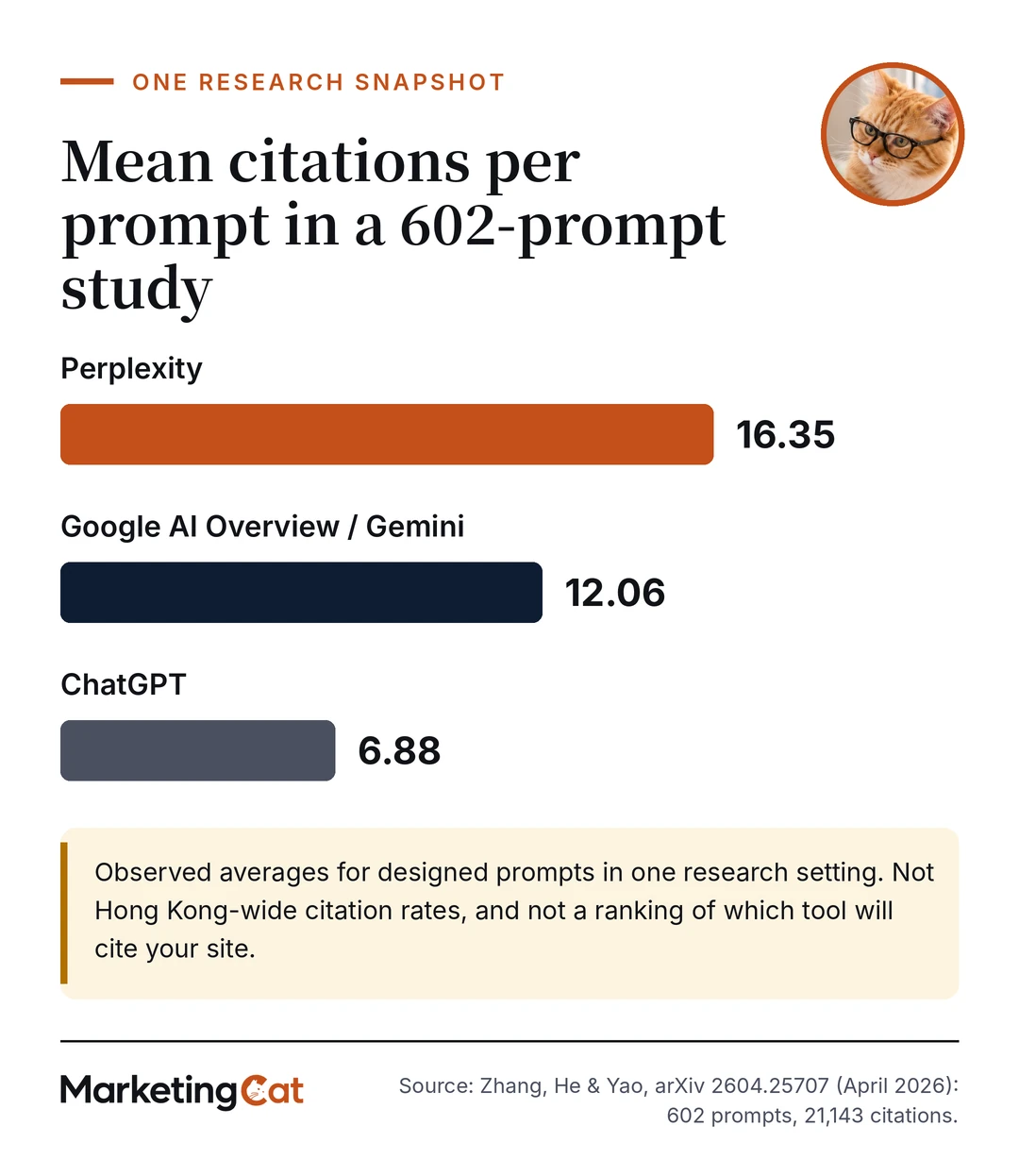
Independent evidence is still thin, and the best study we found has a narrow scope. An April 2026 arXiv preprint by three authors listed as independent researchers in China analysed 602 designed prompts and 21,143 citations across ChatGPT, Google AI Overview/Gemini and Perplexity. It separates two outcomes. “Citation selection” means a page is chosen as a source. “Citation absorption” means the page supplies language, evidence or facts to the answer.
Read its numbers with four limits in mind. The prompts were designed, not randomly sampled. The data is a single snapshot, and the paper gives no collection window. Its influence score is a constructed measure. And the authors make no causal claims. Within that setting, the main patterns were:
- Breadth and depth differ. Mean citations per prompt were 16.35 on Perplexity, 12.06 on Google and 6.88 on ChatGPT. Average influence per fetched page was 0.2713 on ChatGPT, 0.0646 on Perplexity and 0.0584 on Google.
- Q&A formatting alone showed no advantage. Q&A pages averaged 0.0947 influence and other pages 0.1005, about 5.74% lower. That compares different pages; it isn’t an experiment in reformatting one page. Higher-influence pages tended to be longer and more modular, with definitions, numbers, comparisons and steps.
- Being selected isn’t being used. News pages were selected often but averaged 0.0726 influence; encyclopedia pages averaged 0.2144.
- Language effects vary by platform. In one language-comparison subset, ChatGPT averaged 7.77 citations on Chinese prompts and 7.03 on English prompts, while Google showed 11.57 on English and 7.53 on Chinese. The paper doesn’t say whether the Chinese prompts were Traditional or Simplified.
These figures don’t tell you which tool will cite a particular Hong Kong website, and they don’t prove any tactic works. The practical lesson is narrower: test English and Traditional Chinese separately, and write each version for its own readers rather than translating mechanically.
A 30-day GEO plan for a small Hong Kong team
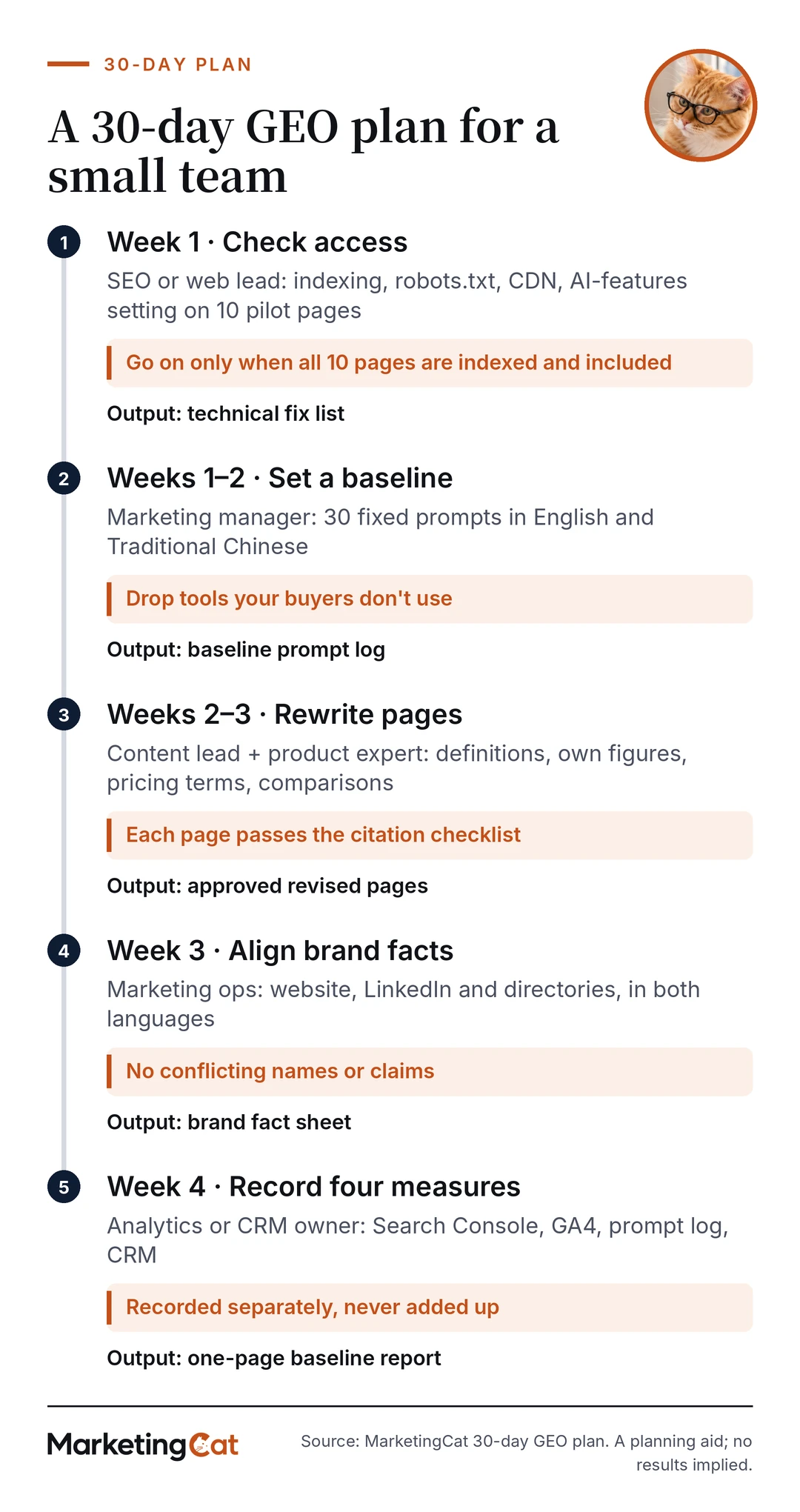
Start with the 10 pages closest to revenue and keep the scope small enough for a team of two or three. Each week has an owner, an output and a decision, so you know by day 30 whether to continue.
| When | Owner | Task | Output | Decision point |
|---|---|---|---|---|
| Week 1 | SEO or web lead | Check robots.txt, CDN rules, indexing, canonicals, hreflang and the Search Console AI-features setting for the 10 pilot pages | Technical fix list | All 10 pages indexed and included in AI features before you go further |
| Weeks 1–2 | Marketing manager | Run 30 fixed prompts, each in English and Traditional Chinese, on the tools your buyers use from the table above | Baseline prompt log | Drop any tool your buyers don’t use |
| Weeks 2–3 | Content lead with a product expert | Add plain definitions, your own figures, pricing terms and comparisons to each pilot page | Revised pages, approved by the expert | Each page passes the citation checklist in our AI citation guide |
| Week 3 | Marketing operations | Match company and product facts across the website, LinkedIn and directories, in both languages | Brand fact sheet | No conflicting names, addresses or product claims |
| Week 4 | Analytics or CRM owner | Record Search Console AI impressions, GA4 AI Assistant sessions, the prompt-log result and CRM enquiries for the pilot pages | One-page baseline report | All four measures recorded separately, ready to compare in 30 days |
Illustrative example, not real client results: a Hong Kong B2B logistics SaaS provider sells to regional supply chain managers. It picks 10 pilot pages, mostly product documentation and pricing explainers, and writes 30 prompts, each in English and Traditional Chinese. Forrester’s 2026 buying study says a typical buying decision involves 13 internal stakeholders and nine external influencers, so the team writes prompts for finance, IT and operations as well as for the person who signs.
For the 30-day pilot, use one primary KPI: the share of your fixed prompts in which your brand is cited with a link or named accurately. It’s a directional sample, not market share. Check it against Search Console AI impressions and CRM enquiries for the pilot pages. After another 30 days, re-run the same prompts. Scale to more pages if visibility and qualified enquiries both rise. Revise the content if visibility rises but enquiries don’t. Our AI search visibility tracking guide shows how to keep those numbers apart in a monthly report, where qualified pipeline becomes the main KPI.
Keep test inputs the same each time: identical wording, language settings and signed-in status. Run important prompts more than once, and log the date, tool and output. The main cost is staff time, plus subject-expert time for rewriting; paid monitoring tools are optional.
If you draw prompts from sales notes or customer emails, get internal approval, use company-approved tools and remove personal data first. The PCPD’s Checklist on Guidelines for the Use of Generative AI by Employees covers permitted tools, what information may be entered, anonymising personal data and human review of AI output. As our own precaution, strip any detail that could identify a person, not just names, and check the vendor’s terms on data retention and training. This isn’t legal advice.
What GEO can’t promise
No team can guarantee a citation, because each platform decides what to cite and how. The arXiv study describes patterns in one snapshot and doesn’t show that adding definitions or tables causes a citation. MarketingCat has not run its own platform tests for this article.
Be wary of headline claims about collapsing search traffic. Gartner’s February 2024 prediction that search engine volume would drop 25% by 2026 was a forecast, and our research contains no measurement showing whether it came true. Plan from your own Search Console and CRM trends.
For most Hong Kong B2B teams, GEO is disciplined SEO with a sharper focus on evidence, language and measurement. It doesn’t need a new budget line built on AI hype. This week, open Search Console, confirm your site is included in Google’s AI features, and pick the 10 pages closest to revenue. Those are your pilot pages.
Frequently Asked Questions
Is GEO different from AEO or “AI SEO”?
The labels overlap. Agencies use GEO, AEO (answer engine optimisation) and AI SEO for much the same work: making content easy for AI answers to find, use and cite. The label matters less than the method. Ask what will be changed, how it will be tested in both languages, and how results will be measured.
Can I stop Google from showing my content in AI Overviews?
Yes, through the Search Console control Google announced in June 2026. Google says a site that opts out gets no traffic or impressions from its generative AI features. For most B2B firms that want buyers to find them, that removes a visibility channel, so review the setting with your SEO lead first.
How long does GEO take to show results?
There’s no fixed timeline. Digitas says results depend on a site’s technical condition, content quality, brand awareness, competition and how quickly AI platforms update. Measure against your own baseline with the same prompts and Search Console data over time.
Should a GEO agency promise a number of AI citations?
Treat any such promise with caution. Digitas, itself a GEO agency, tells readers to avoid “guaranteed AI citations” claims. Ask an agency to show its baseline method instead: which prompts and languages it tests, how often it repeats runs, and how it links visibility to enquiries in your CRM.