
LinkedIn B2B Content Strategy: A 4-Pillar Guide
Your executive posts gain likes and impressions, but target accounts never turn into qualified sales conversations. Here is a four-step framework to divide work across company and personal accounts, an 8-week pilot for small teams, and the compliance checks to clear before outreach.
Meowket's take Stop treating LinkedIn like an announcement board. Split the work so your page builds verification, your executives share industry judgement, and your sales team watches which target accounts interact before starting outreach.
A LinkedIn B2B content strategy that builds pipeline gives each voice a separate job. The Company Page proves you are credible, senior staff supply the market view, employees add hands-on detail, and sales follows up on the target accounts that engage. For Hong Kong teams, this guide sets out a four-step framework, an illustrative 8-week pilot for a small team, and the compliance checks that apply once engagement turns into outreach.
Key Takeaways
- Geber Consulting, a brand and SEO consultancy with offices in Taipei, Tampa and Toronto, reports that the personal profile of Richard deVries, a co-author of its LinkedIn guide, earned 291,333 impressions in the 12 months to 8 November 2026. Its Company Page had 20,851 organic impressions in the 12 months to 6 November 2026. Geber’s own lesson is that the personal account acts as its funnel, while the page serves as proof.
- MarketingCat’s four-pillar framework splits the work between the Company Page, executives, employees and sales follow-up. It can be piloted for 8 weeks with one Company Page post and two executive posts a week (illustrative).
- Judge the programme by engaged target accounts and sales conversations, not impressions. Before any outreach, check PDPO Part 6A and the UEMO, and avoid third-party automation tools, which LinkedIn does not permit.
What does LinkedIn reward now, and what can you measure?
Geber Consulting and the Content Marketing Institute both read LinkedIn’s 2026 feed changes as favouring relevant expertise from real people over generic corporate output. The impressions and follower counts quoted in this guide measure reach, not pipeline. Both points shape the plan before you write a single post.
LinkedIn’s own feed update of 12 March 2026 says the feed now uses larger recommendation models, augmented with large language models (LLMs), to understand what posts are about and how members’ professional interests change. The same update says LinkedIn is cutting repetitive, low-substance posts and engagement bait, and working to make engagement pods ineffective and curb comment automation. Geber Consulting’s summary of the update makes the same points, and the Content Marketing Institute, a content marketing publication, also cites a LinkedIn engineer’s description of the new ranking system.
Plan for consistency. Richard van der Blom’s 2026 Algorithm Insights Report analysed 1.3 million LinkedIn posts and, as summarised by the Content Marketing Institute, attributes about half (50.1%) of what drives impressions to profile-based factors: followers, history, past engagement and topic consistency. For a Hong Kong team, this means a few fixed themes, repeated over months, are likely to do more than a burst of one-off announcements.
Patience is also built into the economics of B2B buying. The Ehrenberg-Bass Institute’s 95-5 rule, from a May 2021 report by Professor John Dawes, holds that up to 95% of business clients are not in the market for many goods and services at any one time. Dawes presents the figure as a heuristic rather than a precise rule, and it suggests your content will often reach buyers before they’re in the market.
Impressions and follower counts are reach, not leads. Decide now to track two things in your CRM: which target accounts engage, and which sales conversations follow. The same principle applies to closing the loop between content and revenue in other channels.

How should a LinkedIn B2B content strategy be structured?
Structure the programme around who speaks, not how much you post. Each account type does a different job, so the same announcement isn’t simply reposted in a different tone. Geber Consulting describes the Company Page as a “trust database” and personal profiles as the professional entry point. The framework below turns that split into four owned steps.
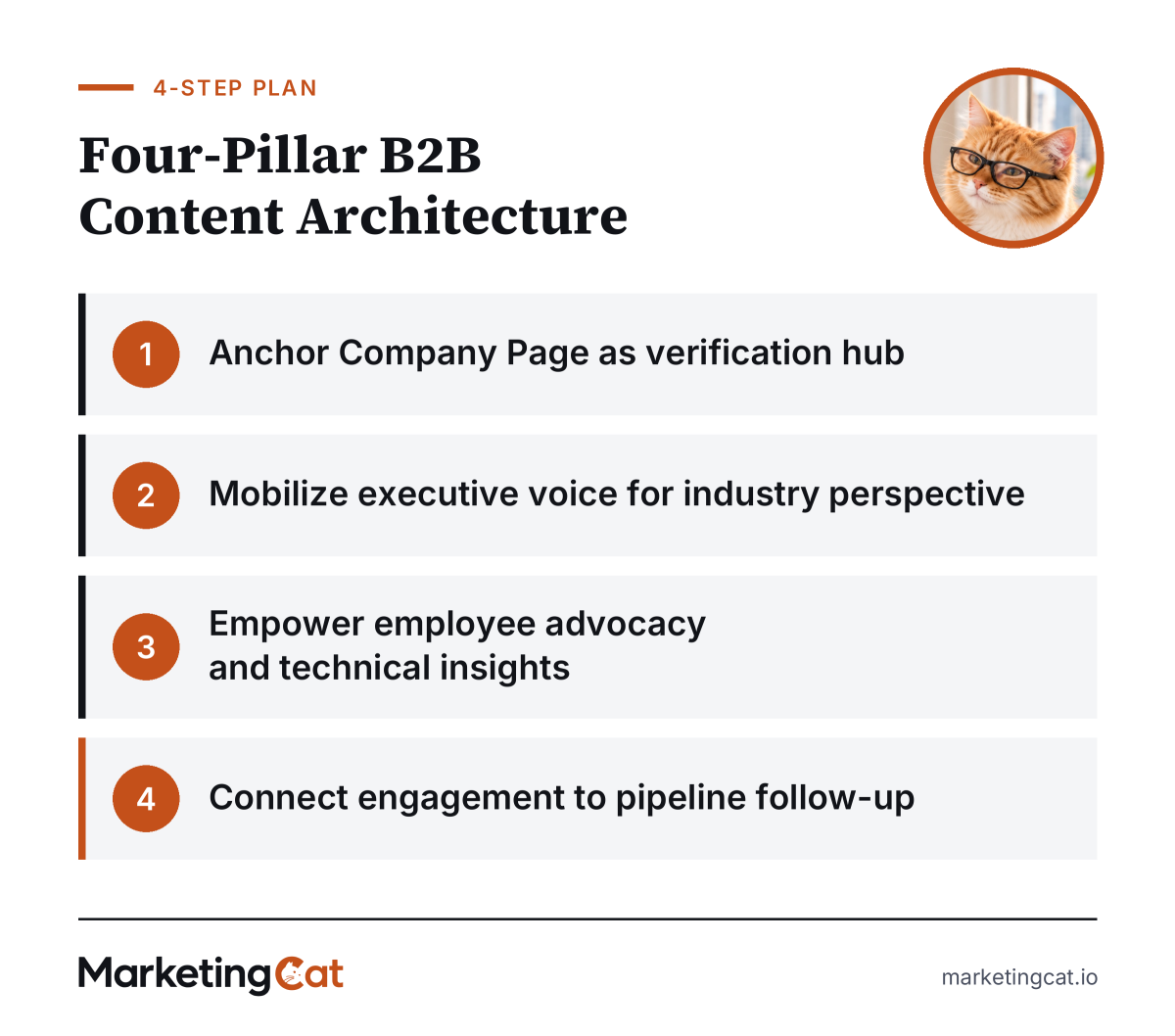
Four-Pillar B2B Content Architecture
- Anchor Company Page as verification hub The marketing lead owns a complete page and a fixed list of content themes, so buyers who check you find cases, services and events.
- Mobilize executive voice for industry perspective The CEO or business head commits to a weekly posting slot, with marketing as editor, and the output is an agreed topic list.
- Empower employee advocacy and technical insights Sales and delivery leads, coordinated by marketing, agree a roster of who posts which customer questions and implementation lessons.
- Connect engagement to pipeline follow-up The sales manager reviews a weekly list of engaged target accounts against the CRM and decides which ones are worth a conversation.
The matrix below is MarketingCat’s template for allocating content to each voice. It draws on the account roles Geber Consulting describes.
| Voice or element | What it publishes |
|---|---|
| Company Page | Official case studies, milestone announcements, service links, event hosting |
| Executive profile (CEO/founder) | Macro trends, market shifts, long-term strategic opinions |
| Sales and delivery leads | Client FAQs, implementation challenges, lessons from handling objections |
| Format strategy | Short video for complex concepts; PDF document posts for guides |
Step 1: Make the Company Page your verification hub
Treat the Company Page like a website section that buyers use to check you, not as a social feed. The Content Marketing Institute advises exactly that, and LinkedIn’s own Pages best-practice guide says Pages with complete information get 30% more weekly views. That is a platform claim rather than independent research.
B2B buyers who open your page usually want practical reassurance, Geber Consulting says. They are asking whether the company is stable, has relevant industry experience and understands their application. A feed of only event photos and standard releases makes it hard for buyers to judge whether you’re worth a conversation.
Case studies do more work when they are broken into parts. Geber suggests separate posts on the problem, the solution, the implementation process, common customer doubts and how the team handled risk. Even when client names are confidential, industry context and publicly shareable facts can still build credibility.
Step 2: Give senior staff a recurring market view
Executives supply the perspective a Company Page can’t: a named person’s judgement on where the market is heading. Their posts also reach buyers you can’t see. The Content Marketing Institute, citing the 2025 Edelman-LinkedIn report, says hidden decision-makers, meaning buying influencers sellers haven’t identified, use thought leadership as part of their vetting process. That report is published by PR firm Edelman with LinkedIn.
Geber Consulting’s own accounts show the reach gap. Richard deVries’s profile had 291,333 impressions and 13,323 followers in the 12 months to 8 November 2026. The Company Page had 20,851 organic impressions and 4,002 followers in the 12 months to 6 November 2026, and ads added 99,713 more. These are one agency’s figures and measure reach, not leads. Geber does say that some prospects first saw his posts and then used its contact form.
Useful topics don’t require long essays. Geber points to market changes spotted at trade shows, questions clients ask most often, and where implementations tend to get stuck. Each is something only your own people can write.
Step 3: Turn employees into the technical and local voice
Employee posts let you address the whole buying group, not only the person who signs. Forrester’s 2026 State of Business Buying release says a typical buying decision now includes 13 internal stakeholders and nine external influencers, and more for complex purchases. Procurement, engineering and finance each need different proof.
Many teams start with reshares, which is a reasonable first step. Geber Consulting notes that reshares extend reach, but staff writing in their own words builds more trust. It also observes that Taiwanese executives tend to be more low-key on LinkedIn than Western ones. When an executive is reluctant, Geber asks other colleagues to post instead. Whether the same holds for Hong Kong leaders is not covered in the sources, but the fallback is useful either way.
Geber says AI can help organise interviews, rewrite posts and prepare different versions. If you want it to work from sales call notes or project debriefs, get internal approval first, use company-approved tools and remove personal and client details. As a precaution, MarketingCat suggests removing any detail that could identify a person or client, not only names. Check the vendor’s terms on data retention and model training, and have the named author approve every post before it goes live.
English, Traditional Chinese or both?
Write each post for the language its intended reader works in, rather than translating one master version. A LinkedIn’s own B2B content marketing guide, republished in Simplified Chinese by marketing services firm SinoClick, advises using the language your audience is familiar with while keeping a consistent tone that is recognisable everywhere.
The research has two gaps here. The sources we reviewed contain no data comparing bilingual and single-language reach in Hong Kong or the Greater Bay Area. They also don’t show how actively GBA decision-makers use LinkedIn. Before committing effort, check whether contacts at your own target accounts are active there. This is one of the screening questions the Content Marketing Institute suggests.
Step 4: Connect engagement to pipeline follow-up
Content only feeds pipeline when someone acts on the signals it creates. Geber Consulting suggests tracking four questions, and MarketingCat recommends reviewing them weekly. Which job functions are engaging? Which companies keep returning? Are trade-show contacts still interacting on LinkedIn? Can sales use posts and case articles as conversation openers?
When you promote content to cold audiences, offer something useful before asking for a meeting. Geber reviewed two years of lead ads for an industrial technology client in late 2023. Message Ads had higher open rates, but single-image ads converted better to leads. Ads inviting people to book demos produced few leads, while tutorial video series and application guides beat their lead targets. This is one agency’s account of one client, so treat it as a hypothesis to test.
Keep the follow-up on LinkedIn manual. LinkedIn’s Help Center says it does not permit third-party software that scrapes, modifies the appearance of, or automates activity on its site, and it may restrict accounts that use such tools. Staying within a daily sending limit does not make such a tool permitted. Our comparison of lead generation tools covers the wider options.
Compliance checks before outreach
Moving engaged contacts into email, SMS or WhatsApp follow-up brings in two Hong Kong laws. Under Part 6A of the Personal Data (Privacy) Ordinance, using personal data for direct marketing generally requires prior notice and the person’s consent, and opt-out requests must be honoured. Providing personal data to another person for that person’s own direct marketing has stricter rules.
The PCPD’s direct marketing guidance also says that marketing to someone in their work capacity, about products meant only for their organisation’s use, may fall outside Part 6A. The PCPD judges this case by case, and the data protection principles still apply.
Separately, the Unsolicited Electronic Messages Ordinance covers commercial electronic messages with a Hong Kong link. The government told the Legislative Council in 2016 that the ordinance is technology-neutral and covers commercial messages sent through instant messaging apps such as WhatsApp. Senders must give clear sender information and an unsubscribe facility, and must honour unsubscribe requests within ten working days. They must not use misleading email subject headings. From the tenth working day after a number is registered on the Do-not-call registers, they must not send it commercial electronic messages without the registered user’s consent. How these rules apply depends on the circumstances, and this is not legal advice. Contact only relevant people who have agreed to receive marketing.
How often should a small Hong Kong team post? An 8-week pilot
Start with a cadence you can sustain, and let your own results set the long-term rhythm. The sources give only general advice on posting regularly each week. They contain no controlled frequency tests and no Hong Kong or APAC benchmarks comparing text posts, carousels and short video. Treat the formats in the matrix above as starting choices, not proven winners.
Illustrative example, not real client results. A Hong Kong industrial IoT solutions firm targets manufacturing and logistics decision-makers across the Greater Bay Area. The plan:
- Accounts: 60 target accounts across Hong Kong and the GBA, listed in the CRM before launch.
- Cadence: one Company Page post a week, plus two executive thought-leadership posts a week.
- Buying group: content planned for 13 internal stakeholders per deal, an illustrative assumption. Forrester’s figure counts people, not distinct roles, and gives no Hong Kong or GBA figure.
- Test period: 8 weeks, compared with the period before launch.
- Primary KPI: the number of the 60 accounts with at least one contact who engaged, plus the sales conversations that followed.
Making the pilot reliable
Keep the inputs steady for the whole period: the same account list, posting days and themes. Change one thing at a time, such as language or format. Log every post with its theme, format, language and author, so you can see what was tried. Check engagement signals against what sales actually hears, because a liked post is not a buying signal on its own. Repeat a promising result before you build the plan around it.
Costs and when to decide
The cost lines are mainly time and production:
- Executive time to supply ideas and approve posts.
- A marketer’s editing and scheduling time.
- Design or simple video production.
- Optional paid amplification.
- An optional Sales Navigator seat. Prices are not stated in our sources.
After 8 weeks, decide whether to scale, revise or stop. Scale if more target accounts engage and sales conversations follow. Revise the themes if impressions rise but target accounts stay quiet. Drop any format that doesn’t move either measure.
Pre-publish checklist and common mistakes
A short check before each post catches the habits that turn a content engine back into a notice board. This is MarketingCat’s template:
- Does the post address a specific decision role’s problem, such as procurement risk, engineering feasibility or executive ROI?
- Does it replace generic corporate claims with real practitioner experience or verified case data?
- Does it avoid engagement pods, prohibited scraping or automation extensions, and engagement bait?
- If it leads to direct outreach, has the contact list been checked against PDPO Part 6A and the UEMO?
The common mistakes follow from the steps above:
- Identical posts everywhere. Staff repost the same announcement word for word.
- AI drafts that sound like everyone else. Geber Consulting warns that AI output tends toward the average when positioning is unclear.
- Demo requests too early. Cold audiences are asked to book a demo before they have received anything useful.
Limitations of this guide
Most of the sources behind this guide are agencies, vendors and publications, and the case figures come from agencies’ own accounts and clients. They measure impressions and leads, not revenue. The research contains no Hong Kong or APAC format benchmarks, no data on bilingual reach and no tested posting frequencies. Your own pilot data should outweigh any benchmark here.
Before you post more, decide who speaks for the company and check that what those people publish connects to sales follow-up. This week, list your target accounts in the CRM, agree one weekly topic slot with one senior leader, and record the baseline you’ll compare against when the pilot ends. Our Hong Kong B2B lead generation guide shows where LinkedIn fits among other channels.
Frequently Asked Questions
Can we use AI to write executive LinkedIn posts?
Partly, as a drafting aid rather than the author. Geber Consulting says AI can help organise interviews and produce versions, but it can’t decide your positioning. Without a clear point of view, AI output tends to resemble everyone else’s. LinkedIn’s March 2026 feed update also says it is cutting repetitive, low-substance posts. Use AI to structure an executive’s own notes and examples, then have the executive edit and approve the final wording so the judgement in it is genuinely theirs.
Do engagement pods or comment groups still help reach?
They are now a risk rather than a shortcut. Engagement pods are groups that agree to like and comment on each other’s posts. In November 2025 LinkedIn said it wants pods to stop working and is limiting the reach of content they boost, Social Media Today reported, and its March 2026 feed update repeats the aim of curbing pods and comment automation. Encouraging colleagues to comment thoughtfully when a topic is relevant to them is different from a coordinated pod. Keep any staff participation genuine and voluntary.
Is LinkedIn Sales Navigator worth it for a small team?
Only if someone will use it every day. Sales Navigator is LinkedIn’s own paid prospecting product, so it isn’t one of the third-party automation tools LinkedIn prohibits. Geber Consulting admits it paid for Sales Navigator and barely used it, and says the tool only adds value as a daily habit. Our sources don’t state its current price. Check LinkedIn’s pricing page, and assign a named owner before subscribing.
Do executives need to post every day?
No, according to the sources reviewed. Geber Consulting says executives don’t need to publish long posts daily, but should leave a visible record of professional judgement. LinkedIn marketing agency The Cool Lion publishes a 90-day authority plan for executives that avoids daily posting and relies on expertise and strategic comments. A steady, sustainable rhythm on consistent topics matters more than volume.
