B2B Lead Generation Tools Compared for Hong Kong Teams
Lead generation tools do different jobs, and buying the wrong category is costly. This guide compares leading tools and their checked prices, then adds three Hong Kong checks: local data coverage, Traditional Chinese outreach, and the privacy and platform rules for outbound.
Meowket's take Most useful for Hong Kong B2B marketing and sales teams selecting or auditing their lead generation stack.
A Hong Kong B2B team can end up with one tool to find prospects, another to enrich contact data, another to send follow-ups and a CRM to track the deal. These tools overlap, and an expensive subscription will not fix a weak sales process. This guide compares the main B2B lead generation automation tools by the job they do, using vendor guides and the vendors’ own pricing pages, then adds three Hong Kong checks: local data coverage, Traditional Chinese outreach, and the privacy and platform rules for outbound marketing. It is a research-based comparison: MarketingCat has not yet tested these tools on Hong Kong accounts. If you are still choosing channels or checking the outreach rules, start with our guide to B2B lead generation in Hong Kong.
New to this? Start with our guide to lead generation in Hong Kong: channels, rules and a 90-day plan.
Key Takeaways
- Lead generation tools do different jobs. ZoomInfo’s guide splits the category into data, intent, engagement, identification and orchestration layers, and says most enterprise teams run a stack rather than a single tool.
- None of the sources we reviewed independently measures Hong Kong or Greater Bay Area data coverage. Run a sample of your own target accounts through any tool on your shortlist before you sign.
- Before cold outreach, check the PDPO’s direct-marketing rules and the Unsolicited Electronic Messages Ordinance, not just a vendor’s GDPR claim. LinkedIn also does not permit third-party tools that automate activity on its site, whatever their daily limits.
Why the Tool Category Matters Before You Pick a Platform
ZoomInfo’s guide defines B2B lead generation software as tools that find and qualify prospects who match your ideal customer profile and route them into your sales workflow with verified contact data. In practice, that definition covers several different jobs. Chattie’s August 2026 guide groups tools by function rather than ranking them, because a data platform and an AI SDR do not compete, and it calls buying from the wrong category the most expensive mistake its list can help readers avoid.
As ZoomInfo’s guide describes, core capabilities include contact and company data, intent signal detection, sales engagement tools, CRM integration and data enrichment.
How the Leading Tools Compare
The table groups widely listed tools by the job they do. Prices were checked on each vendor’s own pricing page on the date shown unless a guide is named; “quote only” means the vendor publishes no price. Database sizes and identification rates are vendors’ own claims, and none of the sources we reviewed independently measures data accuracy for Hong Kong or the wider Asia-Pacific region. Prices change often, so confirm them before you buy.
| Tool | Main job | Pricing (checked 28 Oct 2026) | What the sources say |
|---|---|---|---|
| Apollo.io | Contact data + sequences | Free plan; Basic listed at US$49/user/month, billed annually, in HeyReach’s and ZoomInfo’s guides | Leadinfo lists 275M+ contacts and 73M+ companies, and calls Apollo primarily US-focused, with data quality that varies outside the US |
| ZoomInfo | Enterprise contact data + intent | Free Lite tier (10 credits a month, per ZoomInfo’s guide); paid plans quote only | Leadinfo lists high cost and complex implementation as drawbacks |
| Cognism | Contact data, Europe-focused | Quote only (Standard and Pro packages include 5 seats); Leadinfo estimates €10,000–30,000/year | Phone-verified mobile data; strong in Europe and the UK (Leadinfo) |
| Clay | Data enrichment workflows | Free (100 Data Credits, 500 Actions/month); Launch from US$185/month billed monthly or US$167/month billed annually; Growth from US$495/month, or US$446 billed annually | Waterfall enrichment from many data providers (75+ per Leadinfo, 150+ per ZoomInfo); a learning curve for complex workflows |
| HubSpot | CRM + marketing automation | Free CRM for up to 2 users; paid Starter from US$7/seat/month | Enrichment fills fields on records already in the CRM; teams needing direct dials or intent data at scale add a data provider (ZoomInfo) |
| Leadinfo | Website visitor identification | From €69/month (up to 50 identified companies) | Its own 35–40% identification rate is for Benelux and DACH, not Hong Kong |
| LinkedIn Sales Navigator | LinkedIn prospecting | Core US$119.99/month billed monthly, or US$1,079.88/year | Pair it with a data provider for emails and direct dials (ZoomInfo) |
| Salesloft / Outreach | Multichannel sales engagement | Quote only | Chattie suggests both for multichannel sequencing across a large team |
| Pipedrive | Sales-focused CRM | From US$14/seat/month, billed annually | Visual pipeline; phone and email enrichment only on the top (Ultimate) plan (HeyReach) |
| n8n / Zapier / Make | Workflow automation | Free tiers (Zapier 100 tasks, Make 1,000 credits a month); Zapier Professional from US$19.99/month; n8n Cloud Starter €20/month billed annually, or self-hosted | Connect the other tools so data moves without manual exports |
Sources: each vendor’s pricing page (checked on the date in the table); Leadinfo’s guide (January 2026); ZoomInfo’s guide (December 2025); HeyReach’s review (updated October 2026); Chattie’s guide (August 2026). All four guides are published by vendors that sell their own tools, so treat their product claims as such.
Three Local Criteria Hong Kong Teams Should Evaluate First
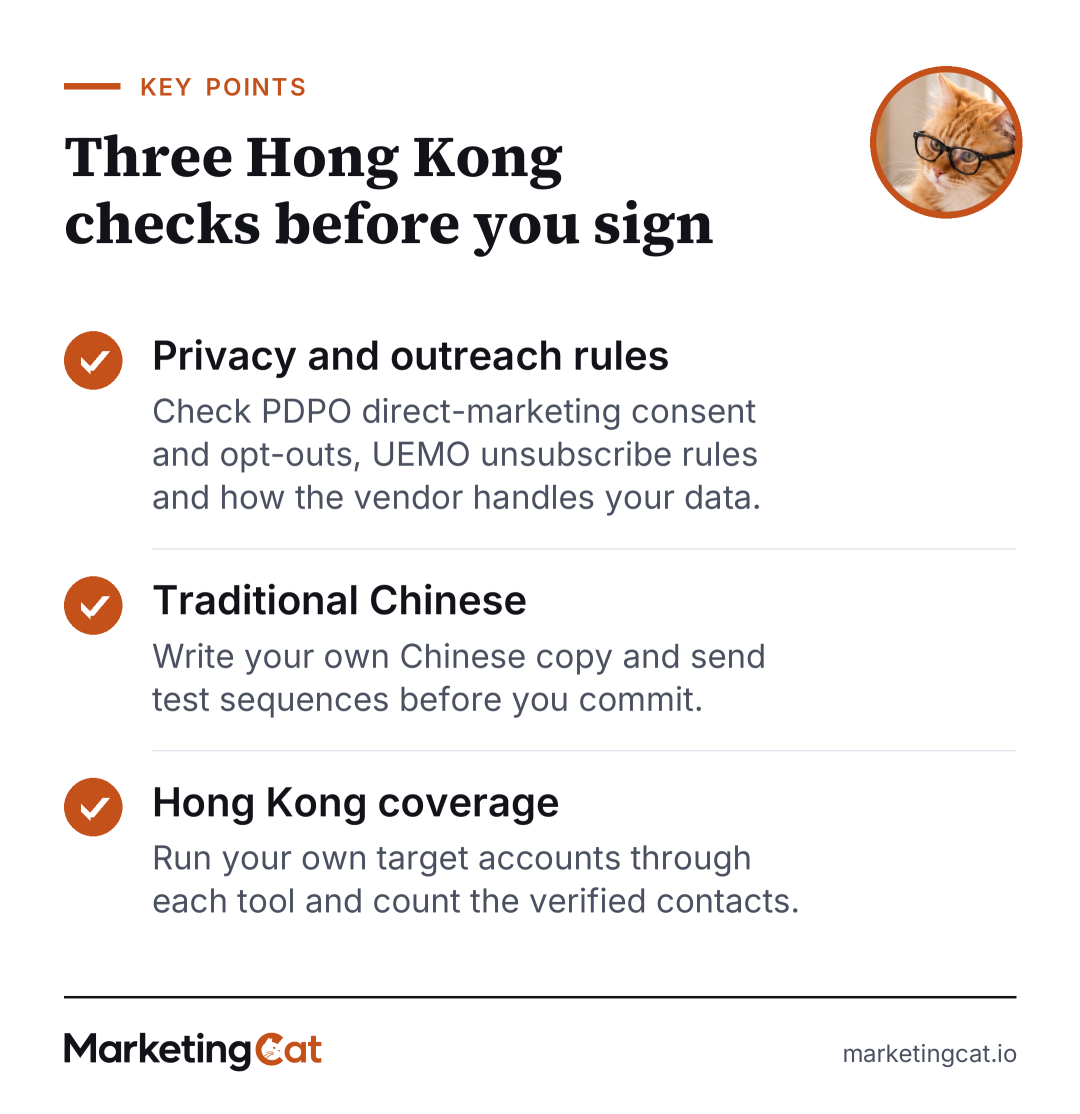
1. Privacy and outreach rules, not just GDPR
Hong Kong’s privacy law is the Personal Data (Privacy) Ordinance (PDPO). In May 2026 the Office of the Privacy Commissioner for Personal Data (PCPD) published the results of compliance checks on 60 organisations. Of the 24 that collected or used personal data through AI systems, all gave people a Personal Information Collection Statement on or before collection; the seven that kept such data set retention periods; and 15 (about 63%) referred to the PCPD’s AI guidance.
Those checks were about AI use, not outreach. Cold outreach raises a different question: may you use a named person’s contact details to market to them? Buying a contact database does not settle it. Under the PDPO’s direct-marketing provisions (Part 6A), a company that wants to use personal data for direct marketing generally has to tell the person and get their consent first, and must stop when they opt out; the PCPD’s Guidance on Direct Marketing explains the details. The PCPD says marketing sent to someone in their work capacity, about products meant only for their company’s use, may fall outside Part 6A; it assesses this case by case, and the PDPO’s other data protection principles still apply. Commercial emails and text messages with a Hong Kong link also fall under the Unsolicited Electronic Messages Ordinance (UEMO). OFCA’s list of sender duties includes clear and accurate sender information, an unsubscribe facility, acting on unsubscribe requests within ten working days, no misleading email subject headings, and not messaging numbers on the Do-not-call registers without consent.
How these rules apply depends on the data, the channel and the circumstances, so have your privacy or legal adviser review the outreach workflow before launch. Then ask each vendor where data is stored, how long it is kept, whether it is used to train models and who can access it. A vendor’s GDPR-compliance claim or ISO 27001 certificate is a useful signal, but neither shows that your own use meets Hong Kong law. This article is general information, not legal advice.
Before you put prospect lists, CRM notes or call transcripts into any AI tool, get internal approval, use only company-approved platforms, check the vendor’s terms on data retention and model training, and keep a person reviewing important outputs.
2. Traditional Chinese outreach: test it yourself
For Hong Kong teams selling to local SMEs or GBA contacts, language support matters at two levels: the interface your team uses every day, and the outreach messages the tool writes or sends. The guides we reviewed do not say how any of these tools handle Traditional Chinese or Cantonese; Leadinfo lists AI-driven email personalisation for Apollo, for example, without mentioning languages. Before committing to an annual contract, write Traditional Chinese copy yourself, send test sequences to internal addresses, and check character rendering, subject lines and any AI-drafted text.
3. Hong Kong data coverage and LinkedIn rules
The guides we reviewed give no coverage figures for Hong Kong or the Greater Bay Area, and MarketingCat has not yet tested them. Leadinfo describes Apollo as primarily US-focused, with data quality that varies outside the US, and Cognism as strong in Europe and the UK. Before buying, run a sample of your own target accounts through each tool on your shortlist and record how many verified emails and direct numbers come back.
For teams whose buyers are active on LinkedIn, Sales Navigator is LinkedIn’s own prospecting product. Third-party tools that send invitations or messages automatically are a different matter: LinkedIn does not permit third-party software, including bots and browser extensions, that scrapes or automates activity on its site, and accounts that break the rules can be restricted. Staying under a daily sending limit does not make a tool permitted, so ask any vendor to show how its product complies with LinkedIn’s current terms.
Which Tool Fits Which Team: A Decision Framework
Hong Kong B2B Lead Generation Tool Selection Framework
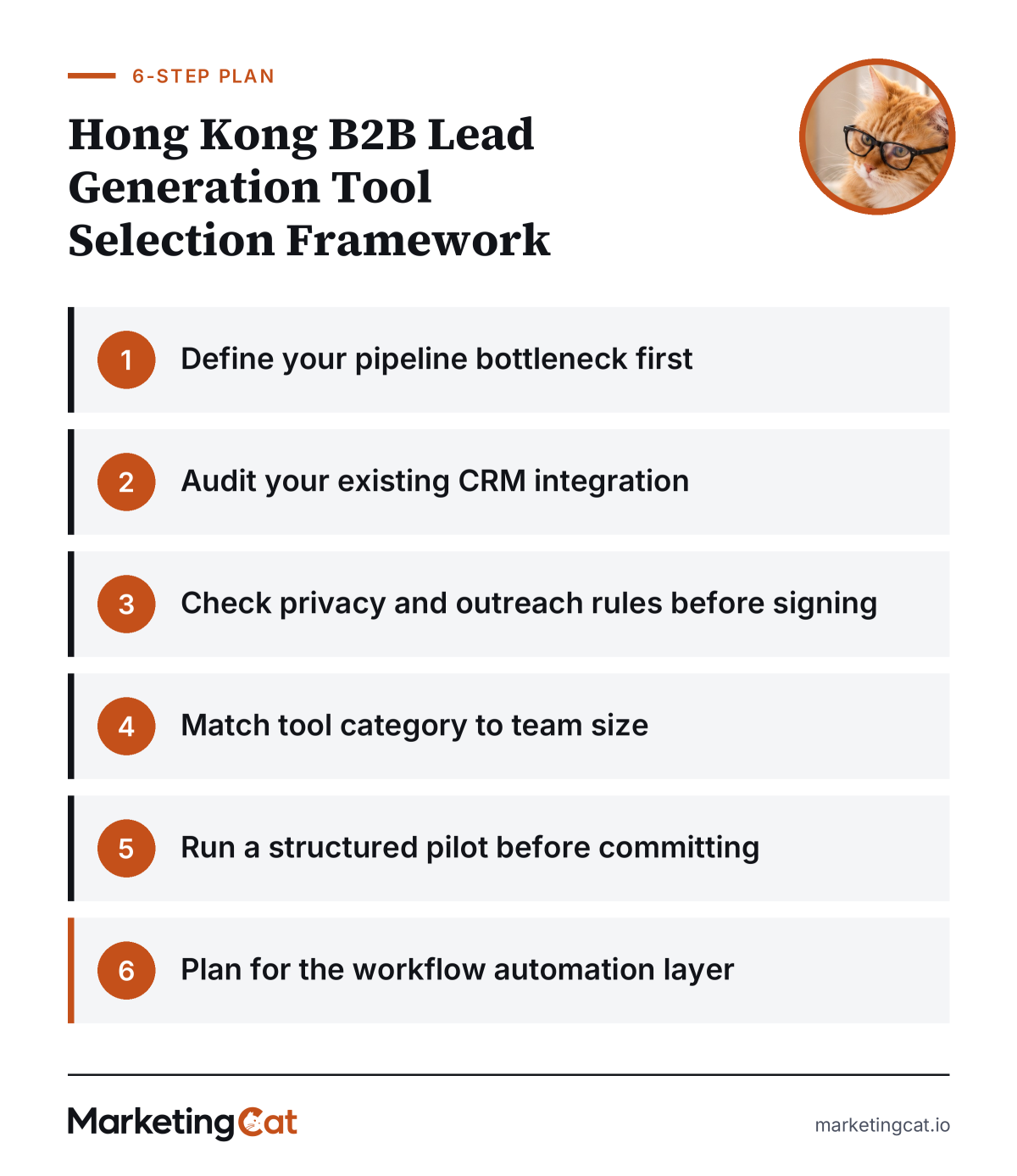
- Define your pipeline bottleneck first. If you lack verified contact data for target accounts, look at a contact-data tool such as Apollo, or Sales Navigator plus Clay for enrichment, and test coverage on your own target accounts. If your website gets traffic but you cannot identify visiting companies, look at Leadinfo or HubSpot Breeze Intelligence.
- Audit your existing CRM integration. Check whether the tool connects natively to your CRM or needs Zapier, Make or n8n in between, and whether that adds cost or delay.
- Check privacy and outreach rules before signing. Confirm where the data comes from and how you will use it. If you will use it for direct marketing, prepare the notices, consent and opt-out handling the PDPO requires, and check emails and texts against the UEMO. Then ask each vendor where data is stored, whether it is used for model training, what the retention period is and whether you can get a data processing agreement.
- Match tool category to team size. A solo marketing manager or two-person sales team is unlikely to need an enterprise platform such as ZoomInfo, whose drawbacks Leadinfo lists as high cost and complex implementation. Apollo’s free plan is a reasonable place for a small team to start.
- Run a structured pilot before committing. Choose a consistent ICP segment, use the same messaging for a manual control group and a tool-assisted group, and measure reply rate, meetings booked, data accuracy and cost per lead, not just opens.
- Plan for the workflow automation layer. As Leadinfo’s 2026 guide notes, a standalone tool creates data silos; the best platforms offer native integrations plus Zapier or Make connectivity. Build your stack so data flows between tools without manual exports, or qualified leads will still go cold between handoffs.
Autonomous AI SDRs vs. AI-Assisted Sales Tools
The sharpest practical distinction in 2026 is between autonomous AI SDR platforms (such as 11x or Artisan, which Chattie says advertise booking meetings themselves) and AI-assisted tools like Apollo or Outreach, where AI helps human reps by scoring leads or drafting messages. Chattie’s guide describes three overlapping product categories (automation tools with cosmetic AI features, AI-augmented platforms, and truly autonomous agents) and warns that teams buying automation tools while expecting autonomous SDR behaviour will be disappointed.
For most Hong Kong SME teams, an AI-assisted platform is the safer starting point. Even with an autonomous agent, Chattie notes, people still define the ICP, review results and step in when needed, and the broader an agent’s scope, the more calibration it needs to stay on-brand. Chattie also warns that a team paying for an autonomous agent when it only needs sequence management is overspending.

What This Means for Teams Selling Across the Greater Bay Area
Teams operating across both Hong Kong and mainland GBA cities face a split-jurisdiction challenge. None of the sources we reviewed covers mainland China’s data rules or how these tools handle them, so teams expanding northward should get specialist legal advice before choosing tools for that market. Until then, keeping mainland and Hong Kong contact records separate in your CRM is a cautious working measure.
For B2B strategies in the region, see our coverage of B2B lead generation in Hong Kong and B2B AI marketing trends for 2026.
Starting Points by Team Situation
These are options to test, not fixed stacks. Start from where your pipeline is actually breaking down.
- Small team, limited budget: if the gap is contact data, start with Apollo’s free plan and check how many of your target accounts it covers. Add Sales Navigator only if your buyers are active on LinkedIn, and add Zapier or Make once the process works.
- Growth-stage team doing regular outbound: a paid data and sequencing tool, Clay for priority accounts if someone can build and maintain the workflows, and your CRM. Check any LinkedIn add-on against LinkedIn’s terms before you buy it.
- Enterprise team with an ABM focus: ZoomInfo or Cognism for verified contacts and intent data, plus Salesloft or Outreach for sequencing. ZoomInfo’s paid plans, Cognism, Salesloft and Outreach are all quote only, so allow time for procurement.
- Inbound-heavy team: Leadinfo (from €69/month) or HubSpot Breeze Intelligence if you already use HubSpot. Leadinfo’s published identification rates are for European markets, so test them on your Hong Kong traffic.
Before comparing prices, add up seats, credits, add-ons and setup time: an entry price can rise quickly once usage grows. And avoid buying from the wrong category, such as paying for contact data when the real problem is a broken follow-up sequence, or investing in an AI SDR before the ICP is clearly defined. Fix the process first, then automate it.
Frequently Asked Questions
Is Apollo.io’s contact database reliable for Hong Kong and Greater Bay Area prospects?
There is no independent Hong Kong evidence either way, and we have not tested it yet. Leadinfo’s 2026 guide lists Apollo’s database at 275M+ contacts and 73M+ companies, but calls the platform primarily US-focused, with data quality that varies outside the US. Treat Apollo as a starting point for list-building, test it on a sample of your target accounts, and consider enriching records from a second source, such as Clay’s waterfall enrichment, before outreach. Verify email addresses before sending to protect deliverability.
Do any of these platforms support Traditional Chinese-language outreach natively?
The guides we reviewed do not say. Teams targeting Cantonese-speaking decision-makers should write Traditional Chinese copy themselves and test character rendering, subject lines and any AI writing features before committing to an annual contract.
What should I ask vendors about PDPO?
Ask where personal data is stored and processed, whether it is used to train AI models, how long it is kept and how deletion is confirmed, and whether the vendor will sign a data processing agreement. The answers help, but your company carries the PDPO duties as a data user and cannot pass them to the vendor, including the direct-marketing rules on notice, consent and opt-outs, and the UEMO rules for commercial emails and texts. Ask your privacy or legal adviser to review the outreach workflow. This is general information, not legal advice.
What is the realistic timeline before a new lead generation tool improves pipeline quality?
Expect an initial period covering setup, CRM integration and ICP definition before outreach data (reply rates, bounce rates, opt-outs) starts to show data quality and messaging fit. Pipeline impact can only be judged once you have enough consistent data to compare. If you use an autonomous AI SDR, allow extra time: Chattie notes that the broader an agent’s scope, the more calibration it needs to stay on-brand and on-message.
Should a small Hong Kong B2B team build a full stack from day one?
No. Start with the single layer where pipeline is breaking down most visibly, usually either contact data or follow-up consistency, and add layers once the first is working. Add workflow automation (Zapier, Make or n8n) only when you have a working process worth automating; automating a broken process at scale makes the problem worse faster.