
Gemini 4 Hydrogen in Google Search: Hong Kong Status
Google’s AI search models are updating fast, leaving teams uncertain whether their pages are even being cited. Here is what Gemini 4 Hydrogen changes in Search, how Hong Kong availability stands, and a five-step framework to audit your visibility.
Meowket's take Do not restructure your website based on vendor promises about AI intent. Baseline your current Search Console impressions across languages first, then see whether query fan-out actually links your technical subtopic pages.
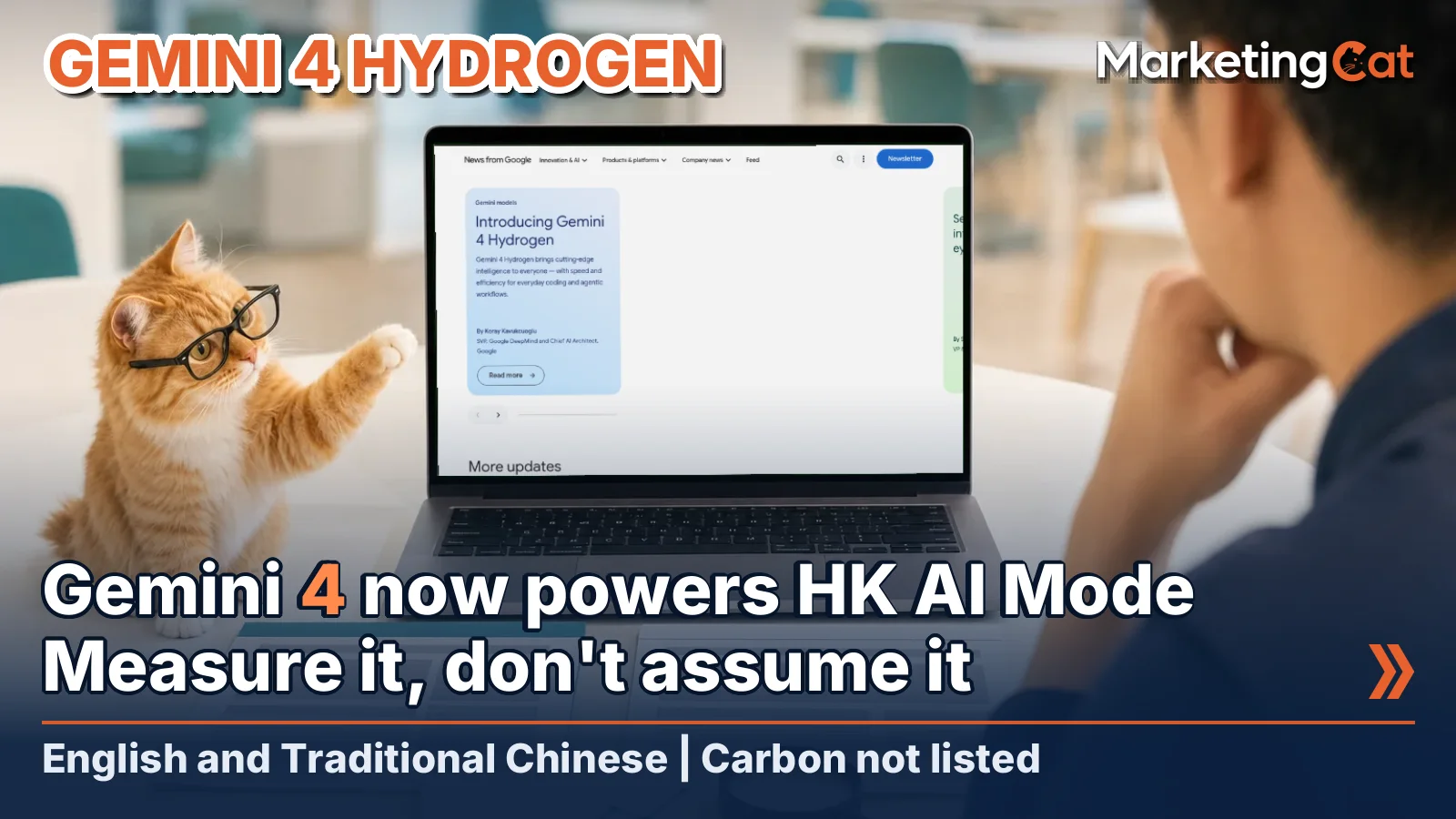
Google announced on 12 November 2026 that Google Search is getting a major upgrade with Gemini 4 Hydrogen. Google’s Hydrogen announcement describes the model as “built for rapid execution across diverse agentic workflows”. It also says Search should now understand intent better, give more visual answers and link to a wider range of sites. For Hong Kong marketers, AI Overviews and AI Mode are officially available locally in English and Traditional Chinese. Google hasn’t published click or citation data for the upgrade, so its effect on your B2B traffic is something to measure, not assume.
Key Takeaways
- Google’s help pages list Hong Kong for both AI Overviews and AI Mode, with English and Chinese (Traditional) among the supported languages. Gemini 4 Carbon in AI Mode is not on its Hong Kong list.
- Google says Hydrogen upgrades query fan-out to surface “a broader range of helpful links”. It hasn’t explained how pages are chosen or shared any click-through data.
- Search Console’s Generative AI performance report shows impressions in AI Overviews and AI Mode, not leads or revenue. MarketingCat’s five-step audit below turns that into a weekly check.
Last checked against Google’s help pages: 13 November 2026.
Can you use Gemini 4 Hydrogen in Google Search in Hong Kong?
Yes, in AI Mode. Google’s AI Mode help page says Hydrogen handles “fast, all-around assistance on most questions”. The announcement says Hydrogen is upgrading Search generally, but it doesn’t say whether Hydrogen powers AI Overviews. Hong Kong appears under Asia-Pacific on Google’s AI Overviews availability list and its AI Mode help page. Both pages list English and Chinese (Traditional) as supported languages (checked 2026-11-13). Google’s announcement says the Hydrogen upgrade reaches “all users globally” and gives no separate country list for it. One exception matters. Gemini 4 Carbon, the frontier model you can pick manually in AI Mode, is not on its own list of supported countries for Hong Kong. Taiwan, Japan, Singapore and South Korea are on that list.
Being on the list doesn’t mean every query shows an AI answer. In March 2026, one user on Google’s support forum reported the AI Mode button missing on google.com in Hong Kong when using English, while AI Overviews worked normally. That is a single report, not a pattern. It’s still a good reason to check what your buyers actually see in each language.
These help pages cover the organic Search features only. They say nothing about ads inside AI answers, which are a separate Google Ads product with their own country list. See our guide on AI Overviews ads in Hong Kong for that question.
What launched, and what each feature can’t do yet
Hydrogen is the new part. AI Overviews and AI Mode are established features, and both are listed for Hong Kong. Only the AI Mode help page names Hydrogen as its model.
| Feature | What it does | Documented limits | Hong Kong status |
|---|---|---|---|
| AI Overviews | AI-generated snapshot with key information and links. It appears when Google’s systems judge it helpful. | “AI responses may include mistakes.” Not every query shows one. | Listed; English and Chinese (Traditional) |
| AI Mode | Conversational answers using query fan-out. Hydrogen handles “fast, all-around assistance on most questions”. Carbon is selectable for harder tasks. | May misinterpret web content or miss context. May show web links when confidence is low. Carbon requires a personal Google Account you manage yourself. | Listed; English and Chinese (Traditional). Carbon option not listed for Hong Kong |
What Google says changes in Search with Gemini 4 Hydrogen
Google lists three Search improvements in its model announcement:
- Better understands your true intent: it handles questions asked in a natural flow of thought, including multi-part queries, hard-to-understand typos and highly specific requests.
- More visual responses: “highly adaptive, visual, and easy-to-scan responses” relevant to the user’s needs.
- Wider range of relevant links: an upgraded query fan-out technique that connects searchers to “a broader range of helpful links than before”.
Query fan-out is the method AI Mode uses to split a question into subtopics and search each one at the same time. The results are then combined into one answer, according to Google’s AI Mode help page.
So does the upgrade apply to AI Overviews, AI Mode or both? The announcement refers to “Search” in general. The AI Mode help page names Hydrogen as AI Mode’s everyday model. Neither source says outright which model generates AI Overviews. These are Google’s claims about quality, not independently measured results.
Will better link discovery change which B2B pages get cited?
It might. The material we reviewed contains no independent measurement of how the upgrade changes which B2B pages get cited. Google says the upgraded fan-out helps people “find sites you previously might not have discovered”. It hasn’t published the criteria fan-out uses to choose one page over another. That means there’s no evidence yet on whether a specialist vendor’s page now beats a large category portal.
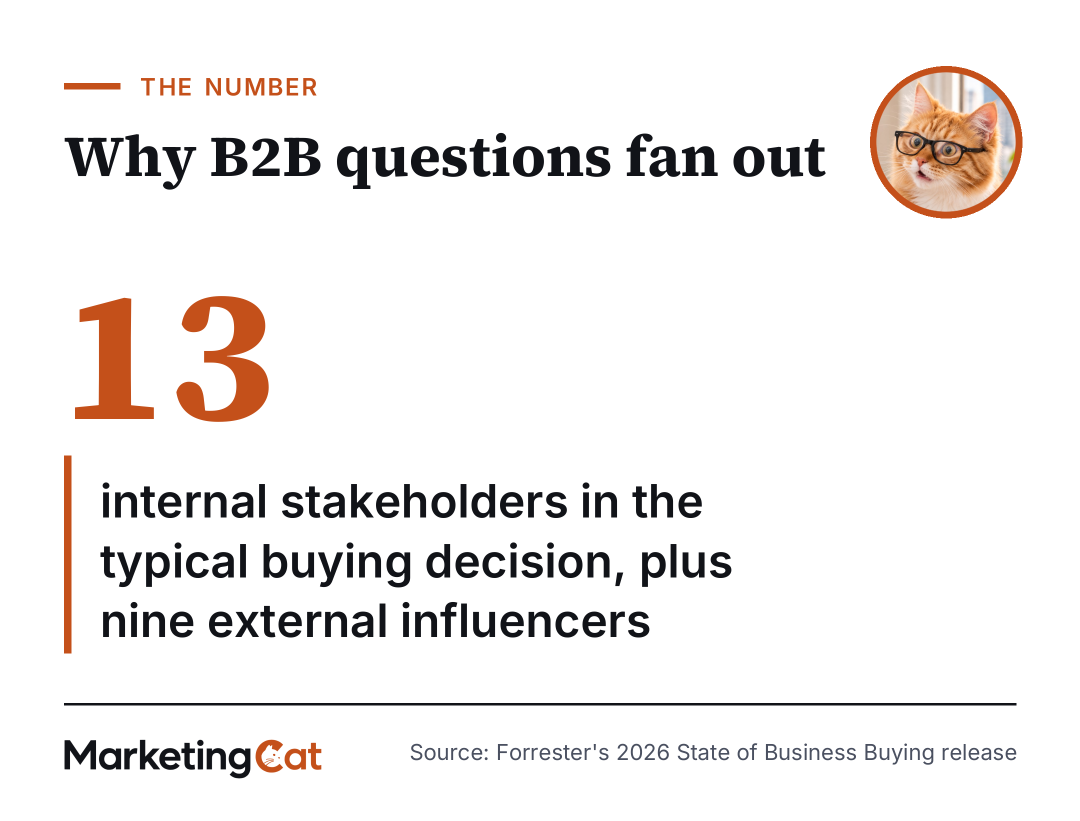
The logic is still useful for B2B planning. A complex buying question breaks into many sub-questions. Forrester’s 2026 State of Business Buying release says the typical buying decision includes 13 internal stakeholders and nine external influencers. They are likely to ask different things, such as integration, security, pricing model or local support.
A page that answers one of those sub-questions clearly has a plausible route into a fan-out answer. That’s a hypothesis to test, not a ranking rule.
Language is an open question for Hong Kong. Google hasn’t confirmed that fan-out behaves the same way for English and Traditional Chinese multi-part queries. A team with bilingual service pages should therefore test both versions separately.
What can you measure in Search Console?
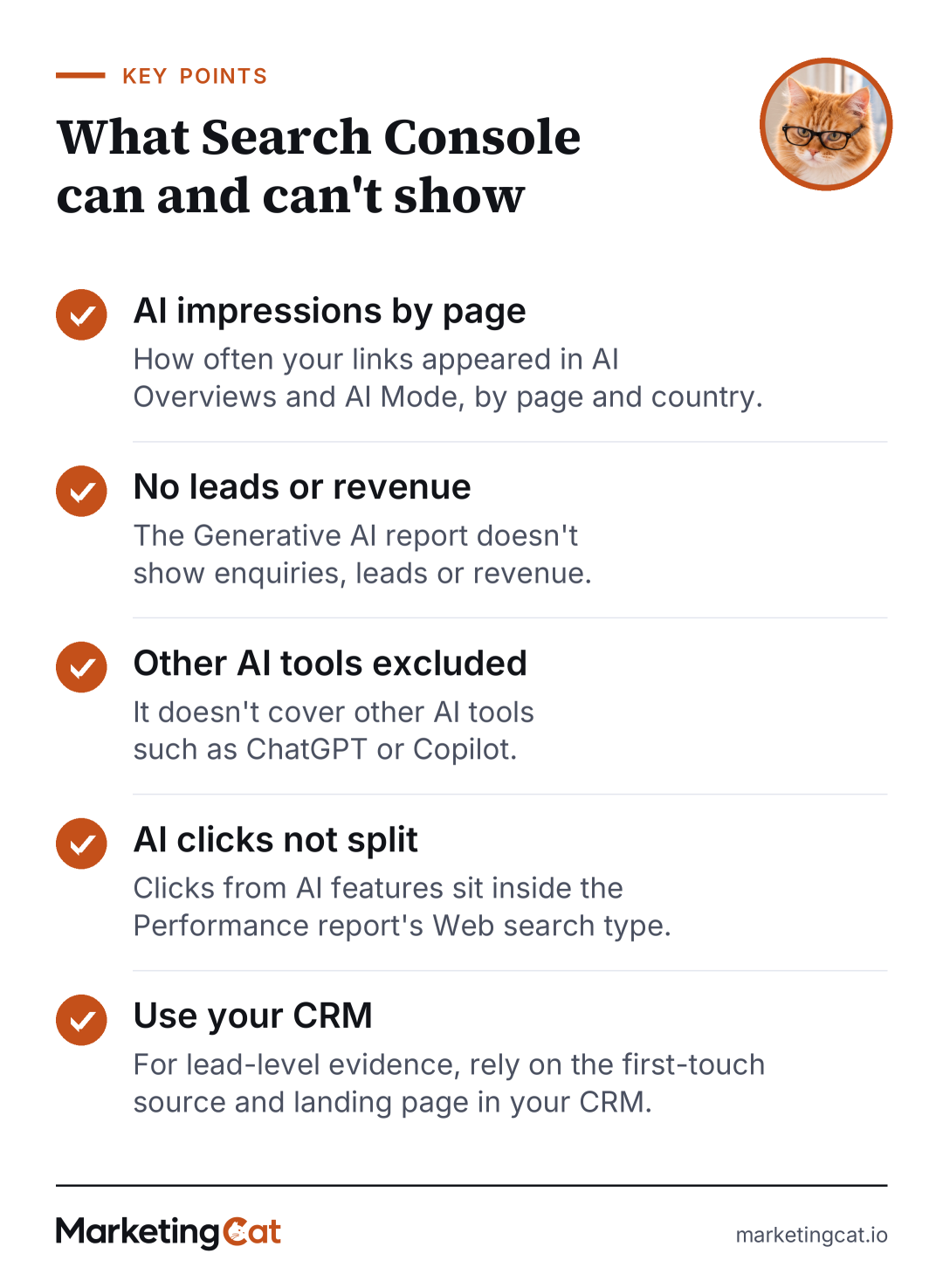
You can measure impressions, but not the leads that follow. Google’s Generative AI performance report was rolled out to all websites worldwide as of 31 August 2026. It shows how often links to your site appeared in AI Overviews and AI Mode, by page, country, device and date. It doesn’t show enquiries, leads or revenue. It also doesn’t cover other AI tools such as ChatGPT or Copilot.
Clicks from AI features sit inside your normal Performance report under the “Web” search type, according to Google Search Central. They aren’t split out there. Search Console also hides anonymised low-volume queries, which affects niche B2B terms. It can’t tell you which query an individual lead used.
The branded queries filter splits Performance report data into aggregate branded and non-branded queries. Google says some queries may occasionally be misidentified. For lead-level evidence, rely on the first-touch source and landing page recorded in your CRM. Our guides to measuring B2B SEO ROI and AI search visibility tracking cover that connection.
What should a Hong Kong team do this week?
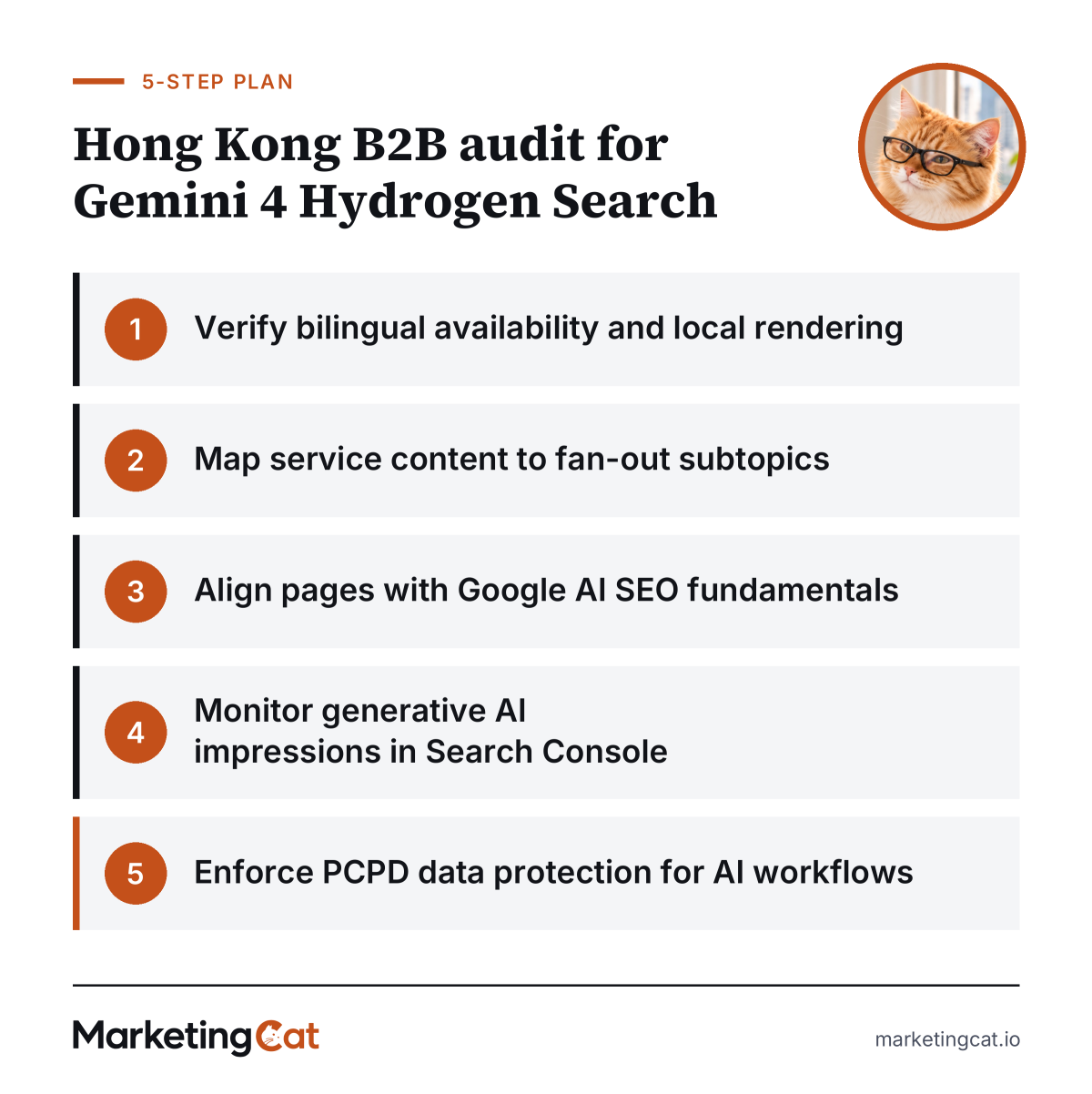
Start with what you can observe: how your bilingual pages appear in AI answers, and how impressions move against a baseline. The checklist below is MarketingCat’s framework, built from Google’s help pages and the PCPD checklist. It is not a list Google publishes.
Hong Kong B2B Audit for Gemini 4 Hydrogen Search
- Verify bilingual feature availability and local rendering: the SEO lead runs your core queries in English and Traditional Chinese on desktop and mobile in Hong Kong, then produces a dated log of which features appeared and which of your pages were linked.
- Map B2B service content to fan-out subtopics: the content lead and a sales manager list the sub-questions each buying role asks, then produce a map showing which page answers each one and where gaps sit.
- Align web pages with Google AI SEO fundamentals: the web or SEO owner checks key pages against Google’s generative AI guide, then produces a prioritised fix list of headings, clarity and indexing issues.
- Monitor generative AI impressions in Search Console: marketing analytics compares weekly AI impressions by page and country against a baseline, then reviews them alongside CRM first-touch data to decide which pages to revise.
- Enforce PCPD data protection for marketing AI workflows: the marketing manager and the data protection lead agree which AI tools and data the team may use for this work, then record that decision as a short approved-use note.
Step 5 matters because a team might paste CRM notes, call summaries or prospect lists into AI tools to brainstorm buyer questions. Before doing so, follow the PCPD’s Checklist on Guidelines for the Use of Generative AI by Employees, published in March 2025. In practice, that means:
- Get internal approval and use company-approved tools only.
- Limit and anonymise any personal data you enter. Check that the anonymisation is adequate before you share anything.
- As MarketingCat’s additional precaution, not part of the PCPD checklist, check the vendor’s terms on data retention, model training and access.
- Have a person review important outputs before they shape content or sales messages.
How it might look in practice
Illustrative example, not real client results. A Hong Kong enterprise logistics and supply chain software vendor audits 20 core bilingual service pages. It maps them to questions likely to come from 13 internal stakeholders and nine external influencers, in line with Forrester’s typical buying group. Each week it tests 30 fan-out subtopic queries in both languages. It compares results against a 60-day Search Console baseline.
To make the test reliable, keep the inputs consistent:
- Use the same query wording, device and signed-in state each week.
- Repeat important queries rather than relying on a single run.
- Log every result with its date.
- Check any pattern against Search Console impressions before changing pages.
MarketingCat’s template: Gemini 4 Hydrogen visibility readiness checklist
- Bilingual pages have clear H2/H3 headings and concise summary paragraphs for human readers, with no custom AI tags.
- Technical solution specifications answer the specific multi-part implementation questions that query fan-out targets.
- Search Console’s Generative AI report is active and checked weekly for impression trends across Hong Kong and regional markets.
- Branded and non-branded query trends are tracked in Search Console as proxies for brand demand and discovery. The filter works only for top-level properties with sufficient query and impression volume.
- Marketing and sales teams follow the PCPD’s generative AI checklist when researching prospect queries or reviewing outputs.
What Google hasn’t backed with detail, and what to watch
The main limitation is that every claim about better answers and wider links comes from Google itself. Several things are missing:
- Google has published no click-through or referral data for the upgrade.
- It hasn’t explained how fan-out picks pages.
- It hasn’t confirmed equal behaviour across English and Traditional Chinese.
- The sources give no Hong Kong user counts.
This article draws on the Search section of Google’s Hydrogen announcement and Google’s help pages. Check Google’s Search upgrade post itself for any added detail. Watch three things next: your weekly impression trend, any update to the Gemini 4 Carbon country list, and whether Google releases traffic data for websites.
The upgrade doesn’t call for a site rebuild. It calls for evidence. This week, run your top 30 service queries in both languages, save the results, and set your Search Console baseline. Review the visibility trend after two months. Treat that as a review point, not proof of what Hydrogen did to your buyer traffic.
Frequently Asked Questions
Do we need special markup or an AI text file to appear in AI Overviews?
No, according to Google. Its guide to optimizing for generative AI features, last updated 10 July 2026, says standard SEO best practices still apply. Sites don’t need new machine-readable files, AI text files, Markdown or special schema.org markup. Google also says content doesn’t need to be broken into tiny pieces for AI. Organise it with paragraphs, sections and clear headings for people. Advice to build special “AI answer blocks” is an agency view, not Google guidance.
Why can’t I see the Generative AI report in Search Console?
Google’s help page gives two possible reasons: your site has had too few impressions in AI Overviews or AI Mode, or it has excluded itself from these features. The report also leaves out Search Labs experiments. Low-volume B2B sites may therefore see gaps. In that case, compare the overall Web search type trend in the Performance report until the report appears.
Can searchers turn off AI Overviews?
Not directly. Google’s help page describes AI Overviews as a core Search feature, like knowledge panels, which can’t be switched off. After running a search, users can select the Web filter, which shows only text-based links without AI Overviews. For marketers, this means classic blue-link rankings still matter. Some buyers may also see your pages without any AI summary in between.
Does Gemini 4 Hydrogen cost extra to use in Search?
Google’s sources give no Search price. The prices Google published apply to developers: $1.50 per million input tokens and $7.50 per million output tokens across Hydrogen’s context window, per Google’s 12 November announcement (checked November 2026). Separately, choosing Gemini 4 Carbon in AI Mode requires a personal Google Account you manage yourself. That option isn’t listed for Hong Kong.


