
How to Get Cited in AI Search: A 5-Step Playbook
When an AI answer names a competitor but not you, the fix is usually reachability, a direct answer with evidence, or consistent brand facts. Here are five steps to improve your citation odds.
Meowket's take Don't pay for AI-only schema or thin query-variant pages. Make sure the right crawlers can reach your key pages, then answer the buyer's question first with evidence only you have.
Why does an AI answer name a competitor but not cite your page? Usually for one of three reasons: the tool couldn’t reach or use your page, your page didn’t answer the question as directly or with as much evidence as another source, or the tool knows your brand only from other sites. Getting cited means fixing all three. This playbook gives five steps, each with an owner, a check and an output, and separates Google’s own guidance from agency and research views. MarketingCat has not run its own platform tests for this guide.
Key Takeaways
- A brand mention, a linked citation, a ranking position and a referral visit are four different outcomes. Track them separately; a mention without a link sends no traffic you can measure.
- Google says its AI features use pages from its search index and need no special AI files or schema. Structured data isn’t required for generative AI search, but accurate markup still helps ordinary results.
- Outside Google, each tool has its own crawler rules. OpenAI says sites that block OAI-SearchBot won’t be shown in ChatGPT search answers; Perplexity uses PerplexityBot for its search results.
Google, OpenAI and Perplexity documentation last checked: 11 November 2026.
Mention, citation, ranking and referral: four different outcomes
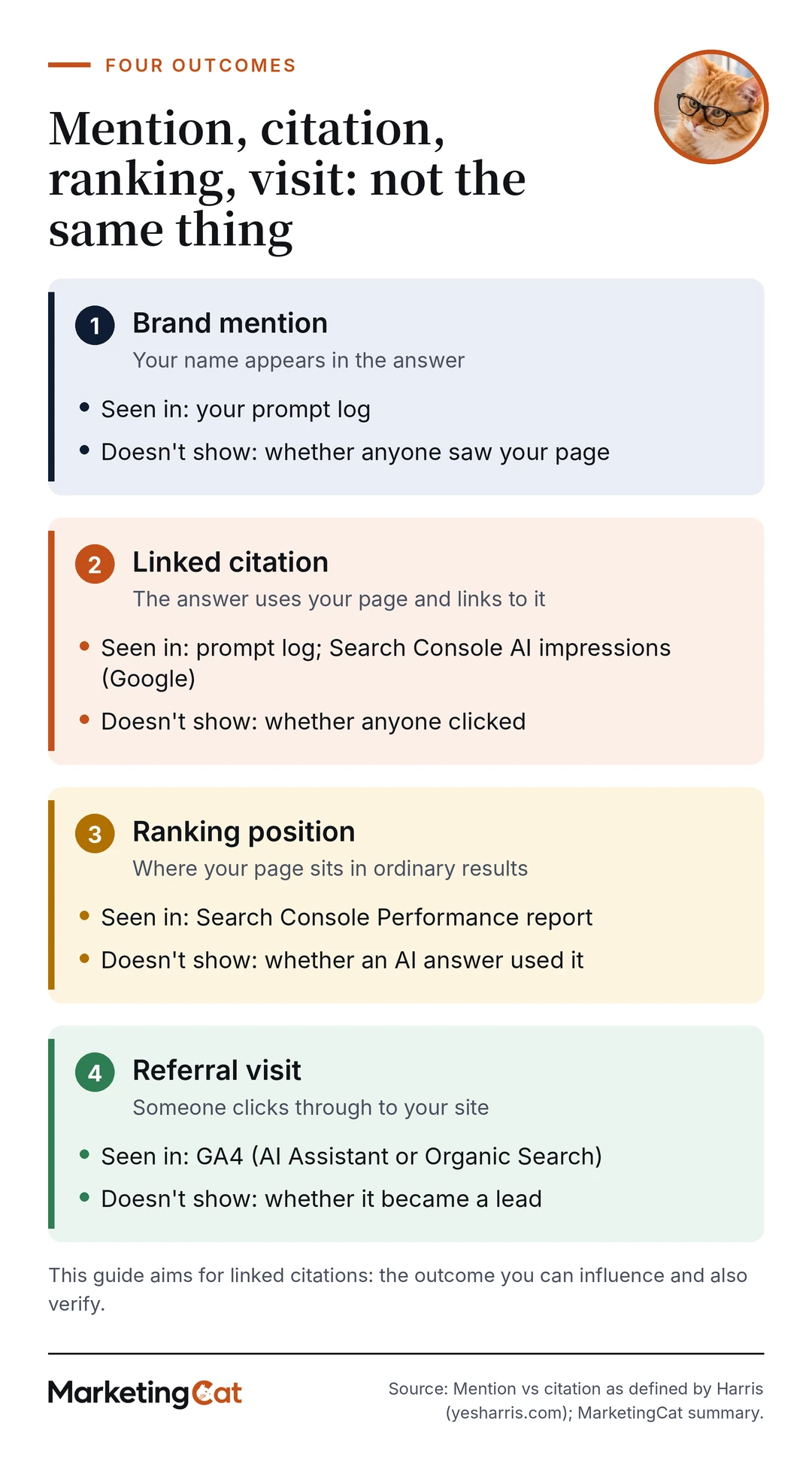
Teams often say “we’re showing up in AI search” when they mean different things. Agree the terms first, because each needs a different fix and a different measure. SEO consultancy Harris (yesharris.com) draws the first distinction: a brand mention is your name appearing in an answer, while a citation is the AI using your content as a source and linking to it.
| Outcome | What it means | Where you see it | What it doesn’t tell you |
|---|---|---|---|
| Brand mention | Your brand is named in the answer | Your prompt test log | Whether the reader saw your page |
| Linked citation | The answer uses your page as a source and links to it | Your prompt test log; Search Console impressions for Google’s features | Whether anyone clicked |
| Ranking position | Where your page sits in ordinary search results | Search Console Performance report | Whether an AI answer used it |
| Referral visit | Someone clicked through from an AI tool to your site | GA4 (AI Assistant channel or Organic Search) | Whether it led to a lead |
This guide targets linked citations, because they’re the outcome you can both influence and verify. For how these outcomes feed a monthly report, see our AI search visibility tracking guide.
How Google’s AI features choose sources
Google’s AI Overviews and AI Mode draw on Google’s search index. Google’s guide to generative AI features, last updated 10 July 2026, describes two techniques. Retrieval-augmented generation, also called grounding, fetches relevant pages to improve the accuracy and freshness of a response. Query fan-out runs a set of related queries at the same time to gather more information.
Fan-out matters for B2B pages. A buyer’s question about “WMS software for a Hong Kong 3PL” may trigger related searches about pricing, integration and support. A page that answers only the headline keyword misses those. The same guide says there’s no need for AI text files, Markdown or special schema.org markup, and that structured data isn’t required for generative AI search. Google’s page on AI features and your website adds that no special optimisations are needed to appear.
Platform availability differs by tool. Google AI Overviews, AI Mode and the Gemini app officially list Hong Kong, Microsoft’s wording implies Copilot is available here, and ChatGPT’s list does not include Hong Kong. Our guide to generative engine optimisation has the full, dated table.
A five-step plan to get cited in AI search
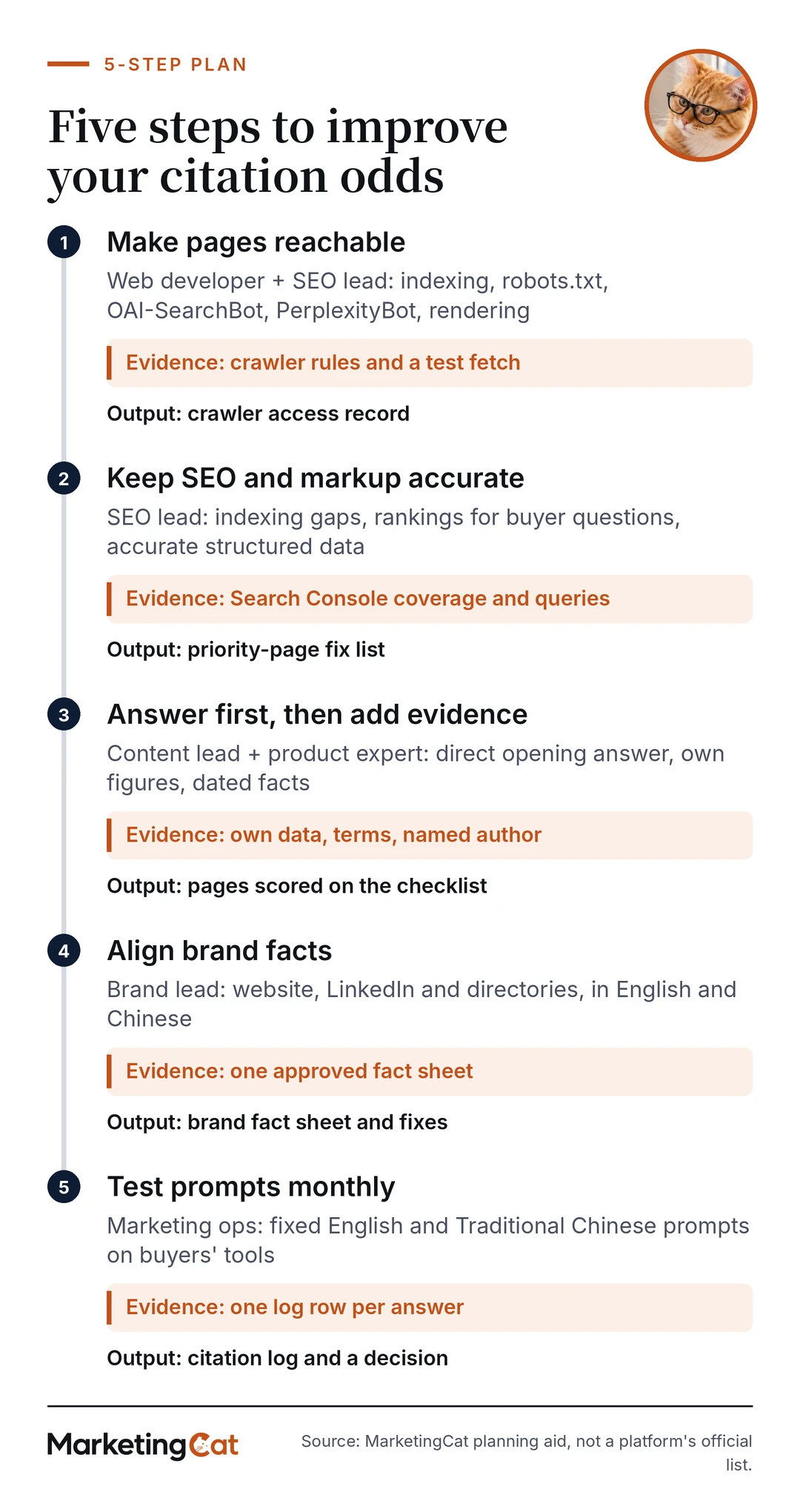
The framework below is MarketingCat’s planning aid, not a platform’s official list. Each step says what to check, who owns it, what evidence to collect and what it produces.
| Step | Owner | What to check | Evidence to gather | Output |
|---|---|---|---|---|
| 1. Crawler access and rendering | Web developer and SEO lead | robots.txt, CDN rules, indexing, rendering, AI-features setting | Crawler rules for each tool you target; a test fetch of key pages | Crawler access record |
| 2. Organic SEO and accurate markup | SEO lead | Indexing gaps, rankings for buyer questions, structured data | Search Console coverage and queries for priority pages | Priority-page fix list |
| 3. Answer first, then add evidence | Content lead with a product expert | Does each page answer the question in its opening and add something others don’t? | Own figures, pricing terms, process detail, named author | Rewritten pages, scored on the checklist below |
| 4. Consistent brand facts | Brand or communications lead | Company and product facts on your site, LinkedIn and directories, in both languages | One approved fact sheet | Brand fact sheet and a list of fixes |
| 5. Monthly bilingual prompt test | Marketing operations | Fixed English and Traditional Chinese prompts on the tools your buyers use | One log row per answer | Citation log and a scale, revise or stop decision |
Illustrative example, not real client results: a Hong Kong B2B cybersecurity software vendor wants citations from enterprise buyers in Hong Kong and overseas. It picks five priority pages, tracks four AI tools and tests 12 prompt scenarios every 30 days. The steps below use this example.
Step 1: Check crawler access and rendering
A tool can’t cite a page it can’t fetch. For Google, the AI features page says a page must be indexed and eligible to be shown in Search with a snippet to appear as a supporting link. Confirm that key pages meet that bar, have no nosnippet rules you didn’t intend, and that nobody has opted the site out of generative AI features in Search Console. For other tools, check their own crawler rules before you edit robots.txt:
- ChatGPT search: OpenAI’s crawler documentation says OAI-SearchBot surfaces sites in ChatGPT’s search features, and sites that block it won’t be shown in ChatGPT search answers. GPTBot is a separate crawler for model training, and each setting is independent.
- Perplexity: Perplexity’s documentation says PerplexityBot helps sites appear in its search results and is not used to train foundation models.
- Microsoft Copilot: check Microsoft’s Bing Webmaster documentation; we haven’t verified Copilot’s crawler rules for this guide.
Rendering matters most for crawlers outside Google. Harris explains that server-side rendering (SSR) sends complete HTML on first load, while client-side rendering (CSR) sends a near-empty page that needs JavaScript. It recommends SSR for home, product, service and article pages. A quick test: view the page source and check that your main answer is in the HTML.
Step 2: Strengthen organic SEO and keep markup accurate
Google’s guidance: its AI features use its search index, so pages that rank and index well start with an advantage. Structured data isn’t required for generative AI search, and there’s no special AI markup. Keep Organization and Article markup accurate because it supports ordinary rich results, not because it unlocks AI answers.
Third-party research: digital agency Kickads cites studies by SE Ranking and seoClarity that found a high overlap between AI citations and top-ranking organic results. The two studies measure different things, and both show correlation only. Read them as “ranking helps you into the pool of candidates”, not as a guarantee.
Before you publish, you can check each page’s title and meta description, in English or Chinese, with our headline and meta description checker.
Step 3: Answer the question first, then add original evidence
Google’s guidance: offer unique, non-commodity content with expert or first-hand takes that go beyond common knowledge. Google also warns that creating pages mainly to manipulate rankings or AI responses violates its scaled content abuse policy. For the cybersecurity vendor, that means one strong page per real buyer question, not dozens of near-duplicates.
Agency view: Kickads recommends answering the question in roughly the first 200 words. That’s a sensible editing rule, not a Google requirement. Separately, a study by researchers from Princeton, Georgia Tech, the Allen Institute for AI and IIT Delhi (Aggarwal et al., KDD 2024) found that adding statistics, quotations and citations raised a source’s visibility in generative answers. That was a research setting, not a guarantee on live platforms.
If writers use call notes or CRM records to draft pages, get internal approval, use company-approved tools and remove personal data first. The PCPD’s Checklist on Guidelines for the Use of Generative AI by Employees (March 2025) covers permitted tools, limiting what’s entered and human review of outputs.
What a citable source page looks like
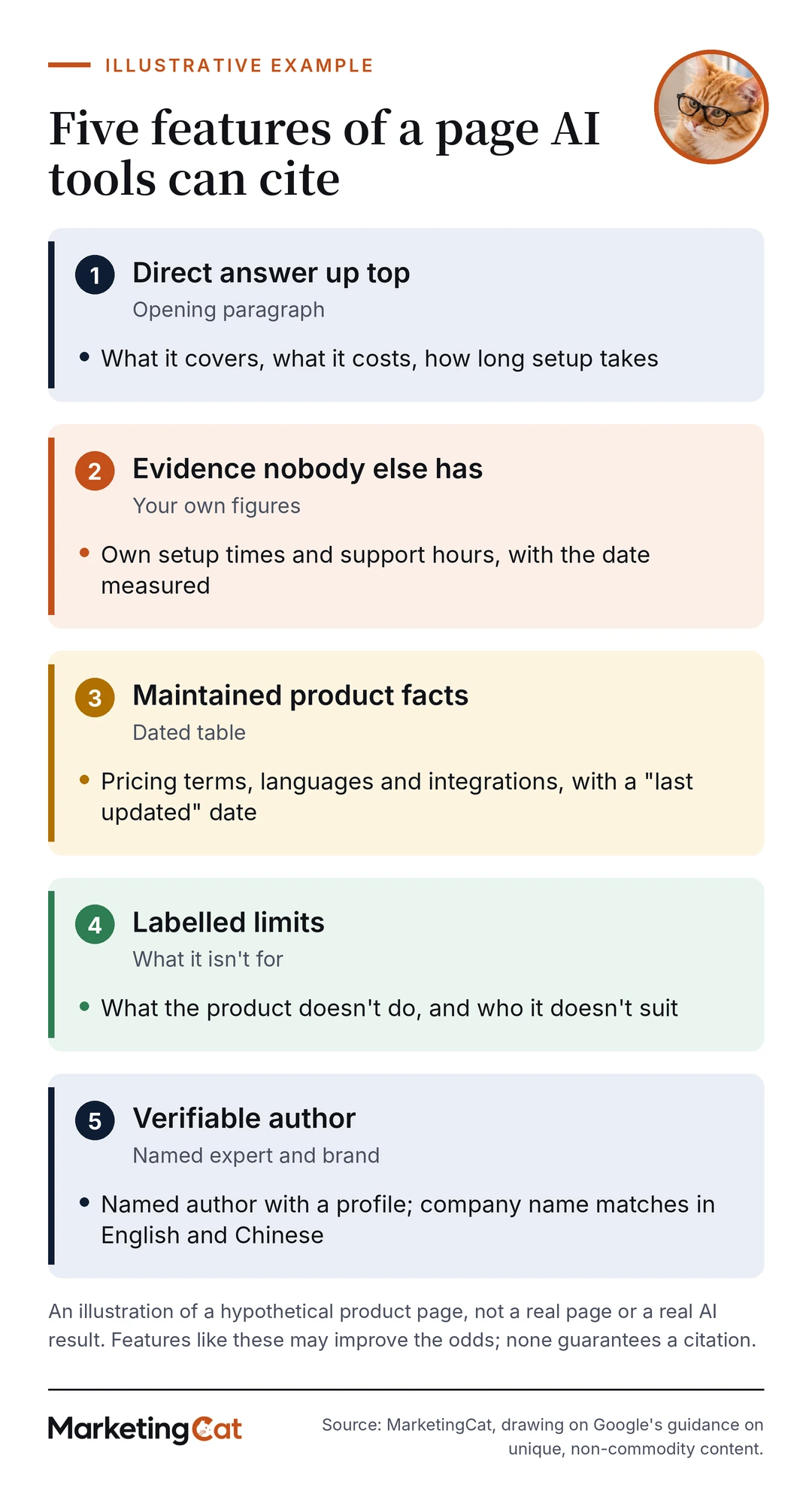
A page that AI tools can use well looks much like a page a busy buyer can use well. The example below is illustrative: a product page for the cybersecurity vendor, annotated to show five features. It is not a real page or a real AI result.
- A direct answer up top. “Phishing detection for Hong Kong banks: what it covers, what it costs and how long setup takes”, answered in the opening paragraph.
- Evidence nobody else has. The vendor’s own setup times and support hours, with the date they were measured.
- Maintained product facts. Pricing terms, supported languages and integrations in a table with a “last updated” date.
- Labelled limits. What the product doesn’t do, and which customers it isn’t for.
- A verifiable author. A named security lead with a profile page, plus a consistent company name in English and Chinese.
MarketingCat’s template: AI Citation Readiness Checklist
Score each priority page yes, partly or no before it goes live. It’s a planning aid, not a proven model, and a high score doesn’t guarantee a citation.
| Check | What “yes” looks like |
|---|---|
| Reachable | Indexed in Google; the crawlers you target are allowed; the main answer is in the HTML |
| Answer first | The opening paragraph answers the buyer’s question on its own |
| Original evidence | At least one figure, process detail or term that only you can provide, with a date |
| Maintained facts | Prices, specifications and languages in a dated table that someone owns |
| Labelled limits | The page says what the product or advice doesn’t cover |
| Verifiable author and brand | Named author with a profile; company name and details match LinkedIn and directories |
| Language fit | English and Traditional Chinese versions written for each audience, not machine-translated |
Step 4: Keep brand facts consistent across the web
AI tools read about you on other sites, not just your own. Hong Kong agency SDMC argues that active company and executive LinkedIn profiles build trust signals for B2B brands; that’s an agency view, not a platform rule.
Write one brand fact sheet in English and Traditional Chinese covering the legal and trading name, products, markets served and certifications. Then check that your website, LinkedIn pages and directory listings match it. Mismatched Chinese and English company names are a common and easy gap to close.
Publish by hand, with LinkedIn’s own tools, or through a scheduler that uses LinkedIn’s official API. LinkedIn doesn’t permit third-party software or extensions that scrape or automate activity on its website, and it may restrict accounts that use it.
Step 5: Run a monthly bilingual prompt test
Search Console covers only Google’s features, so check the other tools by hand. Use the same prompts each month, in English and Traditional Chinese, and record what each tool cites.
Illustrative prompts for the cybersecurity example:
- “Which cybersecurity software vendors serve banks in Hong Kong?” / 「香港有哪些網絡安全方案供應商適合銀行使用?」
- “How can a Hong Kong financial firm detect phishing aimed at staff email?” / 「香港金融機構如何偵測針對員工電郵的釣魚攻擊?」
- “Compare [Brand] with [Competitor] for mid-sized Hong Kong companies.” / 「比較 [品牌] 與 [競爭對手],哪個較適合香港中型企業?」
Keep wording identical and use the same session settings each time. Run important prompts more than once. Log the date, tool, language, location, whether you were mentioned, whether you were cited, the URL and whether the facts were correct. These prompts shouldn’t need customer data.
How to budget, measure and decide
Costs are mostly staff time: developer time for robots.txt and SSR changes, writer and expert time for rewrites, and a few hours a month for the prompt test. Citation-tracking software is optional.
Take as your primary KPI the number of your 12 scenarios in which each tool cites one of your pages with correct facts. Make the first run your baseline, and use Search Console AI impressions for target pages as a supporting signal. Scale when citations hold or grow over several monthly runs and CRM data shows leads landing on those pages. Revise a page when tools cite it with wrong facts. A rise that coincides with your changes is a sign, not proof that the changes caused it.
Common mistakes and limits
- Buying “AI files” or special schema that Google says it doesn’t need.
- Mass-producing query-variant pages, which Google treats as scaled content abuse.
- Blocking OAI-SearchBot or PerplexityBot by accident while trying to block training crawlers.
- Counting brand mentions as citations, or citations as traffic.
- Reading Google’s organic availability in Hong Kong as ad availability.
The SE Ranking and seoClarity studies reach us through an agency blog, not the original reports, so treat them as indicative. We haven’t verified Microsoft’s crawler documentation for Copilot.
For most Hong Kong B2B teams, the fastest gains come from fixing reachability and rewriting a handful of pages so they answer the buyer’s question with evidence only you have. This week, open your robots.txt, check that OAI-SearchBot and PerplexityBot aren’t blocked by mistake, and run three buyer prompts in each language. That log is your baseline.
Frequently Asked Questions
Should we block AI crawlers to protect our content?
Separate search crawlers from training crawlers. OpenAI says OAI-SearchBot controls whether sites appear in ChatGPT search answers, while GPTBot collects training data, and each setting is independent. Blocking GPTBot doesn’t remove you from ChatGPT search; blocking OAI-SearchBot does, although OpenAI says a blocked site can still appear as a navigational link. Gated or confidential material is a separate decision for legal and IT.
Do we need separate Traditional Chinese pages?
Often, if your buyers search in Chinese. Google lists Traditional Chinese among the supported languages for AI Overviews and AI Mode. Give a question its own page when its language or intent differs, then use the monthly test to see which version gets cited.
Can we pay to be cited in AI Overviews?
No. Organic citations come from Google’s retrieval and ranking systems. Paid placements inside AI Overviews or AI Mode are a separate Google Ads product with its own country list, so check Google Ads Help for Hong Kong status and track paid and organic results separately.
How long before changes show up in AI answers?
Our sources give no timetable. OpenAI and Perplexity say robots.txt changes can take about 24 hours to take effect, but that’s only access, not citation. Watch your monthly prompt log over several cycles rather than judging after one run.


