PCPD Agentic AI Guidance: A B2B Marketing Checklist
Hong Kong’s privacy watchdog confirms deployers stay accountable under the PDPO when AI agents act across systems. See how the new guidance impacts automated enrichment and outreach.
Meowket's take Most useful for B2B marketing leaders and RevOps teams deploying autonomous AI agents across Hong Kong CRM workflows.

Hong Kong’s Office of the Privacy Commissioner for Personal Data (PCPD) has made one point clear: organisations that deploy AI agents remain accountable as data users under the Personal Data (Privacy) Ordinance (PDPO). For marketers, that means when an AI agent enriches a CRM record or sends a follow-up, the company behind it is still responsible for the personal data involved. The PCPD’s guidance Protecting Personal Data Privacy in the Use of Agentic AI, published on 25 August 2026, does not create a new law. It explains how existing PDPO requirements apply to autonomous AI tools and sets out nine recommendations. This article maps those recommendations to a six-check deployment framework for B2B marketing teams.
Key Takeaways
- The PCPD published its agentic AI guidance on 25 August 2026. It names five privacy risks (extensive access, system vulnerabilities, vulnerable plugins or skills, function creep and multi-agent risks) and makes nine recommendations.
- The guidance is not new legislation. Organisations that deploy AI agents remain accountable as data users under the existing PDPO for what the agents do with personal data.
- Our six checks cover all nine recommendations, plus the direct-marketing and electronic-message rules for agent-run outreach: access and minimisation; purpose and transparency; accuracy, retention and individual rights; direct-marketing and message gates; security and governance; and risk assessment with a staged roll-out.
What did the PCPD’s agentic AI guidance say?
The PCPD told organisations to limit what AI agents can reach, be open about using them, keep personal data accurate, purpose-bound and time-limited, and put clear responsibility around every deployment. According to the PCPD’s media statement of 25 August 2026, the guidance makes nine recommendations:
- Avoid excessive or arbitrary collection of personal data for use by agentic AI.
- Be transparent about the use of agentic AI in processing personal data.
- Ensure accuracy of personal data processed by agentic AI.
- Set appropriate retention periods.
- Ensure personal data is not used for a new purpose without consent.
- Safeguard the security of personal data in agentic AI systems.
- Uphold data access and correction rights.
- Conduct continuous risk assessments.
- Assign clear responsibilities and provide training.
The guidance also includes a Security Checklist covering evaluation, preparation, deployment, use and cessation of use. The PCPD describes it as supplementary guidance to its 2024 Artificial Intelligence: Model Personal Data Protection Framework, which remains generally applicable to agentic AI. The Digital Policy Office and the Hong Kong Applied Science and Technology Research Institute are its supporting organisations. Law firm Reed Smith notes that it is the PCPD’s first guidance aimed specifically at the privacy risks of autonomous AI systems.
Hong Kong’s guidance does not create a new statutory regime. It explains how existing personal-data obligations apply to agentic AI, against a backdrop of wider international scrutiny. On 29 October 2026, the National Law Review’s Quick Clicks roundup listed Hong Kong alongside Australia and South Korea as places where regulators are looking at privacy in “automated and increasingly autonomous AI systems”. Its practical advice was to look at where AI processes personal information or “acts autonomously across enterprise systems”. AI-assisted marketing workflows such as CRM enrichment and automated follow-ups can fit that description.
Which marketing workflows count as agentic AI?
A workflow is agentic when the software can act on its own across several steps and systems, rather than producing text for a person to use. The PCPD defines agentic AI as an intelligent system capable of autonomous perception, memory, decision-making, interaction and execution. It is built on foundation models such as large language models and connected to tools like databases, memory and computer operating systems. Such agents can carry out multi-step tasks according to pre-defined workflows. The PCPD’s examples include handling emails and settling payments.
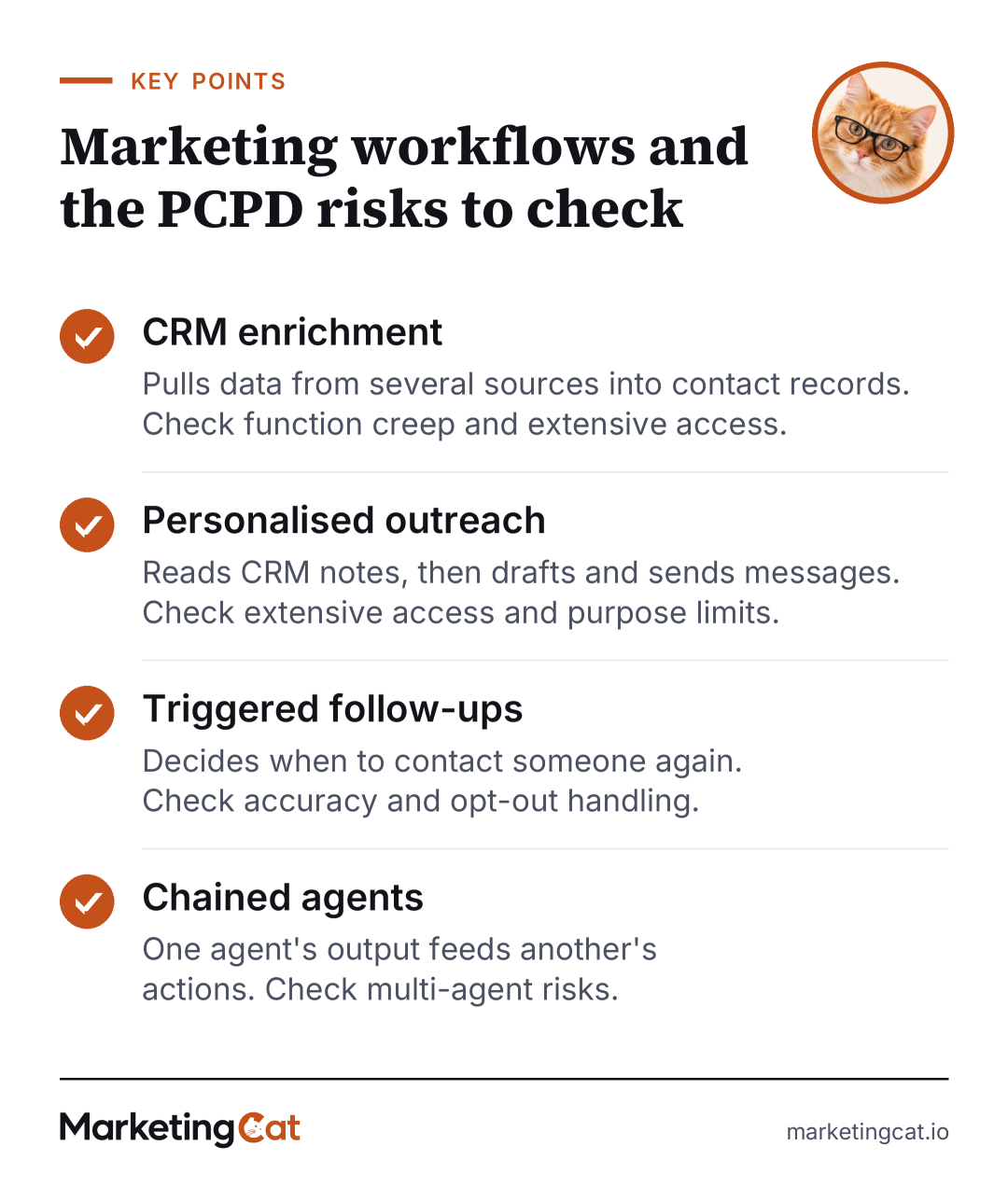
Applied to marketing, a chatbot that drafts an email you copy and paste is at the low end. An agent that reads your CRM, looks up a contact elsewhere, writes the message, sends it and schedules a reminder fits the PCPD’s description much more closely. The table below is our analysis of common B2B workflows against the PCPD’s risk categories.
Illustrative mapping, not a legal classification.
| Workflow | What the agent does | PCPD risk to check first |
|---|---|---|
| CRM enrichment | Pulls data from several sources and writes it into contact records | Function creep; extensive access |
| Personalised outreach | Reads CRM notes, drafts and sends emails or messages | Extensive access; purpose limits |
| Triggered follow-ups | Decides when to contact someone again, based on behaviour | Accuracy; opt-out handling |
| Chained agents | One agent’s output feeds another’s actions | Multi-agent risks |
How do PDPO rules apply when an AI agent, not a person, acts?
The same PDPO rules apply, and responsibility stays with your organisation. As law firm Dentons summarises the guidance, AI agents are not legal persons. Organisations deploying them remain accountable as data users under the PDPO. In our reading, the same applies whether you build the agent or license it from a vendor, so check how your contract sets out the vendor’s own obligations on retention and security.
Data use principles that bite in marketing
A PCPD presentation from October 2026 ties the recommendations to the PDPO’s data protection principles (DPPs):
- Collection (DPP 1(1)): follow data minimisation, don’t collect data for agents simply because it “might be useful in the future”, and ringfence the systems and information an agent can reach for a specific purpose.
- Transparency (DPPs 1 and 5): tell people when agentic AI processes their data, including in Personal Information Collection Statements and Privacy Policy Statements.
- Accuracy and retention (DPP 2): the PCPD suggests chain of thought, context-specific fine-tuning and human review, plus maximum retention periods and timely erasure of conversation histories, cache data and long-term memory. In a CRM, that means verifying enriched contact details against dependable sources, flagging uncertain fields and requiring human approval for higher-risk changes.
- Purpose (DPP 3): spell out what the agent may use data for, so that data isn’t used for a new purpose without consent.
The guidance adds a separate recommendation on data access and correction rights. Under DPP 6, people can ask to see and correct their personal data, so the PCPD recommends choosing agent systems built on “privacy-by-design” and “privacy-by-default” principles that still support those requests.
The purpose rule matters most for enrichment. The PCPD warns that agents often aggregate and recombine personal data from multiple sources, and that some systems may use the data to train large language models. Either can take data beyond the purpose for which it was collected, although whether a particular enrichment does so depends on that original purpose and any directly related one. In multi-agent set-ups, inaccurate data can cascade between agents, and complex data flows can make it hard for people to access or correct their records. A wrong job title from one agent could feed another agent’s outreach.
Direct marketing and electronic message rules
Under Part 6A of the PDPO, the PCPD’s direct marketing guidance says a data user must first tell people how it intends to use their personal data in direct marketing. It must also say which kinds of data it will use and which classes of goods or services it will market, and obtain consent before use. At first use, it must tell people they can ask it to stop, and it must stop if they opt out. Providing personal data to another person, for example by selling it, for that person’s own direct marketing has stricter rules. Marketing sent to someone in their work capacity, about products meant only for their organisation’s use, may fall outside Part 6A. The PCPD judges this case by case, and the data protection principles still apply.
Separately, OFCA’s UEMO page sets out sender duties for commercial electronic messages with a Hong Kong link. Messages need clear sender information and an unsubscribe facility, and unsubscribe requests must be honoured within ten working days. Email subject headings must not be misleading. From the tenth working day after a number is registered on the Do-not-call registers, commercial electronic messages must not go to it without the registered user’s consent. Automated promotional WhatsApp messages may be subject to the UEMO where they qualify as commercial electronic messages with a Hong Kong link. Person-to-person interactive communications can be treated differently, so the applicable rules depend on the message type and context. How both laws apply depends on the circumstances, and this is not legal advice. For an agent, the practical point is that every automated send should check opt-out and unsubscribe status at the moment of sending, not just when the list was built.
If you test agents on real CRM notes or prospect data, get internal approval and use company-approved tools. The PCPD’s generative AI checklist covers permitted tools, limiting and anonymising personal data, and human review of outputs. Assess whether your anonymisation is adequate before you rely on it. Check the vendor’s terms on retention, model training and access.
Where Hong Kong organisations stand on AI and personal data
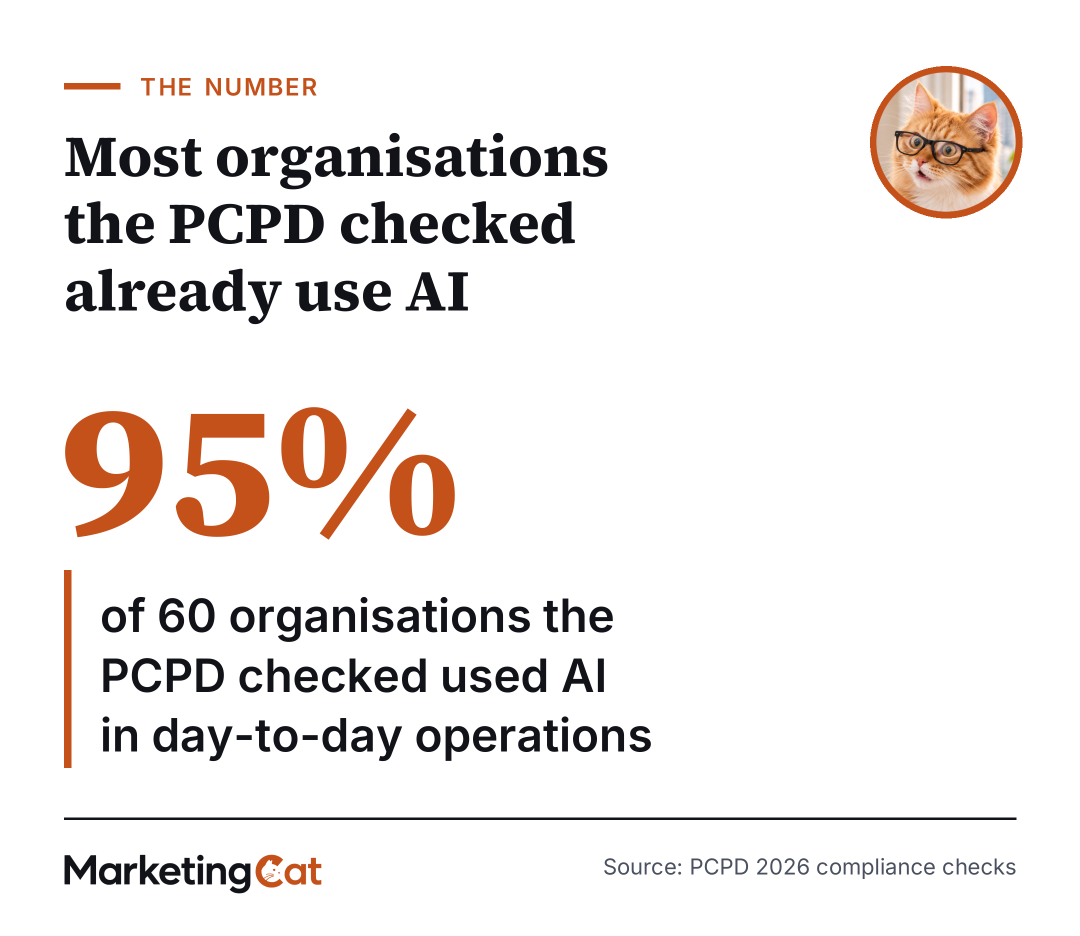
The PCPD’s own compliance checks show what the organisations it examined already do. The figures below come from the PCPD’s compliance-check findings of 19 May 2026, which covered 60 organisations across sectors. They describe that sample, not the Hong Kong market as a whole.
| Finding | Organisations | Share |
|---|---|---|
| Used AI in day-to-day operations | 57 of 60 | 95% |
| Used three or more AI systems | 29 of 57 | About 51% |
| Collected and/or used personal data through AI systems | 24 of 57 | About 42% |
| Said in their collection statements that AI tools process personal data | 7 of 24 | About 29% |
| Ran privacy impact assessments before implementation | 19 of 24 | About 79% |
| Used a “human-in-the-loop” approach to oversight | 19 of 24 | About 79% |
All 24 organisations that used personal data through AI provided Personal Information Collection Statements, but only seven of them said that AI tools process personal data. The five that did not use human-in-the-loop oversight used a “human-in-command” approach, in which people review AI outputs and step in when needed. The PCPD found no contravention of the PDPO in the exercise. These findings are useful governance benchmarks, but the right controls for a marketing agent depend on what it can do. The agentic AI guidance itself calls for a human-in-the-loop approach for decisions likely to have a significant impact on individuals.
What should CMOs check before deploying an AI agent?
Treat each agent as a new data-processing activity and approve it like one. The six checks below are MarketingCat’s B2B implementation framework, adapted from the PCPD’s nine recommendations and the marketing-message rules above. They also connect to wider choices about lead generation automation tools and automating your sales funnel.

Six checks before an AI agent touches your CRM
- Access and minimisation: list which systems, CRM fields, inboxes and records the agent can read, change or delete, and limit them to the task. The PCPD warns that agents often run with higher default access rights.
- Purpose and transparency: record the approved purposes, confirm that enrichment or vendor model training does not create a new purpose, and check that your Personal Information Collection Statement and privacy policy describe the agent’s use of personal data.
- Accuracy, retention and individual rights: name who corrects a wrong CRM field and make sure each change can be traced back to the agent. Confirm that you can still answer data access and correction requests, and set when the agent’s memory, caches and logs are deleted.
- Direct-marketing and message gates: before every agent-triggered send, check consent and opt-out status at the moment of sending, and the PDPO Part 6A and UEMO requirements that apply to the channel and context.
- Security and governance: review plugins and skills before installing them, grant the minimum access rights, keep logs that allow tracing and audit, and agree an incident procedure. Name an owner and an approver, train the people who use or supervise the agent, and bind vendors contractually on retention and security.
- Risk assessment and staged roll-out: test the agent before use, run a proportionate privacy impact assessment and pilot on a small, approved data set. Require human approval for higher-risk actions and for decisions likely to have a significant impact on individuals, and decide what triggers a re-review or shutdown, such as a new model, tool, plugin or data source.
How the six checks map to the PCPD’s nine recommendations
| MarketingCat check | PCPD recommendations covered |
|---|---|
| 1. Access and minimisation | 1 (avoid excessive collection); 6 (minimum access rights) |
| 2. Purpose and transparency | 2 (transparency); 5 (no new purpose without consent) |
| 3. Accuracy, retention and individual rights | 3 (accuracy); 4 (retention periods); 7 (data access and correction rights) |
| 4. Direct-marketing and message gates | Not one of the nine: PDPO Part 6A and the UEMO |
| 5. Security and governance | 6 (security, plugins, traceability); 9 (responsibilities and training) |
| 6. Risk assessment and staged roll-out | 8 (continuous risk assessment, human-in-the-loop); 5 (when human oversight is required) |
Editorial mapping by MarketingCat, based on the recommendation headings and summaries in the PCPD’s media statement. It is not a PCPD checklist.
Example: an AI agent sends a follow-up email
MarketingCat illustrative workflow, not a completed legal assessment or a tested deployment.
- The agent reads only the CRM fields approved for the campaign.
- The workflow confirms the purpose for which the contact’s data was collected and the marketing conditions for the channel, such as direct-marketing consent and the UEMO rules for that message type.
- The agent checks the contact’s current opt-out and unsubscribe status at the moment of sending.
- Higher-risk cases, such as a new segment, an unusual message or a contact with an open complaint, go to a person for approval.
- Approved messages are sent, and the agent keeps a proportionate record of what it sent and which fields it used.
- Corrections, deletion requests and exceptions can be traced to an accountable owner, who updates the record and the agent’s memory.
The vendor questions in checks two, three and five come from the PCPD’s recommendations. The question on action logs and the pilot approach are our own procurement advice, so treat them as a starting point for your procurement and legal teams. Get a separate assessment of whether your own use complies with Hong Kong law, rather than relying on a vendor’s GDPR statement or security certificate.
To make a pilot reliable, give the agent the same inputs across runs and repeat important tasks more than once. Keep a record of prompts, settings and outputs. Check enriched fields against the original records, because an agent’s confident output can still be wrong. Judge commercial value, such as reply rates or meetings booked, against a comparable human-run group before you claim the agent improves pipeline.
What are the limits of this checklist?
We checked the publication date, the five risks and the nine recommendations against the PCPD’s own media statement, and the statistics against its compliance-check findings. The full guidance also contains a Security Checklist for each stage from evaluation to cessation of use, so read it alongside this article before you sign off a deployment. Get legal advice on your specific workflows, especially the work-capacity question under Part 6A and whether a particular message type falls under the UEMO, which both turn on the facts of each case.
Agentic AI could cut manual work in enrichment and follow-ups, but the PCPD’s message is that any efficiency gain doesn’t move accountability anywhere. Agents that touch personal data deserve the same scrutiny as a new CRM integration, and arguably more, because they act without a person in each step. This week, list every tool in your marketing stack that can read contact data and send messages without a human click. Then run the first two checks on the one handling the most records. For context on where AI marketing in Hong Kong is heading, see our 2026 B2B AI marketing trends.
Frequently Asked Questions
Is the PCPD’s agentic AI guidance legally binding?
Not in itself. Law firm Linklaters notes that the guidelines are not law, but they signal what the PCPD regards as compliant behaviour. The PDPO and its data protection principles, which the guidance explains, are binding. In our assessment, a marketing team that ignores the guidance would find it harder to show the PCPD that it handled personal data properly if an agent caused a complaint or a data incident.
Does the agentic AI guidance replace the PCPD’s 2024 Model Framework?
No. The PCPD describes it as supplementary guidance to its Artificial Intelligence: Model Personal Data Protection Framework. That framework covers AI strategy and governance, data preparation, customisation and implementation, continuous monitoring, and communication with data subjects. Teams that already follow the Model Framework should add the agent-specific points, such as restricting access rights and reviewing plugins, rather than starting a separate governance process from scratch.
Can an AI agent automate our LinkedIn prospecting?
Not with third-party automation tools. LinkedIn’s prohibited software policy bans software, including bots and browser extensions, that scrapes or automates activity on its site. It may restrict or shut down accounts that break these rules. Keeping within a daily sending limit doesn’t make such a tool permitted. LinkedIn offers Sales Navigator as its own paid prospecting product. Any personal data you gather still has to meet the applicable PDPO requirements.
Do multi-agent marketing systems carry extra privacy risk?
Yes, according to the PCPD. When several agents pass data between them, an inaccuracy in one record can spread across the chain and lead to unfair or harmful outcomes for the person concerned. Security risks can also be amplified. Complex data flows can make it difficult for people to exercise their rights to access or correct their data. Keeping logs of which agent changed which field helps you trace and fix errors.