How Hong Kong’s Decisions Lab Uses AI to Simulate B2B Buyers
Decisions Lab builds virtual B2B buyers from public information. Here is how marketing and sales teams can use the idea to find weak spots in a pitch, and where real customers still have the final word.
Meowket's take Most useful for B2B software teams preparing a launch or a new sales pitch.

Before a software company approaches a potential customer, how can it tell whether its pitch makes sense to a finance director, an IT manager or a procurement team? Hong Kong startup Decisions Lab is exploring one answer: simulate those buyers with AI. According to Hong Kong Business, it builds virtual buyer profiles from public information and predicts how those buyers might respond to a product and its messaging.
Each of those people judges a pitch differently. The finance director wants to see a return, the IT lead asks about security and integration, and the head of the business unit wants to know whether the team will actually use it. Simulated buyers promise speed, not certainty: they can flag weak arguments early, but they are not evidence of what real customers will do.
Key Takeaways
- Decisions Lab, founded in 2024, mainly works with enterprise software vendors in cybersecurity, insurance and productivity, Hong Kong Business reports.
- Simulated buyers are most useful for finding objections and questions worth testing before a launch, a campaign or a new sales pitch.
- Repeat important tests, record the prompts and confirm the top findings with real buyers; get internal approval before putting customer data into an AI tool.
What Decisions Lab does
In a report published on 26 October 2026, Hong Kong Business said Decisions Lab was founded in 2024; its founder and chief technology officer is Devansh Gandhi. The buyer profiles draw on sources such as social media posts and business developments. Gandhi said the technology also looks at psychological factors that might shape buying decisions, to help clients spot unclear messaging before a product goes to market.
Its clients are mainly enterprise software providers in cybersecurity, insurance and productivity, whose target customers often include CEOs and other senior executives who can be difficult to reach for interviews. Decisions Lab works with clients in Hong Kong and the US and is in talks about potential work in Singapore and Malaysia.
How accurate are the simulations? The report gives no figures. Gandhi told Hong Kong Business that Decisions Lab makes predictions, clients test them in the market, and “the results help us assess their accuracy and improve our technology over time”. He also said the startup would survey real audiences alongside its simulations to compare predicted responses with actual behaviour. Neither amounts to published evidence that the simulations predict real buying decisions.
What a synthetic buyer panel is, and what it is not
A synthetic buyer panel is a set of AI-generated buyer personas that a team can question: you show each one a pitch, a feature list or a pricing page and ask how that kind of buyer would react. Vendors call the wider practice synthetic market research. Vendor Symar defines it as research workflows that use AI-generated or AI-simulated respondents to model how customers are likely to react.
It differs from two tools B2B teams already use. A buyer persona document describes who the buyer is; a simulated panel produces reactions that you can compare across several versions of a message. AI role-play in sales training helps individual sellers practise a conversation; a buyer panel is aimed at the message and the go-to-market plan.
It is not a representative sample. A simulated CFO is a model of what a CFO might say, built from whatever data and assumptions went into it. It cannot tell you how many Hong Kong buyers share that view, what they would pay or who really holds the budget in a given account. Even vendor Minds describes simulated buying committees as giving directional insight, not statistically representative evidence.
An example: one pitch, four buyers
Take a hypothetical case: a Hong Kong software company is selling a customer-service platform to the Hong Kong office of a regional insurer. The purchase might need agreement from finance, IT, the head of customer operations and procurement, and possibly sign-off from regional headquarters. The table shows how the vendor could use a simulated panel to prepare, and what would still need checking with real buyers.
| Simulated role | Possible objection | Message to test | What only real buyers can confirm |
|---|---|---|---|
| CFO or finance director | “How will we measure the return?” | Commercial value and cost assumptions | Their actual buying criteria, return expectations and budget limits |
| CTO or IT lead | “Will this meet our security and integration requirements?” | Integration, reliability and data security | Real technical requirements and approval gates |
| Business unit head | “Will my team actually use it?” | Workflow change and adoption | Day-to-day pain points and rollout barriers |
| Procurement | “What are the contract and vendor risks?” | Support, terms and risk management | Real tender, contract and approval conditions |
Illustrative editorial example, not an actual Decisions Lab client result or a validated buyer-response study.
How to test a sales message with simulated buyers
The five steps below are MarketingCat’s suggested workflow, not Decisions Lab’s method. They assume you already have some real customer knowledge to build on.

Five steps to test a sales message with simulated buyers
- Start from real customer evidence. Build two to four personas from win/loss notes, CRM records, support questions and interview notes, and mark clearly where you are guessing.
- Write the questions first. List three to five things you want to learn, and prepare two or three versions of the message so the panel has something to compare.
- Run the same script for every persona. Use the same prompt structure and source materials for each persona. Repeat important tests and record the prompts and outputs, so you compare patterns rather than rely on a single answer.
- Sort reactions by role and buying stage. Group objections by who raised them and where they would come up: the first meeting, the technical review or the commercial sign-off.
- Take the top two or three findings to real buyers. Test them in discovery calls, customer interviews or a small campaign before you change the pitch, the product page or the price.
If you have little customer data, for example for a new product in a new market, the personas rest mostly on assumptions and are less reliable. The panel can still help you draft interview questions, but treat its output as a brainstorm and plan extra conversations with real buyers to check it.
Where it helps, and where it doesn’t
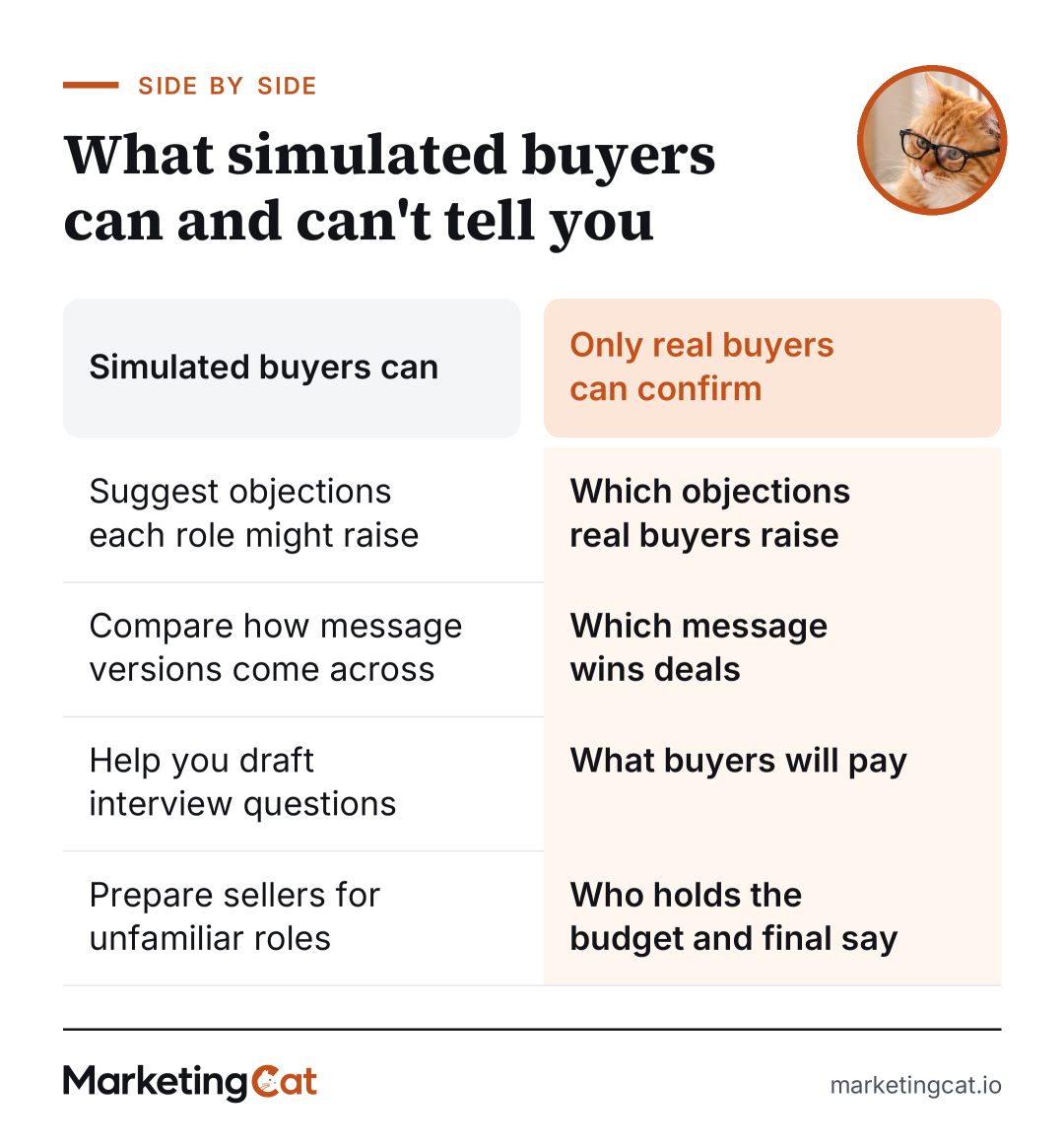
A confusing sales message is easier to fix in a draft presentation than after a campaign has launched. Simulated buyers may help a team spot possible objections while there is still time to change the pitch. They can also help list the questions a new segment might ask, brief sellers on roles they rarely meet, and compare two or three message angles side by side. The same role-by-role thinking applies to B2B lead generation, where each decision-maker in a buying committee needs a different argument.
It is a poor guide to pricing. A simulated procurement buyer can suggest how a per-seat model might be questioned compared with an enterprise licence, which is useful when planning real customer research, but it cannot show what buyers will pay.
Risks to manage before you start
The biggest risk is overconfidence. AI models write fluent, plausible answers, and a confident objection from a simulated CFO can feel like evidence. Personas also inherit the team’s blind spots: if marketing and sales disagree about what customers value, the simulation will simply reflect whichever assumptions went in.
Independent research on AI-simulated respondents is mixed. A 2023 study in Political Analysis found that GPT-3, given demographic backstories, could reproduce broad patterns in US voter surveys. A 2024 study in the same journal found that ChatGPT’s answers matched human averages but varied far less than real responses, shifted with small changes in prompt wording, and changed significantly over three months as the model was updated. Both looked at US political surveys rather than B2B buyers, but they show why a single simulated answer is weak evidence.
Forrester made a related point about sales technology. Writing in October 2026 about the firm’s latest evaluation of revenue enablement platforms, analyst Peter Ostrow argued that AI scales whatever an organisation gives it, weaknesses in its operating model included. He was not writing about buyer simulation, but the lesson carries over: a weak picture of the customer produces weak simulations.
Customer data needs care. CRM notes, call transcripts and support tickets often contain personal data and confidential contract details. In March 2025, Hong Kong’s Office of the Privacy Commissioner for Personal Data (PCPD) published its Checklist on Guidelines for the Use of Generative AI by Employees to help organisations set internal policies. It covers which tools and uses are permitted, what kinds and amounts of information may be entered, anonymising personal data and having people review AI output. In practice, get internal approval before putting customer information into any third-party AI tool, and check the vendor’s terms on data retention, model training and access. Removing names alone may not deal with confidentiality or the risk of re-identification, and your contracts with customers may limit how their data can be used. Check with a privacy or legal adviser when a use is unclear.
What to do this week
Pick your next launch or campaign and write two or three versions of its core message. Then list the customer evidence you actually have for each buying role: interview notes, reasons for lost deals, common support questions. Where the evidence for a role is thin, fix that first: weak or biased assumptions produce misleading simulations, however convincing they sound.
Frequently Asked Questions
Can AI buyer simulation predict whether customers will buy?
Not reliably on its own. A simulation suggests how a type of buyer might react; without independent testing, it is not evidence of what real buyers will do. A simple check: if a simulated objection never appears in your lost-deal notes or customer interviews, treat it as a question to investigate rather than a finding.
Is this the same as buyers using AI to find vendors?
No. Buyer simulation is something a vendor does internally to test its messages. A separate trend is real buyers using ChatGPT, Gemini or Google’s AI features to research suppliers, which affects how your brand appears in AI answers. Our guide to ranking in AI search engines covers that side.
Can a small team try this without a specialist platform?
Yes, as a first experiment. A general AI assistant approved by your company can play a buyer you describe and react to your message. Keep the prompts consistent, run important questions more than once, keep personal data out, and treat the answers as questions to take into real customer conversations.