Cost of Building AI Agents for Business: What to Budget
Custom AI agents cost between $10,000 and over $400,000 to build, but ongoing token and hosting fees quickly add up. Here is how to evaluate vendor quotes and budget realistic first-year costs.
Meowket's take Most useful for B2B operations and marketing leaders scoping AI automation budgets before approaching software vendors.

Building a custom AI agent for business costs anywhere from about US$10,000 to well over US$400,000 (roughly HK$78,000 to HK$3.1 million), depending on the vendor estimate you read. Ongoing costs can materially affect the budget too. Token fees, retrieval hosting, monitoring, prompt maintenance and your own staff’s time keep running after launch. This guide compares building custom agents with licensing managed agentic software, and ends with a budgeting checklist Hong Kong teams can use before committing capital.
Key Takeaways
- Development firm Azilen’s 2026 guide, last updated in October, puts custom builds at $10,000–$400,000+ (about HK$78,000–3.1 million), plus $3,200–$13,000 a month (about HK$25,000–101,000) in running costs after launch. All such figures are vendor estimates, not market data.
- Vendors’ labels don’t line up: VantaSoft’s September 2026 guide shows DevCom’s and SoftTeco’s “multi-agent” estimates far apart, though they cover differently scoped work, not equivalent systems. Compare first-year totals for one named workflow, not headline build fees.
- Before Hong Kong customer data goes into any agent, follow internal approval and the PCPD’s generative AI checklist. Our sources don’t cover local data-residency pricing or Cantonese performance, so test both in a pilot.
This guide is based on published vendor and agency sources; MarketingCat has not tested any of the tools or services mentioned. Dollar figures are in US dollars as each vendor publishes them, with Hong Kong dollar equivalents at HK$7.8 to US$1, rounded.
Updated 20 November 2026: prices rechecked against each source, VantaSoft’s new entry price and Microsoft Copilot’s agent pricing added, and Hong Kong dollar equivalents added.
How much does it cost to build an AI agent for business in 2026?
Published estimates put a simple agent in the tens of thousands of dollars and a multi-agent system in the hundreds of thousands. Ongoing monthly costs rise with complexity. An AI agent is a system that uses a large language model to decide its own next steps and tools, rather than just answering questions.
The clearest tiered breakdown comes from software developer Azilen’s 2026 cost guide, last updated in October 2026 (HKD in brackets):
| Agent type (Azilen’s tiers) | Build cost | Monthly running cost |
|---|---|---|
| Simple FAQ / rule-based chatbot | $10,000–$50,000 (HK$78,000–390,000) | $500–$2,000 (HK$3,900–15,600) |
| LLM-powered task agent | $50,000–$120,000+ (HK$390,000–936,000+) | $2,000–$6,000 (HK$15,600–46,800) |
| RAG-based knowledge agent | $80,000–$180,000+ (HK$624,000–1.4 million+) | $3,000–$9,000 (HK$23,400–70,200) |
| Multi-agent orchestration system | $150,000–$400,000+ (HK$1.17–3.12 million+) | $8,000–$20,000+ (HK$62,400–156,000+) |
A RAG (retrieval-augmented generation) agent answers by searching your own documents and databases, usually stored in a vector database. Azilen splits the build into components. Discovery and design costs $5,000–$20,000, the core LLM orchestration $20,000–$80,000 and RAG infrastructure $15,000–$50,000. Tool integrations come to $10,000–$40,000, admin and observability $8,000–$25,000, DevOps/MLOps $10,000–$30,000 and QA $8,000–$20,000.
Why the quotes you receive won’t match
Vendors use the same words for very different systems. A September 2026 comparison by managed-agent provider VantaSoft reports that DevCom’s 2026 guide prices several agents working together at $11,200–$20,700, though the same page also gives $13,800 as the low end. The same September 2026 VantaSoft comparison puts SoftTeco’s range for this kind of system at $200,000–$500,000 or more. A quote that doesn’t describe your workflow is a guess.
Before comparing prices, check what you’re actually being sold. Gartner has warned about “agentwashing”, where conversational assistants that need a person to type each step are marketed as agents, according to Hong Kong agency ADWire’s September 2026 guide. ADWire suggests asking one question. Will the system start its next step without anyone typing? If not, you’re buying an assistant, and it should be priced like one.

Where do the hidden running costs of AI agents come from?
Azilen names the main running costs after launch as model tokens, retrieval hosting, monitoring, prompt tuning and security upkeep. Another cost, your team’s time, never appears on an invoice. Azilen’s monthly estimates for the first four lines are:
- LLM API tokens: $1,000–$5,000 a month. Retries, longer contexts, memory and multi-step reasoning multiply the bill.
- Vector database and retrieval infrastructure: $500–$2,500 a month, depending on usage and database size.
- Monitoring and observability: $200–$1,000 a month, including internal QA time.
- Prompt updates and behaviour tuning: 10–20 hours a month, which Azilen puts at about $1,000–$2,500.
Treat the token line with care. Azilen’s guide assumes GPT-4 Turbo at $0.01–$0.03 per 1,000 tokens and 5–10 million tokens a month. Yet 10 million tokens at $0.03 per 1,000 is $300. The guide doesn’t reconcile these token assumptions with its monthly estimate. Ask any vendor to show the arithmetic behind its token estimate.
Maintenance compounds over time. Development firm Perimattic says annual maintenance can take 15–25% of the initial build price. It also puts each extra system integration at $3,000–$10,000, and multi-platform integration at $15,000 or more.
Predictability depends on architecture
ADWire’s guide draws on Anthropic’s distinction. A workflow follows paths engineers have coded in advance, while an agent lets the model choose its path at runtime. ADWire argues that predefined paths can be tested step by step, while dynamic paths need evaluation sets and guardrails, which makes costs harder to predict. For many marketing tasks, a fixed workflow (see our guide to content marketing automation with n8n) may be enough and cheaper to run.

Should you build a custom agent or license managed agentic software?
A managed service costs far less up front, while a custom build gives you bespoke code that your team must then run. VantaSoft says which costs less overall depends on how long you keep the agent and who would otherwise maintain it. The options in our sources compare as follows:
| Option | What it covers | Published price | Watch for |
|---|---|---|---|
| VantaSoft managed agent service | Build linked to your email, calendar and team tools; hosting on a private server, monitoring, updates and small changes | Build from $1,000 one-time; hosting from $475/month (VantaSoft’s pricing page, updated 19 November 2026) | Pricing page doesn’t say whether AI usage fees are included; email support in US Pacific business hours |
| Custom agency build (SoftTeco benchmark) | Bespoke build you run yourself | $10,000–$30,000+ rule-based; $40,000–$80,000+ model-based (SoftTeco 2026, via VantaSoft’s September 2026 guide) | Model-based agent hosting $20–$5,000+/month; maintenance and scaling $5,000–$50,000+/year (VantaSoft’s September 2026 guide) |
| Microsoft 365 Copilot (Cowork and Autopilot) | Agents inside Microsoft 365, licensed per user | Copilot Business add-on $21 per user a month; Microsoft 365 Copilot $30 (Microsoft’s Hong Kong price list, checked November 2026) | Cowork and Autopilot billed by usage at unpublished rates; Autopilot is in preview (see our Copilot Autopilot and Workspaces guide) |
| Monica.im Manus | Subscription agent platform | Listed at $299/month base in BetterYeah’s March 2025 guide; not a current price | BetterYeah says the enterprise edition supports custom development |
| BetterYeah AI Agent Platform | Low-code platform with private deployment option (its own description) | Not stated in our sources | Vendor describes its own product |
| Baidu AgentBuilder | Visual orchestration on ERNIE models | Not stated in our sources | Public or hybrid cloud deployment |
The platform descriptions come from Chinese agent vendor BetterYeah’s comparison guide, which covers its own product alongside competitors. SoftTeco’s own guide adds that costs rise when a solution must be deployed on-premises, including LLM hosting. That’s directly relevant if privacy requirements push you towards private deployment.
A first-year comparison
Illustrative arithmetic, not real client results. Take Azilen’s RAG knowledge agent tier. A build of $80,000–$180,000 plus 12 months at $3,000–$9,000 gives a first-year total of roughly $116,000–$288,000 (about HK$0.9–2.25 million), before staff time. VantaSoft’s current entry price works out at $6,700 for year one ($1,000 plus 12 × $475, about HK$52,000), before any AI usage fees and staff time. The two scopes are not equivalent. The point is that first-year totals, not build fees, should drive the decision.
A budgeting checklist before you commit capital
Ask every shortlisted vendor to price the same first workflow in the same lines, then compare first-year totals. The checklist below combines VantaSoft’s four-layer cost model with the running-cost lines from Azilen and Perimattic.
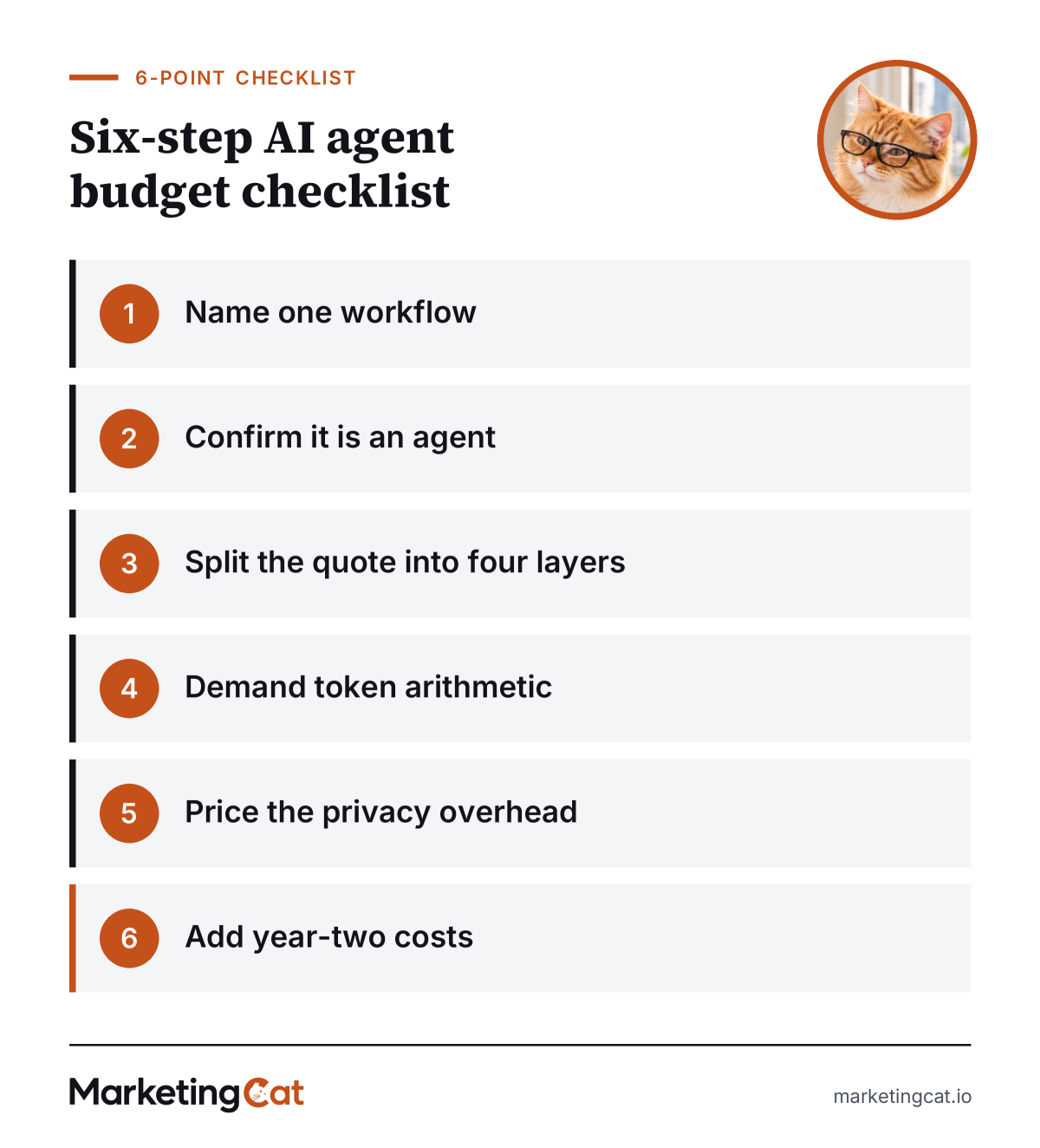
Six-step AI agent budget checklist
- Name one workflow: Define a single, repetitive task with a clear human review point, and give every vendor the same written description.
- Confirm it is an agent: Ask whether the system starts its next step without a person typing, and pay assistant prices if it doesn’t.
- Split the quote into four layers: Ask for one-time build, monthly hosting and maintenance, usage-based AI and tool fees, and your team’s hours as separate lines.
- Demand token arithmetic: Ask for the model, the per-token rate, expected monthly volume, and how retries and long contexts are counted.
- Price the privacy overhead: Ask where data and vector databases are hosted, and what private deployment, access controls and logging add to the bill.
- Add year-two costs: Budget maintenance (Perimattic suggests 15–25% of build a year) and prompt tuning hours, then compare 12- and 24-month totals.
Run the pilot so its results are reliable. Use the same test inputs for every vendor, and repeat important queries several times, since agent outputs vary. Log every prompt change and its cost, and check outcomes against real business data before scaling. If the agent feeds your pipeline, our guide on automating your B2B sales funnel covers where automation fits.
What this means for Hong Kong teams
Hong Kong buyers carry extra privacy and language questions that most global cost guides ignore. In March 2025 the PCPD published its Checklist on Guidelines for the Use of Generative AI by Employees. It covers which tools and uses are permitted, what information may be entered, anonymising personal data, and human review of AI output.
In practice, get internal approval and use company-approved tools before CRM records, call transcripts or support tickets reach an agent. Anonymise personal data first, as the checklist advises. Check the vendor’s terms on data retention, model training and access, and keep a person reviewing important outputs.
The sources we reviewed don’t price Hong Kong-hosted vector databases or data residency. They don’t compare token costs or accuracy for Cantonese queries across models, and they don’t give licence schedules for Chinese low-code platforms such as BetterYeah or Baidu AgentBuilder. Make these explicit test items in any trial.
For the business case, Hong Kong software firm GrowIT Solutions says a full-time customer service employee costs upwards of HK$20,000–25,000 a month. Treat that as an agency’s benchmark, not official salary data.
Risks and limitations of these cost estimates
The main limitation is this: nearly every figure here comes from development firms and agencies that sell agent services. They publish their own ranges, define tiers differently and rarely show their working. None of it is independent market pricing, so use it to structure questions, not to set a budget.
Adoption is also earlier than the noise suggests. McKinsey’s November 2025 State of AI survey, as reported by ADWire, found 62% of respondents’ organisations at least experimenting with agents. Only 23% said they were scaling, and no more than 10% had scaled agents within any single function.
Labour savings can reverse, too. Klarna reported in February 2024 that its AI assistant handled 2.3 million conversations in its first month, equal to 700 full-time agents. By 2025 it had changed strategy and was hiring people for customer service again, according to ADWire’s summary.
Our view is that a first agent should be bought like a pilot, not a platform. Start with one narrow workflow, insist on four-line quotes and judge vendors on 12-month totals. This week, write a one-page description of a single candidate workflow and send it to two vendors with the six-step checklist attached. For wider context, see our 2026 B2B AI marketing trends for Hong Kong.
Frequently Asked Questions
How quickly does an AI agent pay for itself?
It depends entirely on your own numbers, and vendor examples are optimistic. Azilen claims a sales intelligence agent saving 10 hours a week across 15 account executives could repay a $150,000 build in three to six months. That’s a vendor’s illustration, not measured results. Build your own estimate from hours genuinely freed, minus the staff time spent checking the agent’s output and the monthly running costs, then test it in a pilot.
Do open-source models make AI agents cheaper?
Sometimes for prototyping, but not automatically in production. Azilen recommends open-source models and proven frameworks such as LangChain and LangGraph to control prototyping costs. SoftTeco notes that costs rise when a solution must run on-premises, including hosting the LLM yourself. Compare both routes over at least a year.
What engineering roles does a custom agent build need?
Typically several, which is why custom builds rarely stay small. Perimattic says an AI project team might include a project manager, an AI engineer or data scientist, a backend developer, and a frontend developer if the project needs a user interface. Its list also includes a QA specialist and a cloud engineer. After launch, someone still has to own prompt tuning, monitoring and integration fixes. If you lack those people in-house, a managed service or agency retainer becomes part of the real cost.
Can a cheaper workflow tool replace an AI agent?
Often, for tasks with predictable steps. Anthropic’s distinction, as summarised by ADWire, is that workflows follow paths coded in advance, while agents choose their own path at runtime. ADWire argues many firms’ first usable solution is a chain of fixed steps with routing by input type. That’s cheaper to build and test than full autonomy, so consider it before paying for an agent.
How much does an AI agent cost in Hong Kong dollars?
At HK$7.8 to the US dollar, Azilen’s ranges work out at roughly HK$78,000 to HK$3.1 million to build, plus about HK$25,000 to HK$101,000 a month to run. Managed and licensed options start lower. VantaSoft lists a build from about HK$7,800 and hosting from about HK$3,700 a month, and Microsoft’s Hong Kong price list starts Copilot at $21 (about HK$164) per user a month before usage-billed agent work. These are vendor list prices and estimates, so get Hong Kong quotes in writing.