Google Ads A/B Testing: How to Test with Low Lead Volume
When your campaigns generate only a few dozen leads a month, standard experiment rules rarely deliver clear winners. Here is a four-step testing protocol and a pre-launch scorecard designed to run reliable experiments on qualified conversions.
Meowket's take Stop running split tests on raw form fills. When lead counts are low, isolate one structural change at a time and judge the winner strictly on sales-qualified conversions.

Google wants advertisers to treat Google Ads A/B testing as a strategic discipline rather than an occasional tweak. In the latest episode of Ads Decoded, Ads Product Liaison Ginny Marvin and product leads Sagar Shah and Al Nevarez set out three testing rules covering AI Max, budgets and Smart Bidding. For Hong Kong B2B teams that see a few dozen leads a month, those rules raise a practical question: how do you get a trustworthy answer from so little data? This article turns Google’s guidance into MarketingCat’s four-step protocol and a readiness scorecard that a two-person team can use.
Key Takeaways
- Google’s Ads Decoded guidance, published 19 November 2026, recommends templated 50/50 tests, qualified conversions rather than shallow proxies, a four-to-six-week run, and 80% confidence for directional tweaks.
- Google’s help page for value-based bidding experiments recommends at least 50 conversions in the last 30 days. If your campaign falls short of that, test one variable, pool campaigns where Google allows it, and judge on qualified leads.
- Never test different conversion actions against each other, such as form fills against CRM-qualified leads. Smart Bidding trains on all conversions in the Conversions column, whatever the experiment setup.
Last checked against Google’s help pages: 25 November 2026.
What did Google’s Ads Decoded episode recommend?
Google’s summary of the episode, “Build strategic A/B tests”, gives three rules. Here they are in Google’s own wording:
- Start with templated setups: Pre-built templates isolate single variables, split traffic 50/50, and minimize setup errors for cleaner data.
- Focus on business outcomes: Measure qualified conversions rather than shallow proxies, and give tests four to six weeks to account for conversion lag.
- Match confidence to decision scope: An 80% confidence interval works well for directional tweaks. Reserve 95% certainty for major structural overhauls.
Google points advertisers to the Experiments tab in Google Ads. It also tells them to “let data prove the value before scaling”. The guidance gives no minimum lead count for B2B accounts. It offers only the general four-to-six-week duration.
Can Hong Kong advertisers use the new AI Max experiment tools?
The sources we reviewed don’t confirm Hong Kong availability for the newest AI Max testing features. In an August 2026 Google post, Google said a new way to test budgets and ROI targets would roll out in September. It would let advertisers test them across multiple Search campaigns in one A/B test. The same post says AI Max experiments can now run with brand or location controls switched on. It lists no markets.
As of November 2026, open the Experiments tab in your own account to see which options appear. Don’t plan a test around a feature until you can see it there.
What can a low-volume B2B account actually measure?
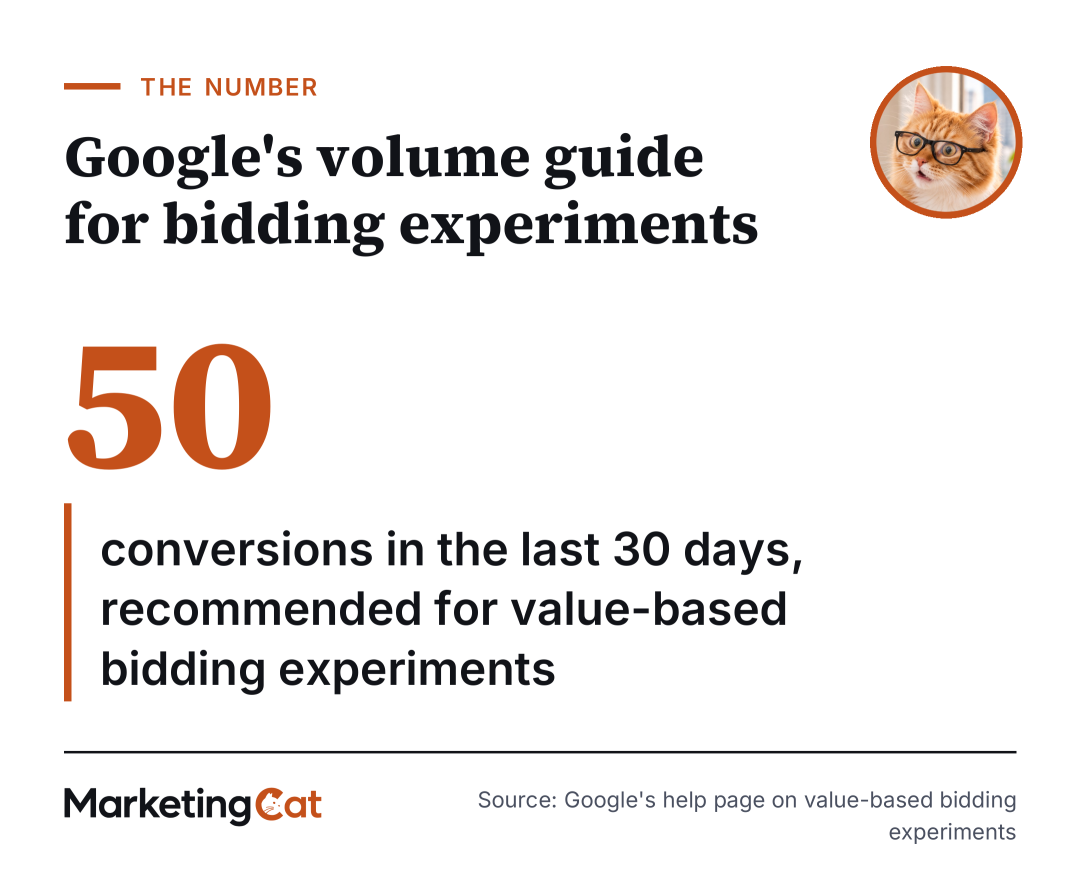
Lead volume limits what you can test, and it should shape your plan before you choose a test. Google’s help page on value-based bidding experiments recommends at least 50 conversions in the last 30 days. Google says this gives enough volume in the base and trial arms. It also says this is not a minimum for using value-based bidding in general. The same page requires a campaign to measure conversion value, with two or more unique, non-zero values, before you test value-based strategies.
Search Engine Journal’s Smart Bidding guide takes the same cautious line. It warns that a campaign with only 10 conversions in 30 days may not be ready for Target CPA (a target cost per acquisition) or Target ROAS (a target return on ad spend). Google’s own definition explains why: Smart Bidding uses Google AI to optimise for conversions or conversion value in every auction. With little data, that AI has little to learn from.
An illustrative Hong Kong case
Illustrative example, not real client results. A boutique Hong Kong logistics software provider targets local supply chain directors with generic Search ads. It spends HK$12,000 a month and gets 25 leads a month.
Hong Kong agency Kick Ads reports a median CPC (cost per click) of HK$8.37 for generic Search. That figure comes from the Hong Kong-targeted accounts Kick Ads managed from August to October 2026, with a middle half of HK$5.58 to HK$13.12. At that CPC, HK$12,000 buys roughly 1,430 clicks a month.
A six-week test would collect about 35 leads in total, or around 17 per arm with a 50/50 split. At 25 leads a month, the campaign also falls short of the 50 conversions in the last 30 days that Google recommends for value-based bidding experiments. The main risk is low statistical power: a real difference between the arms may not show up as significant. The arithmetic decides what this team should test.
What should a small B2B team test first?
Test changes that are large enough to show up in a small sample, and leave fine-tuning for later. In practice, that gives a rough order.
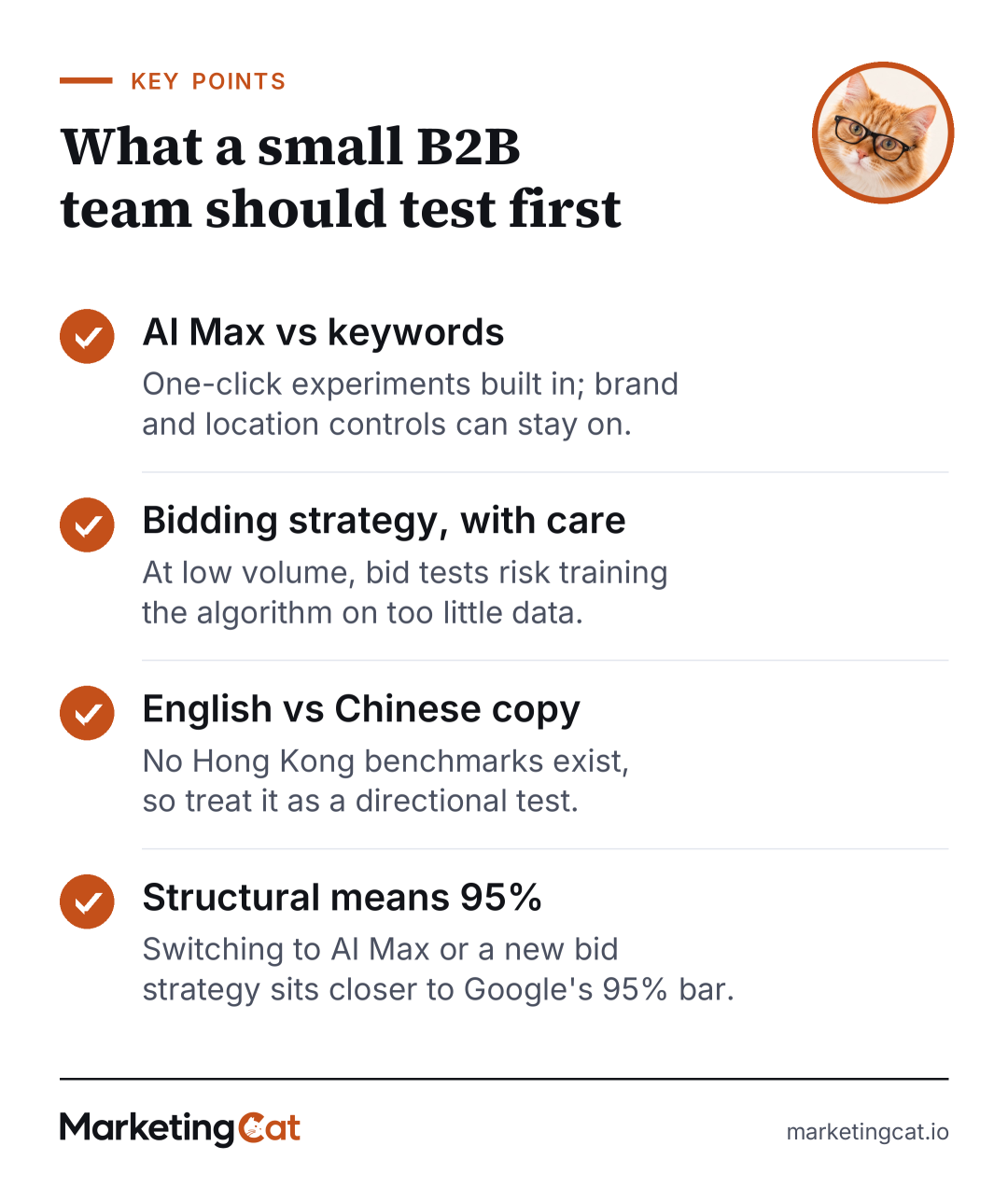
- AI Max against your current keyword setup. Google built one-click experiments for AI Max into the campaign flow. AI Max experiments can also keep brand and location controls on. For a Hong Kong-only B2B advertiser, that means the test can keep its existing location controls. Check the actual targeting settings and the geographic results during the test. MarketingCat’s testing hypothesis is that a change to which searches you reach is more likely to produce a difference big enough to measure.
- Bidding strategy, with care. At low volume, a bid strategy test risks training the algorithm on too little data. Google’s Smart Bidding best-practice document suggests portfolio bidding, which shares one bid strategy across several campaigns, for campaigns with similar goals or low conversion volumes. Google’s value-based bidding help page adds that its Multi Campaign Experiments beta can test portfolio bid strategies across several campaigns, particularly when conversion volume is limited. To join, ask your account representative or Google support. The beta doesn’t support Shopping campaigns.
- English against Traditional Chinese ad copy. This is a natural question in a bilingual market. However, the sources we reviewed give no conversion rate or conversion lag benchmarks for English and Traditional Chinese Search ads in Hong Kong. Treat it as a directional test. Remember that a language change may also change who sees and clicks the ad.
In MarketingCat’s view, a switch to AI Max or to a new bid strategy counts as a structural change. That puts it closer to Google’s 95% bar than to its 80% bar.
Do imported CRM conversions make results more reliable than form fills?
Judging on qualified leads matches Google’s advice to measure “qualified conversions rather than shallow proxies”. A form fill only tells you that someone submitted a form. In this article, a qualified lead means an enquiry that Sales has accepted. For a B2B team, the qualified lead is closer to pipeline.
For a small team, that extra quality comes at a cost in volume and delay. Depending on your lead definition and workflow, qualifying form submissions can reduce the count and add delay. For this reason, Google’s advice to allow for conversion lag matters more once you import CRM outcomes.
Set your conversion action before the experiment starts, and use the same one in both arms. Google warns never to test different conversion actions against each other. Smart Bidding trains on all conversions reported in the Conversions column, whatever the experiment setup. A form-fill arm against a qualified-lead arm therefore gives meaningless results.
The sources we reviewed don’t explain how to import offline conversions. Check Google Ads Help before you set it up. Your CRM must also record lead status consistently. MarketingCat’s closed-loop measurement guide covers aligning lead definitions with Sales. Before you upload CRM records to any platform, ask your privacy lead to approve it.
Some teams use generative AI tools to summarise CRM exports or draft copy variants. If you do, first get internal approval and use company-approved tools. The PCPD’s Checklist on Guidelines for the Use of Generative AI by Employees covers permitted tools, limiting and anonymising personal data, and human review of outputs. As a MarketingCat precaution, check the data for any remaining identifiers after you remove names. Also check the vendor’s terms on data retention and model training.
How long should a Google Ads experiment run when leads are scarce?
Ads Decoded says four to six weeks. For low-volume B2B accounts, the upper end is safer, and value-based bidding experiments need longer. Google’s help page sets out a longer timeline for value-based bidding experiments:
- A ramp-up of 14 days or one to two conversion cycles, whichever is longer. Exclude this period from the evaluation.
- At least 30 days of uninterrupted running after the ramp-up.
- No judging of the most recent days in which less than 90% of conversions have been reported.
If a qualified lead takes weeks to confirm in your CRM, that lag eats into a six-week window. Plan the end date with the lag in mind.
A four-step protocol for small-budget teams
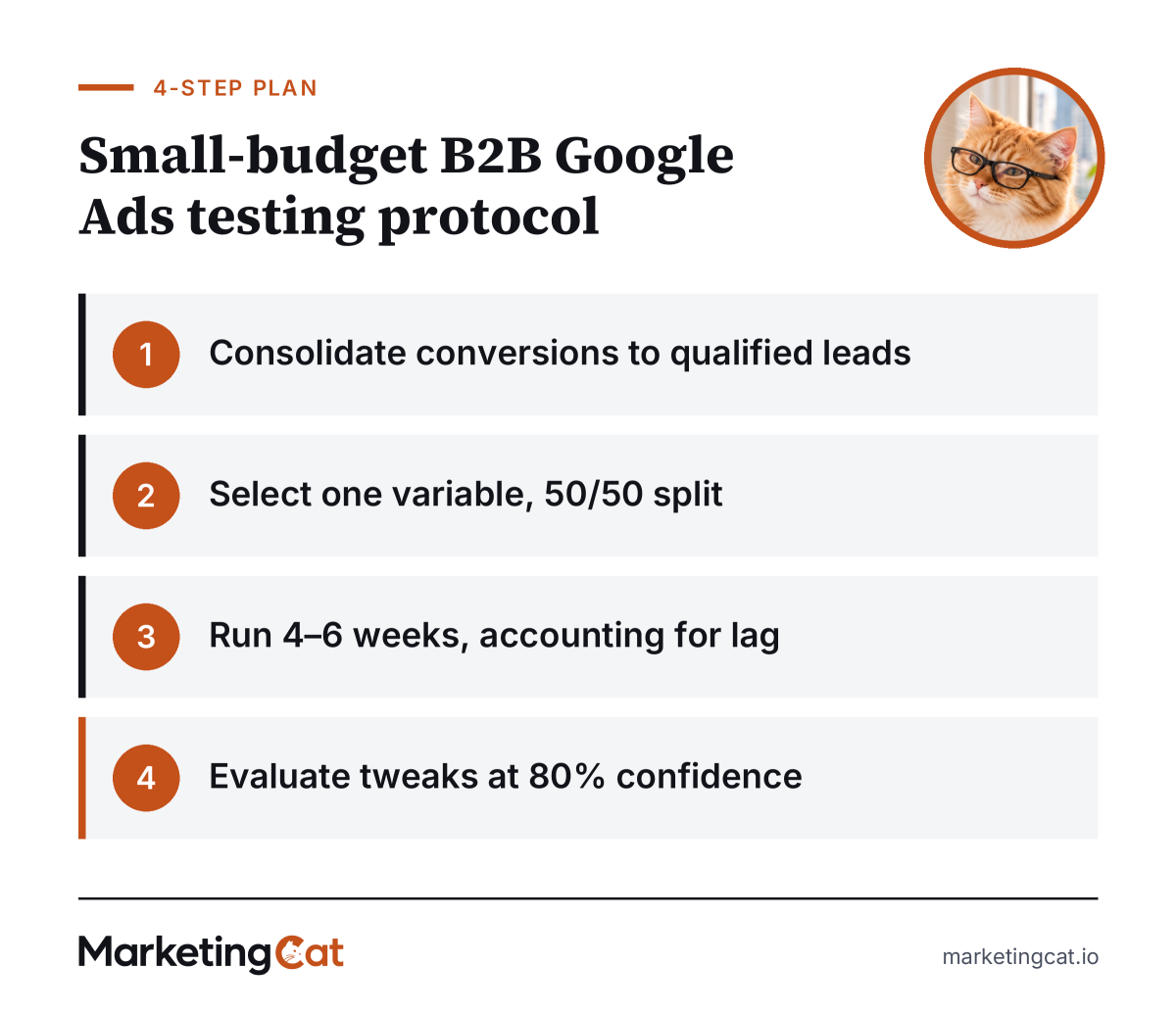
The protocol below is MarketingCat’s framework. It condenses Google’s three Ads Decoded rules and adds rules from Google’s value-based bidding help page. It is not Google’s own list.
Small-Budget B2B Google Ads Testing Protocol
- Consolidate conversion actions to qualified leads The marketing manager agrees one primary conversion action with Sales and records it in a test plan document before any experiment starts.
- Select one variable with a 50/50 split The paid media lead uses a templated or one-click experiment and changes only one thing, such as AI Max or the bid strategy. They write the hypothesis down.
- Run for 4–6 weeks, accounting for lag The paid media lead keeps experiment sync on and avoids large mid-test changes. They exclude the ramp-up and under-reported recent days from the readout. Value-based bidding tests are the exception. They need at least 44 days, and longer if your conversion cycle extends the ramp-up.
- Evaluate at 80% confidence for tweaks The marketing manager decides to apply, revise or stop. The decision uses cost per qualified lead as the primary KPI against the pre-test baseline, and it is logged in the test record.
| Protocol step | Where it comes from |
|---|---|
| 1. Qualified leads | Ads Decoded Rule 2 (qualified conversions); Google’s value-based bidding help page (never compare different conversion actions) |
| 2. One variable, 50/50 | Ads Decoded Rule 1; Google’s value-based bidding help page |
| 3. 4–6 weeks, lag | Ads Decoded Rule 2 (general four-to-six-week duration); Google’s value-based bidding help page (ramp-up, then at least 30 uninterrupted days) |
| 4. 80% for tweaks | Ads Decoded Rule 3 |
The owners, the test record and the choice of cost per qualified lead as the KPI are MarketingCat’s advice. For value-based bidding tests, Google’s help page says to judge on conversion value and ROAS instead, with CPA and clicks as secondary measures. For structural changes, Google’s Rule 3 sets a 95% bar, which step 4 does not cover.
To make results dependable, keep budgets, targeting and creative stable during the test. Log every test and its outcome. Repeat important tests before you roll them out account-wide. Then check the winner against later CRM pipeline, because a result in the Ads interface is not the same as revenue.
The costs are mainly the media spend in each arm, staff time, and any CRM integration work. Each arm receives about half the traffic, although clicks and conversion counts can differ between the arms.
MarketingCat’s readiness scorecard
Score each row yes or no before launch. If any row is a no, fix it before you spend.
| Check | Ready when… |
|---|---|
| Conversion quality | You track offline qualified leads or conversion value, not generic form submits |
| Variable discipline | Exactly one variable is tested, such as AI Max against exact keywords, or bid strategy |
| Timeline commitment | Four to six full weeks are scheduled with no mid-experiment changes. Value-based bidding tests get at least 44 days, or longer if conversion cycles require it. |
| Lag allowance | The readout excludes the ramp-up and recent days with under 90% of conversions reported |
| Statistical threshold | 80% confidence is set for tactical or copy tweaks |
Advanced: settings to check before launch
- Turn on experiment sync so that edits apply to both arms.
- For Target CPA against Target ROAS, set the ROAS target at or below what the CPA campaign achieved over the previous four weeks.
- Use a cookie or traffic split of 50/50.
- Google can spend up to twice your average daily budget on a given day, but no more than 30.4 times it in a month, according to its help page on average daily budgets. Plan each arm’s spend at the monthly level.
Limitations and what to watch
This article relies on Google’s written summary of the Ads Decoded episode, not on the full audio or video. The episode may contain detail that the summary leaves out, so listen to it from Google’s post before you make major decisions. The Kick Ads CPC figures come from one agency’s managed accounts, not from the whole Hong Kong market.
Watch for Google to confirm which markets get the multi-campaign budget and ROI target tests. If you are rebuilding lead tracking at the same time, MarketingCat’s CRM migration roadmap and HubSpot vs Salesforce comparison may help. For planning beyond Search ads, see our guide to B2B lead generation in Hong Kong.
For a Hong Kong B2B team, Google’s guidance is most useful as a filter. Fewer, bigger tests judged on qualified leads will teach you more than a stream of small copy tweaks that never reach significance. This week, count your qualified leads over the last 30 days and fill in the scorecard for one planned test. Then decide whether you have enough data, or whether you first need to pool campaigns or fix your tracking.
Frequently Asked Questions
Can I end a test early if Google Ads shows a significant result?
For value-based bidding tests, Google advises against treating early significance as enough. Its help page notes that the Experiments interface may report statistical significance before the recommended timeline is complete. It tells advertisers to defer to the timeline: a ramp-up period, then at least 30 days uninterrupted. Stopping early risks reading the learning phase as a result. This matters most in low-volume B2B accounts, where a handful of leads can swing the numbers in either direction.
Should a new low-volume campaign start on Maximize Clicks?
Possibly, as a temporary step. Search Engine Journal’s Smart Bidding guide suggests that new campaigns can use Maximize Clicks first to gather traffic and history before moving to conversion-based strategies. That trades conversion focus for data collection, so set a review date. Once you have steady qualified-lead tracking and more conversion history, test a Smart Bidding strategy in a proper experiment rather than switching over in one go.
How much budget does one test campaign need?
Kick Ads, a Hong Kong agency, says Google sets no minimum spend. It cites a rule of thumb of about 30 conversions a month per campaign. At a qualified-lead cost of HK$200, that works out at roughly HK$6,000 a month. Treat this as one agency’s planning estimate, not a benchmark. Your own cost per qualified lead should set the figure.
Is the Google Ad Manager A/B tool the same as Google Ads Experiments?
No, they are separate products. Google Ad Manager’s A/B native experiments let publishers compare two native ad styles on their own placements. That tool is for selling ad inventory, not for buying Search ads. Advertisers testing AI Max, bid strategies or Search campaigns should use the Experiments tab in Google Ads. Guides that mix the two can cause confusion, so check which product a help page covers before you follow its steps.