B2B Case Study Writing: A 6-Step Approval Playbook
Drafting a client story is rarely the hard part; getting legal or marketing sign-off is where projects stall. Here is a six-step workflow to interview champions, protect sensitive details with clean fallbacks, and deliver bilingual assets sales reps actually use.
Meowket's take A published anonymised story beats a named case study trapped in legal review for months. Agree on sign-off scope and fallback descriptors before asking for the interview.

Writing a B2B case study that gets published comes down to three things: ask the right client at the right moment, build the story around that client’s business problem, and plan for approval from the first conversation. SaaS Corner’s step-by-step guide, from a B2B SaaS marketing blog, says the stage that stalls most often is usually approval, not writing. This playbook gives Hong Kong marketing managers six steps. They run from the first ask to an English and Traditional Chinese release and a set of sales assets, with an illustrative example and two templates you can copy.
Key Takeaways
- Plan sign-off before the interview. Get written permission for the final text, company name, logo, people’s names and titles, and every figure, and keep an anonymised version (industry plus headcount) ready if the client declines to be named.
- Write the English and Traditional Chinese versions separately from the same interview notes rather than translating one into the other. Have the client approve each language version as its own text.
- No source we reviewed measures whether AI search tools cite specific client stories more than generic service pages. Google says its usual SEO best practices still apply, and that no special AI text files or markup are needed.
What do you need before writing a B2B case study?
You need three things before anyone books an interview: a client who resembles the buyers sales wants more of, a result you can check, and a named person on the client side who gains from the story. SaaS Corner suggests asking customer success for clients who went live in the last 6 to 12 months and have high account health scores. Freelance B2B SaaS writer Nathan Ojaokomo’s B2B case study guide adds a fourth test: the number should show up somewhere you can verify, such as product data or a quarterly business review deck.
Decide who the story is for, too. Forrester’s 2026 buyer research found that a typical purchase decision involves 13 internal stakeholders and nine external influencers, so one version rarely convinces an operations head and a finance director at once. SaaS Corner suggests writing two versions of the same story when needed, for example one stressing team management for a sales director and one stressing cost for a CFO.
A Hong Kong team should also agree on the costs before starting, even though the sources give no prices. The cost lines are:
- staff time for the interview and internal review
- a writer, in-house or freelance
- a bilingual editor for the second language
- video production
- the client’s own legal and marketing review time
Measurement has a hard limit, and it affects how you justify the work. A woshipm article by a B2B content marketer points out that it’s hard to prove a case study produced a registration or a deal, even with a QR code on the page. Track use and association, and don’t expect proof of cause.
The six-step playbook for client case studies
The framework below is MarketingCat’s planning aid, built from the practitioner sources cited in each section. Each step names an owner and the document or decision it produces.
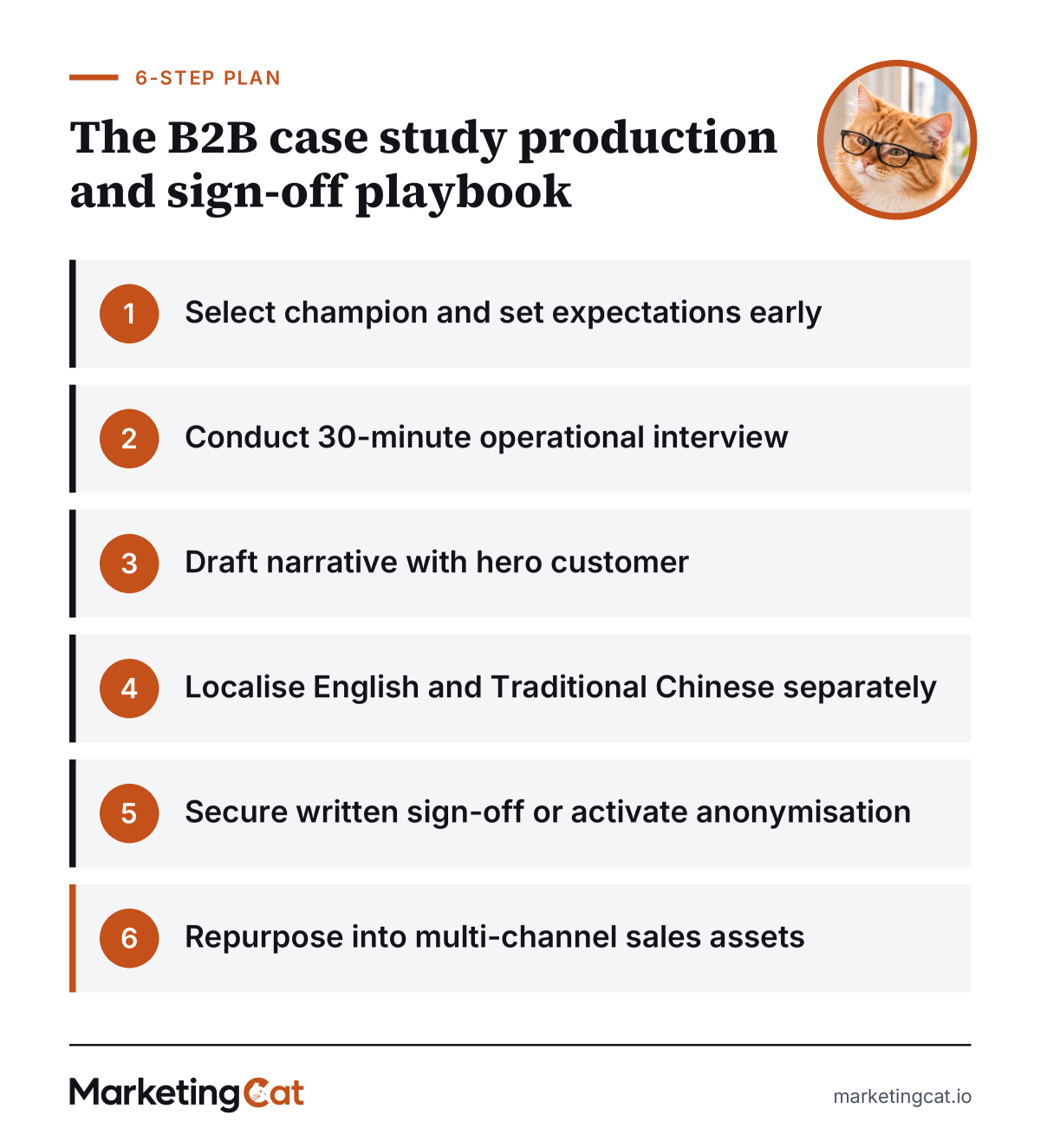
The B2B Case Study Production and Sign-Off Playbook
- Select champion and set expectations early: the account manager makes the ask and shares a shortlist and a short ask email with marketing.
- Conduct 30-minute operational interview: the marketing writer interviews the people who ran the project and produces a transcript plus a sheet of before-and-after figures with their sources.
- Draft narrative with hero customer: the writer delivers a draft that makes the client the hero and leads with a results headline.
- Localise separately for English and Traditional Chinese: a bilingual editor writes the second version from the interview notes, not from the first draft.
- Secure written sign-off or activate anonymisation: the marketing manager obtains a written release on the exact final text, or decides with the client to publish the anonymised version.
- Repurpose into multi-channel sales assets: marketing and sales enablement turn the approved text into a one-page summary, a LinkedIn series and a short video, within the channels the release allows.
Illustrative example, not real client results: a Hong Kong B2B cloud and cybersecurity services firm wants a case study from an enterprise logistics customer that has been live for 6 months. It books a 30-minute interview. It targets a 650-word draft within 5 business days, then plans 3 LinkedIn posts and a 90-second video. The steps below follow this example.
Step 1: How do you ask a client for a case study?
Ask soon after a visible win, through the person who owns the relationship. Ojaokomo lists good moments: a go-live, a renewal or expansion, or a quarterly review with good numbers. He also suggests mentioning the case study at contract stage, so the later ask feels like a follow-up.
Make the request small and specific. SaaS Corner suggests promising “a 45-minute interview in total and a 15-minute review of the draft”. Ojaokomo frames it as 30 minutes and a review, with your team doing the prep and writing. In the illustrative example, the account manager asks for 30 minutes. They also explain what the client’s champion gains, such as visibility in their industry and inside their own company.
Map the client’s approvers in that first conversation. SaaS Corner notes that enterprise clients often route drafts through marketing, legal and sometimes senior management.
Step 2: Who should you interview, and what should you ask?
Interview the people who bought, implemented and used the service, not the client’s PR team. Articulate Marketing, an agency that writes case studies for technology companies, warns that marketing or PR contacts tend to give “a repackaged version of the story”. Ideally the interviewee can also approve the text.
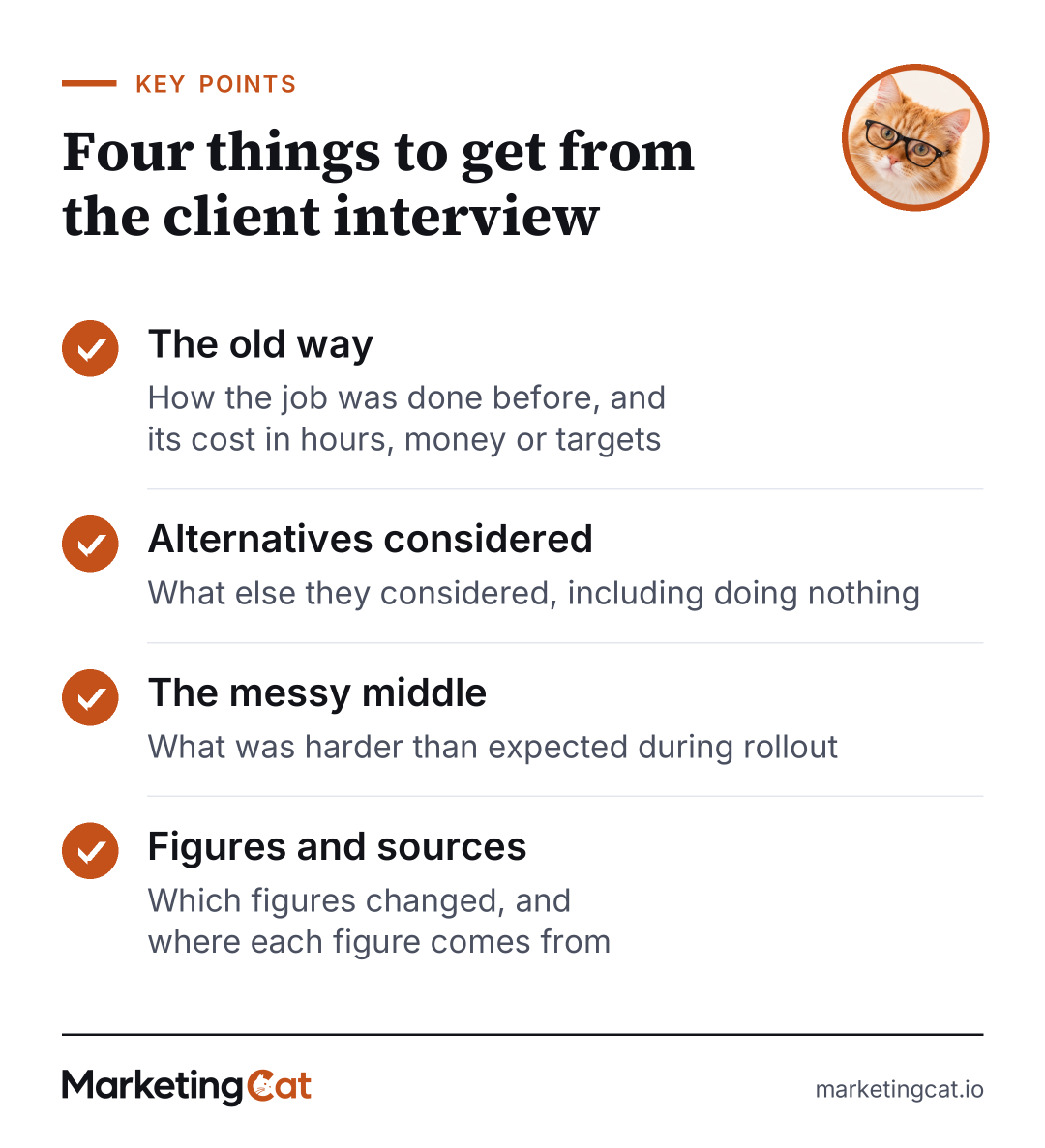
Brief yourself first, so the client’s time goes on the story. Talk to your own sales and delivery staff and read the account notes. Then use the call to get four things:
- how the job was done before, and what it cost in hours, money or missed targets
- what else they considered, including doing nothing
- what was harder than expected during rollout
- which figures changed, and where each figure comes from
In the logistics example, the “before” might be how incident reports were compiled. The figures sheet should record each source before anyone starts writing.
Step 3: How should a B2B case study be structured?
Build the case study around the client’s business problem and make the client the hero. Copywriter Jonas Pinox argues that a story which makes the client look good is more likely to be pushed through approval by the client.
Ojaokomo’s template gives a working order:
- a results headline
- an “at a glance” box with industry, size and two or three numbers
- the client, and the problem and what it cost
- why they chose you, and the rollout, including the messy middle
- results with their source
- one quotable line and one next step
He cites Gong’s customer story for GHX as a model. Its headline states the result, and a Challenge and Outcome box sits right under it.
Keep it short. Articulate Marketing recommends 500 to 750 words, which is why the illustrative draft targets 650. The woshipm writer adds that any claimed improvement must match the stated pain point, rather than being stretched into general cost-cutting.
Speed protects momentum. Pinox reports a case study for u-blox completed in 18 business days, because the copy was drafted quickly and the client turned it round just as fast. That is one writer’s account of one project, not a benchmark.
If you use a generative AI tool to draft from the transcript, protect the data first. Get internal approval and use a company-approved tool. Follow the PCPD’s Checklist on Guidelines for the Use of Generative AI by Employees (March 2025), which covers permitted tools, limiting and anonymising personal data, and human review of output. Remove personal data before upload, and check whether the remaining details could still identify someone. Check the vendor’s terms on data retention and model training. Have a person check every figure and quote against the transcript.
Step 4: How do you produce English and Traditional Chinese versions?
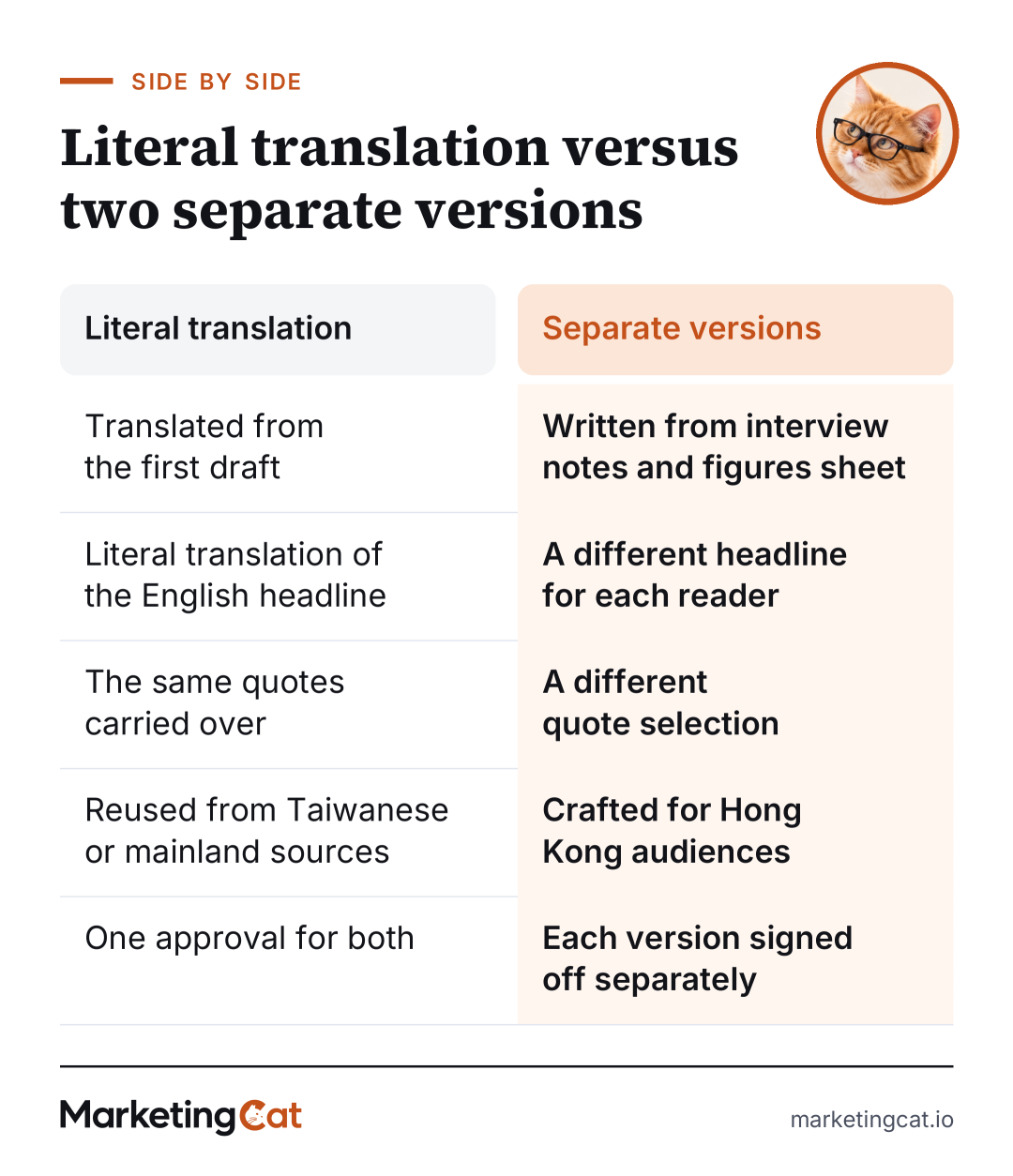
Write each language version from the interview notes and figures sheet, then edit it for its own reader. Hong Kong agency First Page says Traditional Chinese content should be crafted for Hong Kong audiences, not repurposed from Taiwanese or mainland sources. It adds that the choice of language should be informed by testing rather than assumption.
In practice, the Chinese version may need a different headline, a different quote selection and Hong Kong business terms. A literal translation of the English headline is unlikely to deliver that.
Treat each version as a separate document for sign-off. The client is approving exact wording, and a quote rendered in Chinese is new wording attributed to a named person. The sources we reviewed do not cover Hong Kong data on how bilingual case studies perform, so judge each version by how sales uses it.
Step 5: How do you win client sign-off, including anonymised versions?
Send the exact final text with a written release that lists what you may use and where. SaaS Corner advises written approval for the company name, logo, individual names and figures. Spell out the channels as well: website, sales deck, LinkedIn and video.
If the client won’t be named, offer the anonymised version straight away. SaaS Corner suggests a descriptor built from location, industry and headcount. It says anonymous case studies are less powerful than named ones but still valuable when backed by those details. An illustrative descriptor for the logistics example would be “a Hong Kong freight forwarder with 300 staff”.
MarketingCat’s template: Client Sign-Off and Risk Mitigation Checklist
- Engage the internal champion right after a contract renewal, rollout go-live or quarterly business review.
- Build the story around the problem the champion solved and what changed for their team.
- Provide the exact text draft with explicit release terms: logo use, quote attribution and channel scope.
- Prepare an anonymised fallback (illustrative: “A Hong Kong freight forwarder with 300 staff”) in case naming is rejected.
- Check that AI-assisted drafting followed the PCPD checklist and that the draft contains no unapproved sensitive raw data.
Step 6: How do you reuse one case study across sales and social?
One approved story can feed several formats, as long as the release covers them. SaaS Corner lists LinkedIn posts, email sequences, sales deck slides and website content. Ojaokomo says the same structure works as a web page, a one-page PDF or a single slide. The woshipm writer suggests keeping case study videos under two minutes.
MarketingCat’s template: Case Study Repurposing and Sales Enablement Matrix
| Asset | What goes in | Suggested owner |
|---|---|---|
| Website case study | 500–750 words: results headline, problem cost, rollout, metrics, client quote | Content writer |
| Sales one-pager or slide | At-a-glance box: industry, company size, 2–3 verified metrics, 1 quote | Sales enablement |
| LinkedIn series | 3 posts: point-of-view hook, the messy middle, measurable results | Social lead with the champion |
| Short video | Under 2 minutes: champion clip or screen recording of the application | Video producer |
In the illustrative example, the 90-second video sits inside that limit. The sources we reviewed don’t cover video editing tools or their costs. For the LinkedIn series, see our LinkedIn B2B content strategy guide.
Post the series manually or with LinkedIn’s own tools. LinkedIn’s Help Center says it does not permit third-party software, bots or browser extensions that scrape or automate activity on its site, and it may restrict accounts that break these rules. The policy makes no exception for tools that stay within a daily limit.
Are specific client stories more likely to be cited by AI search tools?
The evidence doesn’t answer this yet. None of the sources we reviewed measures whether AI search tools cite verifiable client case studies more often than generic service pages.
The reasoning for trying is still sound. A named client, a dated rollout and a sourced figure give any reader, human or machine, concrete facts that a generic service page lacks. That is a hypothesis to test, not a finding.
Google’s guide to optimizing for generative AI features (updated 10 July 2026) says the usual SEO best practices still apply. You don’t need AI text files, special markup or Markdown versions to appear in Google Search, and Google Search ignores llms.txt files. Google recommends organising content in clear sections, paragraphs and headings written for people.
AI Overviews and AI Mode are both live in Hong Kong. Google’s help pages for AI Overviews and AI Mode, checked November 2026, list Hong Kong among supported locations and English and Traditional Chinese among supported languages. That doesn’t mean every query shows one.
You can now track impressions, within limits. Google’s Generative AI performance report in Search Console had rolled out to all websites by 31 August 2026. Sites with too few impressions in these features, or that have opted out of them, may not see it. It shows how often links to your pages appeared in AI Overviews and AI Mode. It does not show leads, and it doesn’t cover ChatGPT or Copilot. Our guides on getting cited in AI search and AI search visibility tracking go further.
How do you measure a case study, and what are the limits?
Pick one primary KPI that sales controls: the number of open opportunities in the CRM where a rep has shared the case study. Record the current pipeline as a baseline, then review after one full sales cycle. That gives you opportunities associated with the asset, not deals it caused.
Use the review to decide what happens next:
- Scale if reps keep sending it.
- Revise the headline or format if they don’t.
- Stop chasing a client who has stalled beyond your sales cycle.
The B2B SEO ROI guide covers recording first-touch sources in the CRM.
Know the main limitation of this playbook. Its sources are mostly practitioners and agencies describing their own methods. No source gives Hong Kong data on sign-off times, rejection rates or bilingual performance, so treat the figures here as examples, not benchmarks.
Results that stay in an account manager’s inbox risk missing chances to support sales. A well-planned anonymised version beats a named one that never ships. This week, ask customer success for clients who went live in the last 6 to 12 months. Pick one, and draft the release terms before you request the interview.
Frequently Asked Questions
Should marketing or the account manager interview the client?
Usually both have a role. Nathan Ojaokomo advises letting the person who owns the relationship make the ask, because they’ve earned the client’s goodwill. Articulate Marketing prefers the writer to interview the client’s champion directly and build a one-to-one relationship through to sign-off. The woshipm writer also suggests interviewing your own sales, support and pre-sales staff, who often know the client’s day-to-day problems better than marketing does. Sit the account manager in on the call.
What if the client agrees to be named but won’t share figures?
You can often still publish, but the story needs a measurable difference to carry weight. SaaS Corner lists operational measures such as hours of manual work saved per week, shorter reporting time or fewer support tickets. These may be less commercially sensitive than revenue. Ask which figures the client is comfortable releasing, record where each comes from, and include them in the written release. A rich description of the before-and-after process can carry part of the load.
Can the client’s champion share the case study on their own LinkedIn?
Yes, if the release covers it, and it can help both sides. Ojaokomo’s template includes a ready-made LinkedIn post for the champion. Jonas Pinox says he has seen client contacts use case studies to support promotions, new jobs and industry awards. Offer a draft post the champion can edit in their own voice, and confirm that their employer’s social media policy allows it before they publish.