Brand Authority in Generative AI Search for HK B2B
Google’s own research shows AI search expands—not shrinks—brand discovery. Here’s what Hong Kong B2B teams need to do to get cited in AI-generated answers.
Meowket's take Most useful for Hong Kong B2B marketing managers revising their search and content strategy now.
Google identifies brand authority and unique expertise as important priorities for brand authority generative AI search visibility. For Hong Kong B2B marketers still optimising around keyword rankings, this is a direct signal that the playbook needs updating. In GEO terms, indexed content also needs structural clarity and authority to be cited by AI systems—being found is not the same as being surfaced in a generated answer.
Key Takeaways
- Google’s own research shows people using AI search visit nearly three times more touchpoints than in non-AI journeys, expanding—not shrinking—brand discovery opportunities.
- GEO research points to entity clarity, evidence, citability, mentions and authority as important signals for brands seeking visibility in generative AI responses.
- Hong Kong B2B teams should prioritise structured data, earned media citations, and specific thought-leadership content as the foundation of a GEO strategy—while keeping SEO technical hygiene in place.
What Google’s Guidance Actually Says
Google’s Think with Google article published on 14 October 2026 addresses the anxiety many marketing leaders feel about AI search directly. Its central argument is that generative AI does not reduce the buying journey—it extends it. According to the piece, people using AI search visit 12 touchpoints across their buying process, nearly three times more than in non-AI journeys. On Google, three in four people report that AI features help them make faster, more confident decisions.
The practical implication is that brands that are present, credible, and clearly defined as entities gain more opportunities for discovery, not fewer. The article frames CMO priorities around three pillars: following the super-empowered consumer, fuelling brand authority with unique expertise, and focusing on measurable business outcomes. The retelling ends there—what matters now is what this means for your team in Hong Kong.
Why Hong Kong B2B Marketers Face a Specific Pressure
The structural challenge for Hong Kong B2B companies is not just algorithmic—it is competitive and content-related. Many company websites still consist mainly of a service page, an about page, and contact details, with little public knowledge that proves expertise. As digital marketing consultancy MarkethK notes in its GEO analysis for Hong Kong B2B companies, AI cannot see internal deal numbers and will not automatically understand years of sales experience. What it can readily reach is public industry analysis, technical guides, case studies, FAQs, third-party coverage, and bylined expert content.
When an AI system synthesises multiple sources into an answer, a business with no citable public knowledge assets may simply be omitted—not because its work is poor, but because the AI has no signal to surface it. This is a particular risk in Hong Kong’s concentrated B2B market, where competitors chasing similar keywords can drive up paid-traffic costs.
The Similarweb GEO guide adds useful context: according to Similarweb’s 2026 Generative AI Brand Visibility Index, 35% of US consumers now use AI at the product discovery stage, compared to 13.6% who use traditional search. The shortlist, in other words, is being set before a user opens a search bar at all. For B2B buyers researching suppliers, this pattern may mirror how procurement decisions start—though the direct connection remains an analogy rather than a documented finding.
How Brand Authority Signals Work in Generative AI Systems
Generative engine optimisation (GEO)—the practice of structuring content and building brand authority so that AI-powered platforms cite your brand in their responses—works through a two-stage mechanism. First, an AI system retrieves relevant documents from an index. Second, a large language model synthesises those documents into a response, selecting which sources to cite. Being indexed is necessary but not sufficient; your content must also be readable, structurally clear, and authoritative enough for the model to consider it worth citing.
Researchers at Princeton University and IIT Delhi formalised this in a 2024 paper cited by the Similarweb GEO guide: content with added statistics and quotations achieved 30–40% higher visibility in AI-generated responses compared to unmodified content. Keyword stuffing, by contrast, performed below baseline. The content structure that earns AI citations is fundamentally different from the structure that chased keyword density.
Search Engine Land’s analysis puts it plainly: AI search rewards brands with visibility, mentions, and real demand—not simply more content. This aligns with Google’s own framing, which explicitly calls for “unique expertise” rather than commodity-style coverage of broad topics.
For more on how this shift affects your overall search strategy, see our guide on What Is Generative Engine Optimization? A 30-Day Starter Guide.
A Practical GEO Framework for Hong Kong B2B Teams
The following framework translates Google’s guidance and the available research into steps a Hong Kong B2B marketing team can prioritise. It assumes you already have basic SEO hygiene in place—site speed, indexability, mobile optimisation—since site accessibility, content quality and authority signals are the shared foundations for both SEO and GEO.
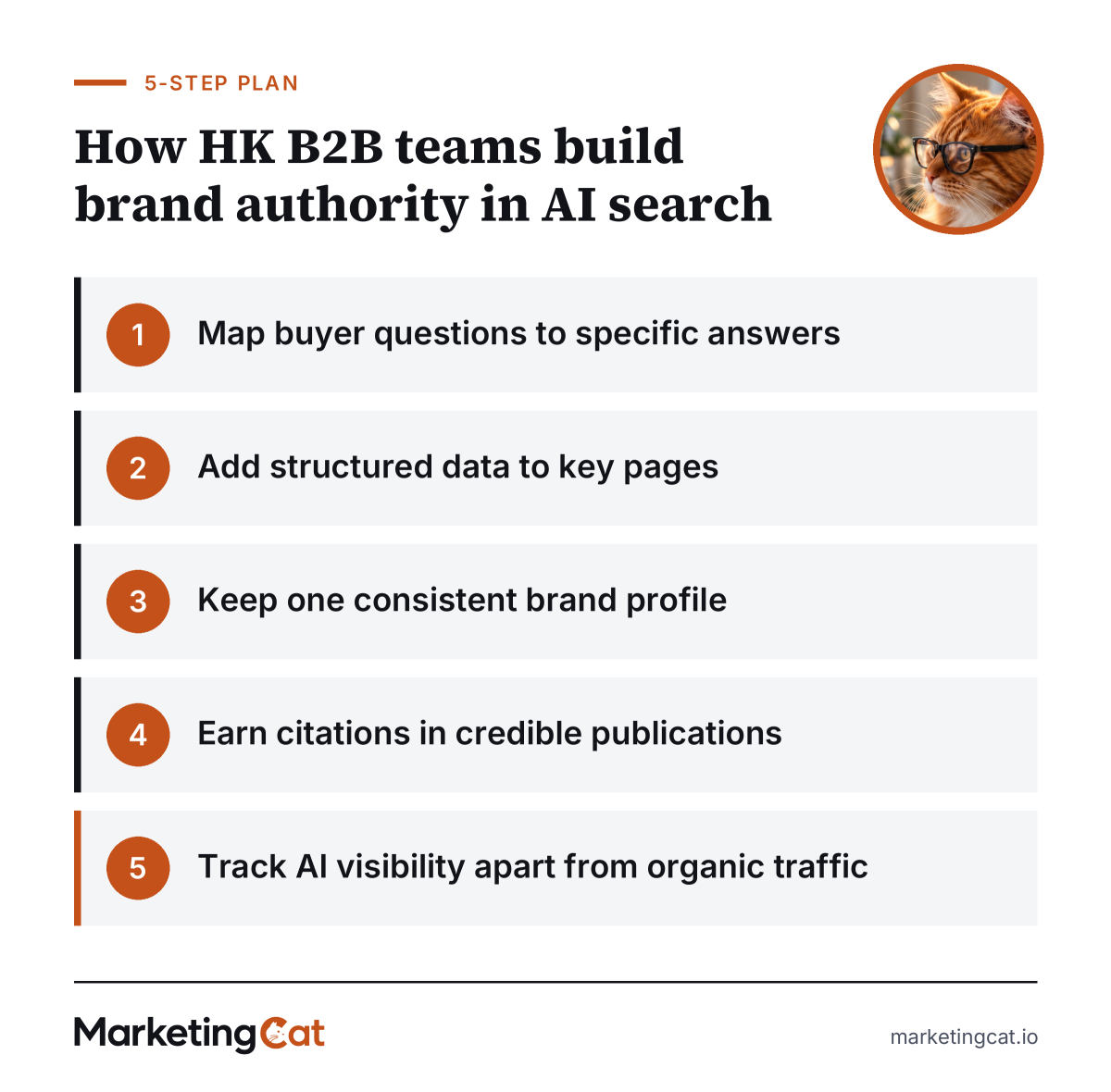
Brand Authority GEO: Five-Step Action Plan for HK B2B Teams
- Map buyer questions to specific answers. Gather the real questions your sales team hears in meetings, tenders, and RFPs, then create individual content pieces that answer each one directly. Google gives specific, expertise-led content as an example of brand advantage, highlighting that answering highly specific questions is where a real connection with consumers begins.
- Deploy structured data across key pages. Implement JSON-LD schema markup (Article, FAQPage, Organisation, and BreadcrumbList as a minimum) so that AI crawlers can extract meaning efficiently. Google says no special schema is needed to appear in AI Overviews, so treat markup as a way to make pages easier to read, and keep it matching the visible text.
- Build a consistent brand entity profile. Based on the principle of entity clarity, ensure your brand name, description, and areas of expertise are stated consistently across your website, Google Business Profile, LinkedIn company page, and any industry directories. Consistent brand entity information can help AI systems understand your business more accurately.
- Earn third-party citations in credible publications. Contribute bylined articles to industry media, participate in research reports, and issue press releases that journalists and analysts can reference. Similarweb lists brand mentions with or without links, and consistent appearance across prompts relevant to your category, as GEO success indicators.
- Measure AI visibility separately from organic traffic. Set up a fixed set of commercial queries—for example, “B2B logistics software Hong Kong” or “enterprise HR platform comparison Hong Kong”—and record monthly whether your brand is cited, in what context, and by which AI platforms. Search Console’s generative AI report, launched in June 2026 and rolling out to some sites first, shows AI Overviews impressions separately, which gives you a starting baseline.
What Thought Leadership Actually Means Here
Google’s guidance offers a running-store example worth adapting for B2B context: instead of a generic “Top 10 Things to Consider” article, the running store creates a deep-dive analysis of exactly why a specific customer’s running shoes collapsed. The following B2B adaptation follows the same logic: a brand that publishes a deep analysis of why a specific client implementation failed—including conditions, constraints, and the resolution—creates content that only that brand could have written. Google presents that kind of specificity and real-world expertise as a brand advantage.
For Hong Kong B2B marketers, consider what your company knows that no AI-generated summary could accurately reproduce: proprietary implementation data (anonymised), real client friction points with solutions, regulatory nuances specific to Hong Kong or cross-border operations with the Greater Bay Area, or evaluation criteria you have developed through actual procurement cycles. That material, published with named authors, clear dates, and cited sources where relevant, is the raw material of brand authority in generative AI search.
IKEA’s deputy CMO Linda Ha, quoted in Google’s Think with Google piece, captures the spirit: the company works “closely across paid, owned, and earned [media] to ensure that we show up in the way that we want to, and that way we can really double down on our home-furnishing expertise.” In this article’s view, integrating channels in this way supports the consistent entity presence that GEO guidance recommends—though the research does not directly connect channel integration to AI-recognised entity signals.
For a deeper look at how to build this kind of authority across AI platforms specifically, our guide on how to get cited in AI search covers platform-specific citation mechanics.
Metrics and What to Watch Next
The metrics for brand authority in generative AI search differ from traditional SEO KPIs. You are no longer optimising primarily for click-through rate from ranked positions. Instead, the signals that matter are: brand mention share across AI responses relevant to your category, AI Overview impressions in Google Search Console (shown separately in its generative AI report since June 2026, where available), referral traffic identifiable as coming from AI platforms in GA4’s AI Assistant channel, and the sentiment context in which your brand appears.
Google has indicated it is improving its tools to help marketers understand how their brand authority shows up in generative search experiences, including visual search query data. These reporting improvements are in progress as of October 2026, so treat current measurement as a baseline, not a complete picture. Trends and commercial outcomes—qualified leads, pipeline from organic sources—remain better signals than any single AI-visibility score.
In our view, the most important thing Hong Kong B2B marketing teams can do this week is audit their existing content against a single question: could an AI system confidently cite this as the expert answer to a specific buyer question? If most pages fail that test, the priority is not more content—it is converting tacit expertise into structured, citable, entity-clear content that AI systems can actually use.
Frequently Asked Questions
Does improving brand authority for AI search require abandoning traditional SEO?
No. Technical health and site accessibility remain shared foundations for both traditional search rankings and AI citation; site speed, indexability, structured data and mobile optimisation are all recommended hygiene items. GEO extends that foundation by adding entity clarity, answer-first content structure, and earned media citations. MarkethK’s analysis for Hong Kong B2B companies confirms that search engines remain an important way for AI systems to discover and verify pages, so both disciplines are now necessary and complementary.
Which AI platforms matter most for Hong Kong B2B brand visibility?
According to StatCounter’s AI chatbot market share data for Hong Kong, the three largest platforms in September 2026 were ChatGPT (51.86%), Gemini (29.33%) and Perplexity (13.24%), together about 94% of the chatbot traffic StatCounter tracks. Microsoft Copilot held 5.06%, but it is still worth watching if you sell to enterprise buyers who work inside Microsoft 365.
How should a small Hong Kong B2B team prioritise if resources are limited?
Start with entity consistency—ensuring your brand name, description, and areas of expertise are stated consistently across your website, Google Business Profile, and LinkedIn—as a practical step for improving entity clarity and helping AI systems understand your business. Then focus content effort on answering the three to five questions that most often change a buyer’s decision in your category. As Search Engine Land notes, more content alone is not enough; specific, high-value answers are what GEO guidance recommends.
How long does it typically take to see results from a GEO strategy?
There is no reliable timeline established in the available research, and anyone who quotes a specific figure without a cited study should be treated with caution. Research indicates that citable content, brand signals and mentions influence AI visibility, so building those assets is the recommended approach. Tracking a fixed set of commercial queries monthly gives you the clearest picture of whether your brand’s presence in AI responses is growing.
Is paid advertising still useful if AI search reduces organic clicks?
Google’s guidance explicitly states that business fundamentals—measuring plans based on real goals like leads or sales—remain unchanged. Paid advertising continues to deliver direct-response outcomes that GEO does not replace. The risk of relying on paid alone is that AI-driven discovery happens before a user reaches an ad.